Jordan Peterson Leaves Joe Rogan SPEECHLESS On The Bible!!!

Truth starts with God and His Word…

God’s word alone is a Lamp unto my feet (Ps 119:105)

“Keep one thing forever in view—the truth; and if you do this, though it may seem to lead you away from the opinion of men, it will assuredly conduct you to the throne of God.”
— Horace Mann

In Psalm 119, after seeking his direction in life from God’s Word, the psalmist declares that God’s Word is a lamp to his feet, giving light for his path in life.

And having seen the divinely illumined Way, he has taken an oath to follow God’s righteous laws.

2 Timothy 3:16-17
The Message

14-17 But don’t let it faze you. Stick with what you learned and believed, sure of the integrity of your teachers—why, you took in the sacred Scriptures with your mother’s milk!

There’s nothing like the written Word of God for showing you the way to salvation through faith in Christ Jesus.

Every part of Scripture is God-breathed and useful one way or another—showing us truth, exposing our rebellion, correcting our mistakes, training us to live God’s way.

Through the Word we are put together and shaped up for the tasks God has for us.
____

When Paul speaks of all Scripture, he is definitely referring to the complete OT, but also to those portions of the NT that were then in existence.

In 1 Timothy 5:18, he quotes the Gospel of Luke (10:7) as Scripture.

And Peter speaks of Paul’s Epistles as Scriptures (2 Pet. 3:16).

Today we are justified in applying the verse to the entire Bible.

This is one of the most important verses in the Bible on the subject of inspiration.

It teaches that the Scriptures are God-breathed.

In a miraculous way, He communicated His word to men and led them to write it down for permanent preservation.

What they wrote was the very word of God, inspired and infallible.

While it is true that the individual literary style of the writer was not destroyed, it is also true that the very words he used were words given to him by the Holy Spirit.

Thus we read in 1 Corinthians 2:13: “These things we also speak, not in words which man’s wisdom teaches but which the Holy Spirit teaches; comparing spiritual things with spiritual.”

If this verse says anything at all, it says that the inspired writers used WORDS which the Holy Spirit taught.

This is what is meant by verbal inspiration. The writers of the Bible did not give their own private interpretation of things, but wrote the message which was given to them by God.

“Knowing this first, that no prophecy of Scripture is of any private interpretation, for prophecy never came by the will of man, but holy men of God spoke as they were moved by the Holy Spirit” (2 Pet. 1:20, 21).

It is false to say that God simply gave the thoughts to the individual writers and allowed them to express these thoughts in their own words.

The truth insisted on in the Scriptures is that the very words originally given by God to men were God-breathed.

Because the Bible is the word of God, it is profitable.

Every portion of it is profitable. Although man might wonder about some of the genealogies or obscure passages, yet the Spirit-taught mind will realize that there is spiritual nourishment in every word that has proceeded from the mouth of God.

The Bible is profitable for doctrine, or teaching.

It sets forth the mind of God with regard to such themes as the Trinity, angels, man, sin, salvation, sanctification, the church, and future events.

Again, it is profitable for reproof.

As we read the Bible, it speaks to us pointedly concerning those things in our lives which are displeasing to God.

Also, it is profitable for refuting error and for answering the tempter.

Again, the word is profitable for correction.

It not only points out what is wrong but sets forth the way in which it can be made right.

For instance, the Scriptures not only say, “Let him who stole steal no longer,” but add, “Rather let him labor, working with his hands what is good, that he may have something to give to him who has need.”

The first part of the verse might be considered as reproof, whereas the second part is correction.

Finally, the Bible is profitable for instruction in righteousness.

The grace of God teaches us to live godly lives, but the word of God traces out in detail the things which go to make up a godly life.

In the following interview, Jordan Peterson leaves Joe Rogan SPEECHLESS on this very subject, regarding the Bible’s immense importance in the formation of our history and culture.

In this interview with Joe Rogan, recorded back in January of 2018, Jordan Peterson related his newfound understanding of the relationship of the Bible to truth.

He had just gone through the Museum of the Bible in Washington DC and that event seemed to coincide with this new revelation for Peterson.

“I just figured this out this week.” He told Rogan.

To sum up Peterson’s explanation, he was stating that our culture is coming apart because any culture is based on a set of common beliefs and the ability to communicate those beliefs.

Culture needs a framework or a structure.

Even our ability to communicate is based upon the use of words and word meaning is determined by usage.

However, the authoritative usage of words is most greatly influenced by fundamental works of literature in the culture.

The examples for the fundamental writers that formed the words, language, and therefore the structure of our culture would be Shakespeare, Dante, and Milton.

Underlying all of those is the Holy Bible.

The role of the Bible, according to Peterson, in forming our common truth is absolute and inarguable.

Jordan Peterson goes on to say in the interview that,

“It’s not that the Bible is true. It’s that the Bible is the prerequisite for the manifestation of truth, which makes it far more true than just ‘true.’

It’s a whole different kind of truth, and that’s not just literally the case – in fact – it can’t be otherwise.

This is the only way to solve the problem of perception.”

He goes on to say,

“What you have in the figure of Christ is a real person who actually lived, more of a myth, and in some sense Christ is the union of those two things, the problem is, I probably believe that, but I’m amazed at my own belief and don’t understand it.”

What Peterson is saying here is the same thing that Christian apologists have been saying for nearly 2000 years, with Jesus being the only figure standing on the stage of history, who for those who have read and have studied the Bible, is the central figure and focus of every chapter and verse.

Peterson is basically saying the same thing that another former atheist turned Christian apologist, C.S. Lewis, said in 1944.

“I believe in Christianity as I believe that the Sun has risen, not only because I see it, but because by it I see everything else.”

The message of the Bible, from Genesis to Revelation, is an instruction manual for life, and in its pages God has given mankind a road map, showing the way for God’s lost children to have their sins forgiven and be reconciled back into God’s family.

This is much too important a message to have left to the whims of man’s fickle and changeable imagination.

Jesus made it very clear that there is only one way to gain reconciliation with God, and that is through the propitious work and shed blood of Christ on Calvary’s Cross.

In John 14:6,

Jesus said to him, “I am the WAY, the TRUTH, and the LIFE. No one comes to the Father except through Me.“

We find in the Bible that TRUTH is manifested, not in various philosophies of man, but in the person of Jesus Christ, who in the Bible is called the “Living Word of God.”

The Bible teaches that absolute truth is established by an omnipotent God. Right and wrong are clearly defined. And the same moral standards apply to everyone.

Since God is sovereign, all earthly authorities submit to Him.

This creates order and stability for a civilized society.

A level playing field of acceptable behavior for all. No one can arbitrarily make up their own rules. Take their ball and go home.

Rewrite the script according to their story.

It is God alone, the Creator and Author of all life, who is the perfect Judge; and He alone establishes the rules of fairness and has the final say.

Without a transcending authority, things get complicated.

How do we even define truth?

Because as imperfect, finite beings, it is impossible to get outside ourselves, and to understand a reality beyond our subjective experience, or create an objective definition of truth. Much less devise consistent, universal rules.

Biblical Truth Provides A Common Reference Point

Since Biblical truth is absolute, it is unchangeable and forms a common reference point for social behavior.

We can accept it or reject it. But rejection brings consequences.

For example, I can reject the law of gravity. Refuse to believe it. Then step off the roof of a 10-story building in defiance to the rule. And suffer the consequence.

Biblical truth provides a solid foundation on which to build a safe society.

We live by shared rules and a common understanding of what is fair.

What is right. What is acceptable. And this fosters trust.

Jordan Peterson Leaves Joe Rogan SPEECHLESS On The Bible!!!

Come join the Adventure!

Skip 🕊️
God watches over the Sparrows…

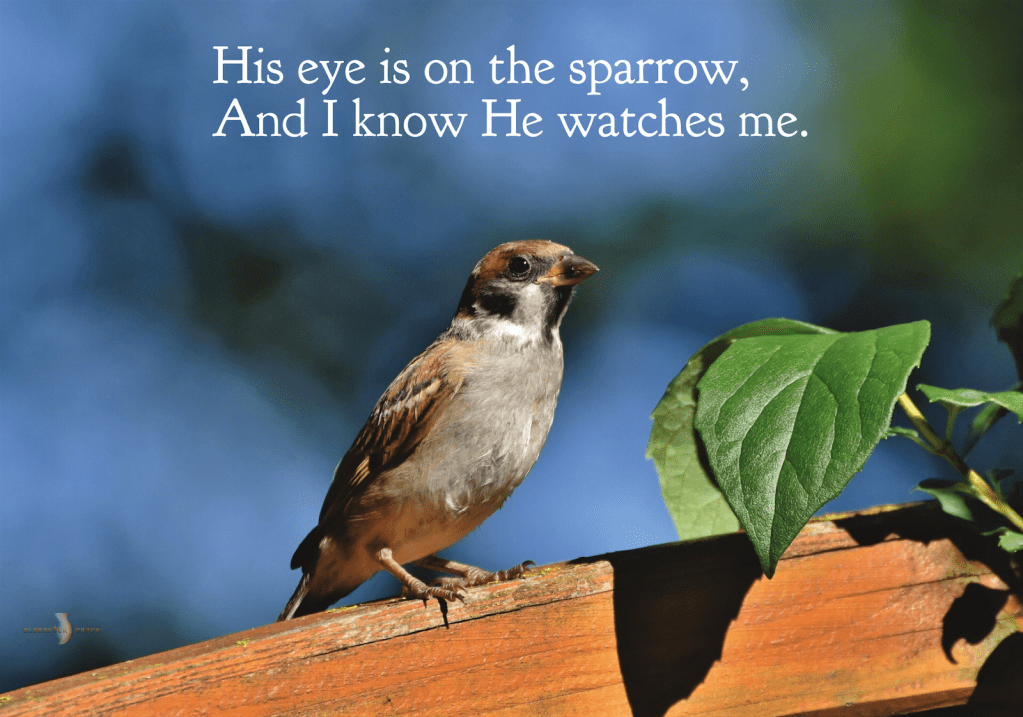
God’s eyes are on the sparrow and I know He watches over me…

“Worry makes you forget who’s in charge. And when the focus is on yourself.. you worry…. With time your agenda becomes more important than God’s. You’re more concerned with pleasing self than pleasing him. And you may even find yourself doubting God’s judgment.”
— Max Lucado

Fear controls too much of life. Afraid that we will not please others, we become hypocrites.

Afraid of those in power, we forfeit our integrity.

Afraid of ridicule, we deny Jesus.

Afraid of poverty and want, we deify our wealth.

Afraid of death and suffering, we lose trust in God.

Afraid we have missed our opportunity, we are not ready when God calls.

Afraid we will not get all that is coming to us, we take things into our hands rather than waiting to accept the reward God has prepared for us.

Afraid of what our family will think, we let family loyalty override loyalty to God.

Jesus seeks to lead us to trust God and overcome all fear.

Luke 12:1-9
New King James Version

Beware of Hypocrisy
12 In the meantime, when an innumerable multitude of people had gathered together, so that they trampled one another, He began to say to His disciples first of all,

“Beware of the leaven of the Pharisees, which is hypocrisy.

2 For there is nothing covered that will not be revealed, nor hidden that will not be known.

3 Therefore whatever you have spoken in the dark will be heard in the light, and what you have spoken in the ear in inner rooms will be proclaimed on the housetops.

Jesus Teaches the Fear of God
4 “And I say to you, My friends, do not be afraid of those who kill the body, and after that have no more that they can do.

5 But I will show you whom you should fear: Fear Him who, after He has killed, has power to cast into hell; yes, I say to you, fear Him!

6 “Are not five sparrows sold for two copper coins? And not one of them is forgotten before God.

7 But the very hairs of your head are all numbered. Do not fear therefore; you are of more value than many sparrows.

Confess Christ Before Men
8 “Also I say to you, whoever confesses Me before men, him the Son of Man also will confess before the angels of God.

9 But he who denies Me before men will be denied before the angels of God.”

(Verse 1) An innumerable multitude … had gathered together while Jesus was condemning the Pharisees and lawyers.

A dispute or a debate will generally attract a throng, but this crowd was also drawn, no doubt, by Jesus’ fearless denunciation of these hypocritical religious leaders.

Although an uncompromising attitude toward sin is not always popular, yet it does commend itself to the heart of man as being righteous.

Truth is always self-verifying.

Turning to His disciples, Jesus warned, “Beware of the leaven of the Pharisees.”

He explained that leaven is a symbol or picture of hypocrisy.

A hypocrite is one who wears a mask, one whose outward appearance is utterly different from what he is inwardly.

The Pharisees posed as paragons of virtue but actually they were masters of masquerade.

Their day of exposure would come. All that they had covered up would be revealed, and all that they had done in the dark would be dragged out into the light.

Just as inevitable as the unmasking of hypocrisy is the triumph of truth.

Up to then, the message proclaimed by the disciples had been spoken in relative obscurity and to limited audiences.

But following the rejection of the Messiah by Israel, and the coming of the Holy Spirit, the disciples would go forth fearlessly in the name of the Lord Jesus and proclaim the good news far and wide.

Then it would be proclaimed on the housetops, comparatively speaking.

With the encouraging and warm-hearted words “My friends,” Jesus warns His disciples not to be ashamed of this priceless friendship under any trials.

The worldwide proclamation of the Christian message would bring persecution and death to the loyal disciples.

But there was a limit to what men like the Pharisees could do to them.

Physical death was that limit.

This they should not fear. God would visit their persecutors with a far worse punishment, namely, eternal death in hell.

And so the disciples were to fear God rather than man.

In verses 6-7, in order to emphasize God’s protective interest in the disciples, the Lord Jesus mentioned the Father’s care for sparrows.

In Matthew 10:29 we read that two sparrows are sold for a copper coin.

Here we learn that five sparrows are sold for two copper coins.

In other words, an extra sparrow is thrown in free when four are purchased.

And yet not even this odd sparrow with no commercial value is forgotten in the sight of God.

If God cares for that odd sparrow, how much more does He watch over those who go forth with the gospel of His Son! He numbers the very hairs of their head.

What worries consume your thoughts? Turn them over to God . . . then breathe a sigh of relief and live for Him.

Let God carry your burdens.
____

Wed, June 15
Positive Words #443
by Peter Wade

THE SPARROWS AND GOD

“Are not five sparrows sold for two pennies? And not one of them is forgotten before God. Why, even the hairs of your head are all numbered. Fear not; you are of more value than many sparrows“
— Luke 12:6-7

(see also Matthew 10:29-31).

“Look at the birds of the air: they neither sow nor reap nor gather into barns, and yet your heavenly Father feeds them. Are you not of more value than they?” (Matthew 6:26)

What a simple yet powerful illustration given by Jesus of God’s comfort and care for those who believe in Him.

These small birds are plentiful in Israel, and even in the time of the gospels were of very little value. Yet God knows they exist and He keeps track of them.

Sometimes a small bird will fly at great speed and hit our front window with a thud!

The window has a slight reflective image and I think the birds see our front garden reflected in them.

Recently, one died as a result of this accident. And God knows about it!

You are worth much more than “many sparrows” to your loving heavenly Father, and He wants only the best for you.

“Encourage yourself” (Judges 20:22; I Samuel 30:6) in the Lord, and “blossom where you are planted.”

You are valuable in God’s sight, and that really is all that really matters.

“Precious [that is, costly] in the sight of the Lord is the death of his saints” (Psalm 116:15).

This is so beautifully expressed in the song lyrics by Civilla Martin, written in 1905 and made famous to a new generation by Ethel Waters at the Billy Graham crusades.

Charles Gabriel wrote the music (a challenging piece to play on a keyboard in the original key of D flat, now usually in the key of C!).

Why should I feel discouraged, why should the shadows come,

Why should my heart be lonely, and long for heaven and home,

When Jesus is my portion? My constant friend is He:

His eye is on the sparrow, and I know He watches me;

His eye is on the sparrow, and I know He watches me.

Chorus: I sing because I’m happy,
I sing because I’m free,
For His eye is on the sparrow,
And I know He watches me.

“Let not your heart be troubled,” His tender word I hear,

And resting on His goodness, I lose my doubts and fears;

Though by the path He leadeth, but one step I may see;

His eye is on the sparrow, and I know He watches me;

His eye is on the sparrow, and I know He watches me.

He sure does, and I am so glad, so take comfort from His care over you.
— Peter Wade
____

Come join the Adventure!

Skip 🕊️

Paul’s message to Timothy: Keep the gospel message alive…

Paul writing to Timothy

In the following epistle, Paul tells Timothy how to deal with false teachers and false doctrines that was being taught in the church…

The Apostle Paul tells Timothy, in 2 Timothy 3:13-17 (MSG)…

Keep the Message Alive

“You’ve been a good apprentice to me, a part of my teaching, my manner of life, direction, faith, steadiness, love, patience, troubles, sufferings—suffering along with me in all the grief I had to put up with in Antioch, Iconium, and Lystra.

And you also well know that God rescued me!

Anyone who wants to live all out for Christ is in for a lot of trouble; there’s no getting around it.

Unscrupulous con men will continue to exploit the faith.

They’re as deceived as the people they lead astray.

As long as they are out there, things can only get worse.
____

In the above verses, Paul is saying that those who neglect the truth of God and His Word will inevitably become enmeshed in a confusing web of deception.

Their consciences and reasoning capabilities suffer damage through sin, and they become incapable of extricating themselves from Satan’s delusions.

Only God’s Truth possesses the power to free such persons.

Each of us is susceptible to this dangerous trap of deception unless we obey Scripture vigilantly.

Following Christ is more than a one-time decision or an occasional church service or kind act.

True Christianity involves continual dependence and obedience to Christ the king.

Paul told Timothy to continue in what you have learned and have become convinced of.

Our faith is proved by its endurance.

Two elements are necessary for faithful living.

First, we must possess knowledge of the Truth.

Truth enlightens a person about what is right and wrong, what constitutes purpose and happiness.

We cannot trust or love what we do not know.

The second element is conviction or belief.

We express our belief system in the daily decisions we make and the behaviors in which we engage.

No one acts contrary to belief (though we may act contrary to our professions of belief).

Paul also wanted Timothy to consider those from whom you learned [truth], and how from infancy you have known the holy Scriptures.

Once again he had Timothy’s mother and grandmother in mind (see 2 Tim. 1:5).

Timothy was schooled in the Old Testament writings and had learned the need for forgiveness, the provision of God, and the necessity of faith.

He had also been discipled by Paul, learning about Christ and the church.

In each case, Timothy had not only been given knowledge; he had been a witness to godly lives.

These people served as examples to Timothy about the truth of God, the need for endurance, and the reward of faithfulness.

Each person had staked his or her life on the revelation of the Scriptures which, according to Paul, are able to make you wise for salvation through faith in Christ Jesus.
____

In Luke 24:36-49, Jesus Reveals Himself and the Meaning of Scripture to the Disciples…

In His resurrected body, Jesus revealed Himself, not only as One with the physical ability to eat, but also as the One whose life, death, and resurrection was a fulfillment of Scripture.

Luke 24:44-49
The Message

You’re the Witnesses

44 Then he said, “Everything I told you while I was with you comes to this: All the things written about me in the Law of Moses, in the Prophets, and in the Psalms have to be fulfilled.”

45-49 He went on to open their understanding of the Word of God, showing them how to read their Bibles this way.

He said, “You can see now how it is written that the Messiah suffers, rises from the dead on the third day, and then a total life-change through the forgiveness of sins is proclaimed in his name to all nations—starting from here, from Jerusalem!

You’re the first to hear and see it. You’re the witnesses.

What comes next is very important: I am sending what my Father promised to you, so stay here in the city until he arrives, until you’re equipped with power from on high.”
____

(Verse 44) “The law of Moses and the prophets and in the Psalms” means the entire Old Testament.

In other words, the entire Old Testament points to the Messiah.

For example, His role as prophet was foretold in Deuteronomy 18:15-20; His sufferings were prophesied in Psalm 22 and Isaiah 53; and His resurrection was predicted in Psalm 16:10 and Isaiah 53:10-11.

As with the two followers going to Emmaus, so it was with the crowd in Jerusalem.

Jesus opened Scripture (Old Testament) and referred back to the passion predictions in the OT.

Resurrection was a surprise, but it should not have been, had they listened and absorbed His teachings.

Scripture did not paint the kingdom the way they had been taught.

Scripture did not paint Messiah in terms they expected.

Scripture could be misread and misapplied.

They had to read Scripture carefully and find what God wanted to say to them through it.

Scripture read correctly points to Jesus, to all that Jesus experienced, especially His death, burial, and resurrection.

Can you read? Can you hear the voice of God as you read?

Do you see Christ as you read?

Check how you read and understand Scripture.

The first telling point is always this: Does it point you to Christ?

24:45. Scripture cannot be understood by the simple human mind.

God has to open the mind to understand Scripture.

Reading Scripture is not like any other reading assignment you might undertake.

Reading Scripture must begin with a dedication of your mind and heart to God and with a willingness to listen to God as He speaks to you through Scripture.

We understand Scripture only as God’s Holy Spirit opens our minds and becomes our teacher.

Again, Jesus went back to His passion predictions.

Old Testament Scriptures such as Isaiah 53 showed that the expected Messiah must suffer and die.

They also indicated that He must be raised on the third day.

This much is past happening. But all the Hebrew Scripture is not yet fulfilled.

The mission is just beginning.

What Messiah did must be proclaimed.

This is why silent witnesses who knew Jesus well had to be at the cross.

Eyewitness proclamation was in order.

The result of Messiah’s suffering, dying, and rising is forgiveness of sins.

That is available only through repentance of sins.

This comes only one way—by God’s witnesses preaching all this in the name of Jesus.

Preach the name of Jesus, He told them.

Call for repentance.

Promise forgiveness.

This is what the Scriptures said would happen.

This is what you must do.

This is your mission. The mission is worldwide.

You cannot accomplish this immediately. You must have a starting point.

That is right here where you are, here in Jerusalem.

Start where you are and preach the name of Jesus, calling for repentance and promising forgiveness.

Then Scripture will continue being fulfilled.

Not yet. You are not ready to go on mission yet, Jesus continued.

One ingredient is lacking. You must have power to do it.

The Father has promised that power. It is the power of the Spirit of God.

It will come to you. Just wait. When God sends His power from on high to you, then you can begin the mission.

Then Scripture will be fulfilled.

As Believers, we must learn to rightly divide the entire Council of God’s Word, including Old Testament and New Testament; as the New Testament is enfolded in the Old and the Old Testament unfolds in the New.
____

Tuesday, June 14
The Berean

Daily Verse and Comment for
2 Timothy 3:15

“…and that from childhood you have known the Holy Scriptures, which are able to make you wise for salvation through faith which is in Christ Jesus.”
____

Luke 24:44-45

44 Then He said to them,

‘These are the words which I spoke to you while I was still with you, that all things must be fulfilled which were written in the Law of Moses and the Prophets and the Psalms concerning Me.’

45 And He opened their understanding, that they might comprehend the Scriptures.
____

A local radio preacher says that the book of Proverbs is in “the Jewish Testament.”

What is that? There is no such thing!

We could call the Old Testament “the Hebrew Testament” with some legitimacy because it was written in Hebrew, but what would make it Jewish?

Was he trying to say that, if we read only the Old Testament, we would become followers of Judaism?

Or, that the Jews somehow own the Old Testament? Or, that because the Old Testament is revered by Jews as their holy book, it is somehow inferior to “the Christian Testament?”

Certainly, the Bible never calls the Old Testament “the Jewish Testament.”

Paul calls it “the Holy Scriptures” in 2 Timothy 3:15.

Jesus calls it “the Law of Moses and the Prophets and the Psalms” in Luke 24:44.

In many places, the writers simply refer to it as “the Word [of God or of the Lord]” or “the Scripture(s).”

The only hint that the Old Testament “belongs” to the Jews is a misinterpretation of Romans 3:2,

“to them were committed the oracles of God.”

This means only that the Jews are responsible for their accurate transmission throughout history, not that they apply only to Jews or that Jews possess them in some way.

No, this all stems from the mistaken idea that the Old Testament is the Old Covenant,

“becoming obsolete and growing old . . . ready to vanish away” (Hebrews 8:13),

while the New Testament is the New Covenant.

Thus, to a “Christian” under the New Covenant, anything that appears in the Old Testament is of lesser value than what appears in the New Testament.

This error has led to countless misunderstandings and misinterpretations of the message Jesus brought to mankind.

In fact, the New Testament cannot be understood without the foundation of the Old Testament—and not just in historical terms.

Paul is not overstating things when he says the church is “built on the foundation of the apostles and prophets, Jesus Christ being the chief cornerstone” (Ephesians 2:20).

After His resurrection, Jesus “beginning at Moses and all the Prophets, . . . expounded to [the disciples] in all the Scriptures the things concerning Himself” (Luke 24:27).

Later, “He opened their understanding, that they might comprehend the Scriptures” (verse 45).

Which Scriptures? The Old Testament, of course!

Just these few verses say that we New Covenant Christians cannot understand Jesus Christ, His doctrine, His church, and God’s plan without the Old Testament.

We can see this by how frequently the apostles quote from the writings of Moses, David, and the prophets to support and fill out their doctrinal teachings.

There is hardly a page in the New Testament that does not have a quotation or allusion to the Old Testament on it.

It is a vital part of the New Covenant—New Testament—Christianity!

Lack of space does not permit an explanation of the differences between the Old Covenant and the New.

However, let it suffice to say that the major problem in the Old Covenant was the people with whom God made it (see Hebrews 8:7-12; Romans 8:3).

The New Covenant is modeled after the Old with its basic law, the Ten Commandments, retained in all its force and wisdom.

In fact, Jesus makes it plain that He added intent to the law’s scope so that it is now stricter under the New Covenant (Matthew 5:17-48)!

In the end, we must conclude that the Bible is a whole with two parts, which came as a result of the ministry of Jesus Christ and the languages in which the two parts were penned.

The theology and the goal of the instruction in the two are the same.

The same God who never changes rules, acts, and speaks in both.

Those who believed and lived by faith in both areas will receive the same gift of eternal life (I Thessalonians 4:14-17; Hebrews 11:40).

Please be aware of this false notion of the Old Testament’s inferiority to the New, as it colors a great deal of “Christian” biblical commentary.

The Word of God is God’s Word, whether spoken in 1400 BC or AD 60.

Above all, remember our Savior’s instruction, quoting from Deuteronomy 8:3, “Man shall not live by bread alone, but by every word that proceeds from the mouth of God” (Matthew 4:4).
— Richard T. Ritenbaugh
____

Come join the Adventure!

Skip 🕊️

When push comes to shove and God seems like He’s a million miles off…

Those who wait upon the Lord shall renew their strength…

Lamentations 3:26-27
The Message

25-27 God proves to be good to the man who passionately waits,
to the woman who diligently seeks.
It’s a good thing to quietly hope,
quietly hope for help from God.
It’s a good thing when you’re young
to stick it out through the hard times.

Quote:

“God cannot give us happiness and peace apart from himself, because it is not there. There is no such thing.”
— C. S. Lewis

In Romans chapter 5, after having proven that justification before God comes ONLY through faith, Paul now reveals the result of that justification, which is peace with God.

What the first Adam lost in the Garden of Eden, the second Adam has restored.

Now any who seek peace with God may have it.

Romans 5

In chapter 5, Paul describes the experience of salvation for all Christians, and he outlines the magnitude of God’s love, which has been revealed in Jesus Christ.

In the first five verses, we are introduced to a section of scripture that contains some difficult concepts.

In order for us to understand what the Holy Spirit is saying in these verses, it helps for us to keep in mind the two-sided reality of the Christian life.

On the one hand, we are complete in Christ, declared righteous and accepted fully by Him.

On the other hand, we are still growing in Christ, becoming more and more like Him everyday.

Even though we are at one with Jesus (are co-heirs with Him – Rom 8:17), and so we have the status of royalty; at the same time we also have the duties of servants (bond-servants).

In our present condition we feel both the presence of Christ and the pressure of sin.

Whereas we enjoy the peace that comes from being made right with God, we still nevertheless find ourselves facing daily problems that help us to grow and mature.

If we will remember these two sides of the Christian life, then we will not grow discouraged as we face the daily temptations and problems of life.

Instead, we will learn to depend on the power available to us from the Holy Spirit, who lives in us and is God’s gift to all who believe.

Our having peace with God does not at all mean that we will not have trials and tribulations.

Having peace with God means that we have now been reconciled with God, through Jesus’ propitious sacrifice on Calvary’s Cross, and it is the trials and tribulations of life, which we all experience, that causes us to grow.

Thanks to Jesus, Satan as the accuser of the brethren, has lost all his leverage.

We no longer have any hostility standing between us and God, and there is no longer any sin blocking our relationship with Him.

Peace with God is possible ONLY because Jesus paid the price for our sins through His death on the cross.

Even in great tragedies, we can have God’s peace because of our confident hope in His promises (Philippians 4:7).

As Paul states clearly in 1 Corinthians 13:13, faith, hope, and love are at the heart of the Christian life.

Your relationship with God begins with faith, which helps you realize that you are delivered from your past by Jesus’ death and resurrection.

Hope grows as you learn all that God has in mind for you; it gives you the promise of the future.

God’s love fills your life and gives you the ability to reach out and love others.

In verse 2 Paul states that, as believers, we now stand in a place of undeserved privilege.

Not only has God declared us not guilty, but He has also drawn us close to Himself.

Instead of being His enemies, we have become His friends—in fact, His own children (John 15:15; Galatians 4:5).

For first-century Christians, suffering was the rule rather than the exception.

Paul explains that in the future we will become, but until then we must overcome.

This means that, for now, we will experience difficulties that help us grow.

We rejoice in suffering, not because we like pain or deny its tragedy, but because we know God is using life’s difficulties and Satan’s attacks to build our character.

And “Through it all we learned to trust in Jesus”…

It’s through the problems that we encounter that will develop our perseverance—which, in turn, will strengthen our character, deepen our trust in God, and give us greater confidence about the future.

We all find that our patience is being tested in some way every day.

Instead of worrying and fretting, let us thank God for these opportunities to grow, as we learn to deal with the problems and tribulations of life in His strength (also see James 1:2-4; 1 Peter 1:6-7).

Let us give thanks everyday, in the knowledge that God has sent the Holy Spirit to fill and refill our lives with His love every day (because we are such leaky vessels), and the Holy Spirit living inside of us enables us to live each day by and in His power (Acts 1:8).

With all this loving care, how can we do less than serve Him completely?

Selah (let us pause and calmly think about these things)
____

Monday, June 13

The Winning Walk
by Dr Ed Young

HAS GOD FORGOTTEN ME?

Ever felt like God has forgotten you?

Joseph must have. He was far from home, given up for dead by his family, framed for a crime he would rather have died than commit, and left to languish in prison.

He must have wondered when God would ever rescue him.

You see, it’s one thing to believe God knows our circumstances, but it’s another thing entirely to believe steadfastly that He will act on our behalf.

The first involves faith in who He is.

The second requires hope in what He will do.

The apostle Paul said that hope in God is a choice that will not disappoint (Romans 5:3-5).

It is an absolutely reasonable choice no matter what our circumstances because it is based on who He is.

Because God is righteous and holy, His actions will always be an expression of His character.

There is an acronym used in the computer industry that is easy to spell and hard to say: WYSIWYG.

It simply means “what you see is what you get.”

Just so with God. He is not capricious or arbitrary; He is faithful and true.

The turning point in Joseph’s dungeon experience came when he ceased to wait anxiously on the system and began to wait expectantly on God.

His belief that God would act on his behalf was based on Joseph’s experiential knowledge.

He knew that God had spared him from death at the hands of his brothers; that He had placed him in a position of influence in Potiphar’s household; that He had given him dreams as a child…and he trusted that the same care would continue.

It was just a matter of time. The faithfulness in question is not His-it is ours!

Will we wait expectantly and trust Him?

Memory Verse

HEBREWS 11:1
Now faith is the assurance of things hoped for, the conviction of things not seen.
____

Come join the Adventure!

Skip 🕊️

On traveling through the valley of Baca (weeping)…

A Pilgrimage to God’s House (Ps 84:5-7)…

All who travel to the temple are blessed even as they anticipate worshipping God there.

As an elderly lady was being conducted through a great cathedral in Europe, the guide carefully pointed out the stunning beauty of its design.

He called special attention to its exquisite statues and wonderful paintings.

Being spiritually minded, the old lady was unimpressed with the external trappings of the building.

At the conclusion of the tour, she asked the guide,

“How many souls have been saved here this year?”

“My dear lady,” said the embarrassed guide, “this is a cathedral, not a chapel.”

Unfortunately, many large and impressive church buildings are just that—little more than ornate cathedrals built to impress people rather than truth-filled chapels where God is glorified.

Bricks and mortar should never be the chief focus of any church.

Whether their facility is large or small, impressive or plain, the primary concern should always be the genuineness of the worship inside.

Wherever believers gather to worship, it should be a place where the Word of God is proclaimed, the name of God is magnified, and the will of God is pursued.

What matters most to God is the pursuit of His glory, not the promotion of the facility itself.

In this sense, every church is to be a chapel, not a cathedral, a place where God’s glory is put on display.

This is the main focus of Psalm 84, a prayer of earnest longing for the house of God, but most of all, for God himself.

Not unlike other psalms in which the psalmist concerns himself with a deep passion to be in God’s house (Pss. 27; 42; 43), the author expressed a consuming desire to be in the house of worship.

He possessed a genuine zeal to worship God in the temple.

In Old Testament times, great importance was placed upon Israel’s temple built in Jerusalem where, admittedly, a unique manifestation of God’s glory resided.

Nevertheless, when the psalmist spoke of his love for the temple, he was actually thinking of God, whose greatness filled the temple.

This psalm pronounced blessing upon the person who trusted God, and ultimately, that is all that truly matters.

According to the superscription, this is a psalm written by the Sons of Korah, referring to the Levitical choir comprised of the descendants of Korah.

They had been appointed by David to serve in the temple as gatekeepers and musicians.

The psalm could have been written before or after the exile in Babylon (6th century BC).

It is attributed to the sons of Korah, and was compiled by David into the Book of Psalms.

It is to be sung according to the gittith, most probably a guitar-like harp associated with Gath in Philistia.

The psalmist starts out (v. 5) by declaring the blessing of all who travel to Jerusalem to be in God’s house.

There is no question as to the primary interpretation of Psalm 84.

It breathes out the deep longings of exiled Jews to be back at the temple in Jerusalem once again.

Blessed are those whose strength is in you. Those who find their strength in God are truly blessed.

Their faith in God transforms their own human weaknesses into a God-given strength.

The genuineness of their faith is seen in their pilgrimage to the temple, pursuing the glory and knowledge of God.

On their way to the temple, they pass through the Valley of Baca, an enigmatic name which is either (1) an unknown place or (2) a figurative place, representing a state of the soul.

Probably, the latter is intended here.

The Valley of Baca means “balsam trees,” which are those trees which grow in arid places.

Literally, the word Baca means “weeping” or “the place of weeping.”

These expectant pilgrims started out in a place of sorrow, spiritually speaking, until they make it a place of springs.

In this process, their broken, barren souls are transformed into blessed hearts.

The autumn rains also cover it with pools, picturing the replenishment and refreshment of their hearts by God.

The person who trusts and worships God may have his burdens transformed into blessings, even on his way to Zion, as he anticipates worshipping God there.

But the application I like best however is that of a godly pilgrim who is downright homesick for heaven. Let us look at the Psalm from this viewpoint.

Growing strong in God’s presence is often preceded by a journey through barren places in our lives.

The person who loves to spend time with God will see his or her adversity as an opportunity to experience God’s faithfulness even more deeply.

If you are walking through your own Valley of Weeping today, be sure your pilgrimage leads toward God, not away from Him.

After all, growth always takes place in the valleys and that’s where you dig the wells, not on the mountain tops.

And those wells that were dug by the Patriarchs of old became a watering hole and a Life Source (a foundation for future ministry) for those who are traveling down that same path behind them; and so it is with us today, as we travel through our Valley of Weeping.

It is in these valleys that God pours out His rain and fills our well, and we go from strength to strength.

Selah (let us pause and calmly think about these things)
____

Explore Sermons by Dr. Lloyd-Jones

THE VALLEY OF BACA

[David Martyn Lloyd-Jones (1899–1981) was a Welsh Protestant minister and medical doctor who was influential in the Calvinist wing of the British evangelical movement in the 20th century. For almost 30 years, he was the minister of Westminster Chapel in London.]

“Blessed are those whose strength is in you, in whose heart are the highways to Zion. As they go through the Valley of Baca they make it a place of springs; the early rain also covers it with pools.They go from strength to strength; each one appears before God in Zion.”
— Psalm 84:5-7

Repentance prepares the highway for people to come into the presence of the Lord.

They need substance and direction for life; not only repentance, but regeneration.

From where does such a thing come?

In this sermon on Psalm 84:5–7 titled “The Valley of Baca,” Dr. Martyn Lloyd-Jones looks at Christ as the source of encouragement for the believer, despite the circumstances he or she might find themselves in.

The result of such a faith is a clear view of life as a whole, and of self in relation to God.

Are the pains of life the result of others’ faults or one’s own sin?

Find purpose and direction for life, rather than living in a state of selfish chaos.

God withholds nothing good from those who walk uprightly.

Does one have a road to follow when calamity and trials come?

It is in this valley of Baca, one of tears and sorrow, that this psalmist’s joy springs to life.

Learn to rejoice, even in the valley of Baca.

Let troubles make the Christian consider the goodness of God and cause rejoicing; praise Him, He has overcome the world!
____

Come join the Adventure!

Skip 🕊️

Yeshua (Jesus) is the Bread/Manna of Life…

John 6:51-58
The Message

47-51 “I’m telling you the most solemn and sober truth now: Whoever believes in me has real life, eternal life.

I am the Bread of Life. Your ancestors ate the manna bread in the desert and died.

But now here is Bread that truly comes down out of heaven.

Anyone eating this Bread will not die, ever.

I am the Bread—living Bread!—who came down out of heaven. Anyone who eats this Bread will live—and forever!

The Bread that I present to the world so that it can eat and live is myself, this flesh-and-blood self.”

52 At this, the Jews started fighting among themselves: “How can this man serve up his flesh for a meal?”

53-58 But Jesus didn’t give an inch.

“Only insofar as you eat and drink flesh and blood, the flesh and blood of the Son of Man, do you have life within you.

The one who brings a hearty appetite to this eating and drinking has eternal life and will be fit and ready for the Final Day.

My flesh is real food and my blood is real drink.

By eating my flesh and drinking my blood you enter into me and I into you.

In the same way that the fully alive Father sent me here and I live because of him, so the one who makes a meal of me lives because of me.

This is the Bread from heaven. Your ancestors ate bread and later died. Whoever eats this Bread will live always.”

Jesus is the Bread/Manna of Life

Torah Portions
(Understanding the scripture from the hebraic perspective)

Eat my Flesh; Drink my Blood

Years before the Last Seder occurred, Yeshua told the people of Capernaum to eat His flesh and drink His blood.

How were the people present that day supposed to eat Him?

The text in John 6:53 is ordinarily understood as a sacramental reference to the cup and bread of Passover, but chronologically speaking, the Last Seder had not yet occurred.

Instead, Yeshua invited the people to come to Him, look to Him, and believe in Him.

DESCENT FROM HEAVEN THE REAL DIFFICULTY

The manna of the wilderness did not impart eternal life.

Those who ate the manna in the wilderness died because,

“Man does not live by bread alone, but man lives by everything that proceeds out of the mouth of the LORD” (Deuteronomy 8:3).

The Master contrasted the living manna (Himself) against the manna in the wilderness.

He implored the people to set aside their objections.

He said, “I say to you, he who believes has eternal life. I am the bread of life” (John 6:47-48).

Yeshua is the heavenly bread that came forth from the mouth of the LORD, “the bread which comes down out of heaven, so that one may eat of it and not die … if anyone eats of this bread, he will live forever” (John 6:50-51).

Some of the people in the Capernaum synagogue that day (many of whom had come looking for another miraculous feeding) misunderstood.

They objected and began to argue with others,

“How can this man give us His flesh to eat?” (John 6:52).

Undaunted, the Master turned their misunderstanding into a further teaching:

“Amen, amen,” He said, “I say to you, unless you eat the flesh of the Son of Man and drink His blood, you have no life in yourselves” (John 6:53).

The image is disturbing even outside of a Jewish context where the Torah severely censures ingesting blood.

Yeshua took the imagery even further:

“He who eats My flesh and drinks My blood has eternal life, and I will raise him up on the last day. For My flesh is true food, and My blood is true drink” (John 6:54-55).

How were the people present that day supposed to eat Him?

Yeshua was not actually made of manna or bread. Nor did He expect the congregation in the Capernaum synagogue to gather around and begin to cannibalize Him.

He explained to the people,

“He who eats My flesh and drinks My blood abides in Me, and I in him” (John 6:56).

In other words, consuming the Master’s flesh and blood consists of abiding in Him and allowing Him to abide within oneself.

Like food that nourishes the body and becomes one with the human body, Yeshua nourishes the human spirit and becomes one with the spirit.

In the Torah and the teachings of the rabbis, the manna from heaven mystically represents the study and incorporation of Torah—the Word of God—into one’s consciousness and life.

A similar meaning lies behind the Master’s words.

Yeshua compared Himself to manna.

Eating the manna (which is Messiah) symbolically means coming to Him, looking to Him, and believing in Him.

He had already made that much clear earlier in the discourse:

This is the work [required by] God, that you believe in Him whom He has sent. (John 6:29)

Come to the Son, behold the Son, and believe in Him. (John 6:35, 40)

Listen to the Father and learn from Him and come to the Son (6:45).

Believe in the Son and receive everlasting life. (John 6:47)

Selah (let us pause and calmly think about these things)
____

Friday, June 10
cFaith – Freedom in the Word
Verse A Day

HIS FLESH AND BLOOD
by Tim Davidson

“He who eats my flesh and drinks my blood abides in me, and I in him.”
— John 6:56

Jesus said that if you eat His flesh and drink His blood, you are one with Him, and He is one with you.

This statement may be very difficult to understand if we try to explain it naturally.

Eating flesh and drinking blood is not culturally acceptable. But when we endeavor to understand this spiritually it makes tremendous sense to us.

The Message Bible says:

“By eating My flesh and drinking My blood you enter into Me and I into you.”

Partaking of Jesus is partaking of the Word of God.

We are to taste and see that the Lord is good.

We are to eat His Word and we will be eating His substance.

We are to drink of the water of the well of salvation and drink in the Spirit of God to sustain us in this dry and thirsty land.

Put spiritual things first and you will be eating and drinking the heavenly components that will uphold you.

Today’s Thought to Take With You:

I eat the flesh and drink the blood of Jesus through the Word.

These are the spiritual substances that God provides for me in Christ Jesus.

Source: A Verse A Day
by Tim Davidson
____

Come join the Adventure!

Skip 🕊️

What does the LORD require of us?… “to act justly, to love mercy, and to walk humbly with our God” (Micah 6:8)…

The Power of Humility…

“Pride is the mother hen under which all other sins are hatched.”
—C. S. Lewis

In Philippians 2, Paul admonishes the church at Philipp to, Live unselfishly, as Jesus did, who gave up trying to advance Himself. Instead, He lived to help others; and when He humbled Himself, God highly exalted Him, and He will do the same with you.

Philippians 2

https://youtu.be/W9xSWTigQo0

What do we do when we don’t feel like obeying God?

He has not left us alone in our struggles to do His will.

He wants to come alongside us and be within us to provide help.

God gives us the desire and the power to do what pleases Him.

We find the secret to a changed life when we submit to His control and let Him work in and through us.

In our struggle against temptation, we must ask God to help us both do His will and desire to do His will.

To change our desires to be more like Christ’s, we need the power of the indwelling Holy Spirit (1:19), the influence of faithful Christians, obedience to God’s Word (not just exposure to it), and sacrificial service.

Often it is in doing God’s will that we gain the desire to do it (see 4:8-9).

Do what He wants and trust Him to change your desires.

Why are complaining and arguing so harmful?

If all that people know about a church is that its members frequently argue, complain, and gossip, they get a false impression of Christ and the Good News.

Belief in Christ should unite those who trust Him.

If people in your church often complain and argue, they lack the unifying power of Jesus Christ.

Stop arguing with other Christians and complaining about people and conditions within the church; instead, patiently work on your issues and let the world see Christ.

Our lives should be characterized by moral purity, patience, and peacefulness, so that we will shine “like bright lights” in a dark and depraved world.

A transformed life effectively demonstrates the power of God’s Word.

Are you shining brightly, or are you clouded by complaining and arguing?

Don’t let dissensions snuff out your light. Shine out for God until Jesus returns and bathes the world in His radiant glory.

God views service and humility as strengths, not weaknesses.

If we are going to be like Jesus, we need to love people – even people who are hard to love.

Jesus set the example for us, coming to die even for the people who hated Him.

As good parents know, love means a willingness to be inconvenienced, a willingness to set aside our own concerns to attend to the needs of someone else.

Love is a lot more than good feelings – it must also include good actions.

God is good not because He is powerful, but because He is good.

He always uses His power to help other people, not to serve Himself.

We praise people who risk their lives to save others; we do not praise people who had the power but refused to use it.

We admire self-sacrifice, not selfishness.

Jesus came to serve, not to lord it over people (Matthew 20:28).

He told His disciples they should not be like power-hungry rulers, but should set an example by helping people.

“Whoever wants to become great among you must be your servant” (verse 26).

Jesus shows us what the Father is like (John 14:9) – not just what He was like 2,000 years ago, but what He is like all the time.

If we follow Jesus, grace should fill our families, our friendships and our workplaces.

Being like Jesus means that we are not always demanding to get our own way.

We are not bragging about ourselves or insulting others.

Paul describes the results of God at work in our lives:

“The fruit of [God’s] Spirit is love, joy, peace, patience, kindness, goodness, faithfulness, gentleness and self-control” (Galatians 5:22-23).

If we are to be like Jesus, our relationships may have to change a lot.

It won’t be easy, and it won’t happen overnight. It takes time, so we need patience with the process, both in ourselves and in others.

We need faith that God will finish the work he has started in us (Php 1:6)

Selah (let us pause and calmly think about these things)
____

Wednesday, June 8
Joy and Strength Devotional

OPPORTUNITY FOR GRACE

“Do everything without grumbling or arguing, so that you may become blameless and pure, “children of God without fault in a warped and crooked generation.”

Then you will shine among them like stars in the sky as you hold firmly to the word of life.”
— Philippians 2:14–16

There is an invitation, even in suffering, to practice laid-down love.

Are we quick to argue when others don’t see what we want them to?

Are we prone to complain when our expectations are unmet?

As God’s people, we get to cast all of our frustrations at the feet of Jesus.

May we walk in the wisdom of his Word that leads us into life.

Today, may we look at every hiccup in our plans as an opportunity to receive and extend grace.

In getting to know why we react the way we do, we are able to offer compassion to both ourselves and to others.

In receiving God’s great mercy, we are empowered to forgive and seek forgiveness over and over again.

Then we will shine as lovers of God who do not let pride keep us from loving well.

God over all, I need your grace to empower me to turn my offenses over to you.

I know that you don’t expect me to be perfect, so I’m laying down that impossible bar for myself.

Let me be full of humility and grace. And when I am offended, help me to look within to see why without blaming others for my consternation.
____

Come join the Adventure!

Skip 🕊️

Jesus the Apostle and High Priest of our confession…

Christ was superior to Moses and Joshua…

https://youtu.be/3F5kY1Dm6IQ

Moses was one of Israel’s greatest national heroes. Therefore the third main step in the writer’s strategy is to demonstrate Christ’s infinite superiority to Moses.

The message is addressed to holy brethren, partakers of the heavenly calling.

All true believers are holy as to their position, and they should be holy as to their practice.

In Christ they are holy; in themselves they ought to be holy. Their heavenly calling is in contrast to the earthly call of Israel.

Old Testament saints were called to material blessings in the land of promise (though they did have a heavenly hope as well).

In the Church Age, believers are called to spiritual blessings in the heavenlies now and to a heavenly inheritance in the future.

Consider Jesus. He is eminently worthy of our consideration as the Apostle and High Priest of our confession.

In confessing Him as Apostle, we mean that He represents God to us.

In confessing Him as High Priest, we mean that He represents us before God.

There is one aspect in which He was admittedly similar to Moses.

He was faithful to God, just as Moses also was faithful in God’s house.

The house here does not mean only the tabernacle but also the entire sphere in which Moses represented God’s interests.

It is the house of Israel, God’s ancient earthly people.

But there the similarity ends. In every other respect there is undisputed superiority.

First the Lord Jesus is worthy of more glory than Moses because the builder of a house has more honor than the house itself.

The Lord Jesus was the Builder of God’s house; Moses was only a part of the house.

Second, Jesus is greater because He is God.

Every house must have a builder. The One who built all things is God.

From John 1:3, Colossians 1:16, and Hebrews 1:2, 10, we learn the Lord Jesus was the active Agent in creation.

The conclusion is unavoidable—Jesus Christ is God.

The third point is that Christ is greater as a Son.

Moses was a faithful … servant in all God’s house (Num. 12:7), pointing men forward to the coming Messiah.

He testified of those things which would be spoken afterward, that is, the good news of salvation in Christ.

That is why Jesus said on one occasion, “If you believed Moses, you would believe Me; for he wrote about Me” (John 5:46).

In His discourse with the disciples on the road to Emmaus, Jesus began at Moses and all the prophets, and “expounded to them in all the Scriptures the things concerning Himself” (Luke 24:27).

But Christ was faithful over God’s house as a Son, not as a servant, and in His case, sonship means equality with God.

God’s house is His own house.

Here the writer explains what is meant by God’s house today.

It is composed of all true believers in the Lord Jesus: whose house we are if we hold fast the confidence and the rejoicing of the hope firm to the end.

At first this might seem to imply that our salvation is dependent on our holding fast.

In that case, salvation would be by our endurance rather than by Christ’s finished work on the cross.

The true meaning is that we prove we are God’s house if we hold fast.

Endurance is a proof of reality. Those who lose confidence in Christ and in His promises and return to rituals and ceremonies show that they were never born again.

It is against such apostasy that the following warning is directed.

(vv. 7-15) During the journey to the Promised Land, the Israelites had hardened their hearts in the wilderness.

A hardened heart resembles a hardened lump of clay or a stale loaf of bread.

Nothing can restore it to make it useful.

Psalm 95 warns against hardening our hearts as Israel did in the wilderness by continuing to resist God’s will and doubting His ability to bring deliverance (see Exodus 17:7; Numbers 13–14; 20).

The people were so convinced that God couldn’t deliver them from their enemies and bring them safely into the Promised Land that they simply gave up their faith in Him.

People with hardened hearts stay so stubbornly set in their ways that they cannot turn to God.

This does not happen suddenly; it is the result of a series of choices to disregard God’s will.

Each day we should pray for God to soften our hearts so we can hear Him speak to us.

God’s rest has several meanings in Scripture:

(1) the seventh day of creation and the weekly Sabbath commemorating it (Genesis 2:2; Hebrews 4:4-9);

(2) the Promised Land of Canaan (Deuteronomy 12:8-12; Psalm 95);

(3) the peace with God we now have because of our relationship with Christ through faith (Matthew 11:28; Hebrews 4:1, 3, 8-11); and

(4) our future eternal life with Christ (4:8-11).

All of these meanings were probably familiar to the Jewish Christian readers of Hebrews.

We should warn each other about the danger of missing God’s rest.

If we let doubt about God’s promises, lack of trust in His power, or rejection of His love overtake us, we could forfeit the good things He has for us.

Our hearts turn away from the living God when we stubbornly refuse to believe Him.

If we persist in our unbelief, God will eventually leave us alone in our sin and rebellion.

But God can give us new hearts, new desires, and new spirits (Ezekiel 36:22-27).

To prevent yourself from having an unbelieving heart, stay in fellowship with other believers, talk daily with them about your mutual faith, be aware of the deceitfulness of sin (which attracts but also destroys), and encourage one another with love and concern.

The Israelites failed to enter the Promised Land because they did not believe in God’s protection and did not believe that He would help them conquer the giants in the land (see Numbers 14–15).

So God sent them into the wilderness to wander for 40 years.

This was an unhappy alternative to the wonderful gift He had planned for them.

Lack of trust in God leaves us with the dangerous alternative that we won’t enter His rest and receive His best.

The Sin of Unbelief

In 1 John 2:2, speaking of Jesus’ atonement on calvary’s Cross we’re told that, “He is the atoning sacrifice for our sins, and not only for ours but also for the sins of the whole world.”

When the Bible says that Christ was the sacrifice for all sin, it does not mean that all sin was automatically forgiven.

It simply means that the offering to secure forgiveness for the whole world has been made; whether that offering actually results in the forgiveness of any individual is another matter, because the offering must be accepted by faith.

Our way back to God has been prepared by Christ; the question now is, will we avail ourselves of the opportunity?

Christ died for all sin; that is, His sacrifice was completely sufficient to pay for the sins of the entire world.

But forgiveness only comes to an individual when he or she repents and believes (see Mark 1:15).

Until we accept (by faith) the provision of God in Christ, then we are still in our sins.

Those who die in unbelief die in all their sin—they are unforgiven liars, murderers, adulterers, etc. (Revelation 21:8).

Those who trust in Christ for their salvation do not die in sin; they die in Christ, with all sins forgiven.

We are justified by faith (Romans 5:1); without faith, we are condemned (John 3:18).

Forgiveness is received through faith in Christ and comes with the promise of an eternity in heaven; lack of faith keeps us unforgiven and consigned to an eternity in hell.

In the Bible, belief, or faith, is more than just thinking something is a fact.

Faith has more to do with trust and personal acceptance, deliberate acts of one’s will.

So, in Scripture, the sin of unbelief is not merely ignorance; rather, it is willfully refusing God’s free gift of forgiveness of sin—including the sin of unbelief.

When God offers to forgive a man’s sin if he believes, logic dictates that his response cannot be, “No, I refuse to believe in You, but forgive my sins anyway.”

Forgiveness is a conditional offer: if the required condition is met (faith), then the promised result occurs (forgiveness).

Faith in Christ is how people rightly respond to God’s offer of salvation.

The Bible says much about the necessity of choosing faith in Christ and the results of unbelief.

Christ longed to gather the sinful inhabitants of Jerusalem to Himself, yet they remained in their sin; Jesus’ condemnation places the onus directly on them: “You were not willing” (Luke 13:34).

Their unbelief kept them away from Christ, their only salvation.

On the logic of requiring belief:

“And without faith it is impossible to please God, because anyone who comes to Him must believe that He exists and that He rewards those who earnestly seek him.” (Hebrews 11:6)

On unbelief as an act of will, a deliberate choice:

“Even after Jesus had performed so many signs in their presence, they still would not believe in Him.” (John 12:37)

The Bible is clear that the only way to get into God’s perfect heaven is to be as perfect (pure and sinless), as God Himself (Matthew 5:20, 48; Luke 18:18–22).

Even if you sin only once in your whole life, you have broken all of God’s law, just as breaking one link in a chain breaks the whole chain (James 2:10).

God’s perfect justice means that every sin must be punished. That penalty is death in the form of eternal separation from God in hell (Exodus 32:33).

No human can meet God’s perfect standard, so without a supernatural Savior to rescue us, we are all lost sinners (Acts 15:10; Romans 3:9–23).

God loves you and wants to rescue you from hell (John 3:16; 2 Peter 3:9).

So He sent His own perfect Son to take your punishment on Himself—His life for yours— paying your debt to God in full by dying on the cross, and forever freeing you from God’s righteous condemnation.

Every one of your sins—past, present, and future—is forgiven “IF” and only if you choose to accept that gift of forgiveness by faith (believing and trusting God to keep His promise)…

And that happens only as you repent (change the way you think) and turn away from your sins (Luke 24:47; Acts 11:18; 2 Corinthians 7:10); and then you must ask Him to save you (Joel 2:32; Acts 2:21).

The blood of Jesus covers your sins so that God sees you as perfect as His own Son (Isaiah 53:4–6; 2 Corinthians 5:21).

The instant you accept God’s free gift by faith, you are changed:

“Therefore, if anyone is in Christ, he is a new creation: The old has gone, the new is here!” (2 Corinthians 5:17).

You become God’s own beloved child (1 John 3:1), an eternal relationship that can never be broken (Romans 8:38–39; Ephesians 1:13–14).

God as Father, Son and Spirit indwell you and make their “home” with you (John 14:17, 23).

You can see then why the Gospel of Christ is called the Good News (Luke 2:10; Acts 5:42, 14:15)!

In accepting this gift, you agree that you belong to God (1 Corinthians 6:19-20).

You are not your own because He bought (redeemed) you with the precious blood of His Son (1 Peter 1:18–19).

So the Bible says that we are saved by GRACE, through FAITH; and ultimately always our faith is expressed by the words that come out of our mouth.

God’s plan to restore the world disfigured by sin and death reaches its climax with the resurrection of Jesus.

When the King enters, all the prophecies, all the hopes, all the longings find in Him their true fulfillment.

There may have been earlier fulfillments; but these are only partial fulfillments, signposts along the way to God’s true goal.

God’s goal has always been the restoration and reconciliation of His lost children.

With Jesus, we find the only perfect man with right standing before God.

He comes to blaze a path defined by God’s justice, not by our own sense of right and wrong.

All men, women, and children who commit their lives to Him will be made right with God and will begin new lives defined by faith and God’s new covenant.

Romans 10:5-11
The Voice

5 Moses made this clear long ago when he wrote about what it takes to have a right relationship with God based on the law:

“The person devoted to the law’s commands will live by them.”

6 But a right relationship based on faith sounds like this:

“Do not say to yourselves, ‘Who will go up into heaven?’” (that is, to bring down the Anointed One),

7 “or, ‘Who will go down into the abyss?’” (that is, to bring the Anointed One up from the dead).

8 But what does it actually say? “The word is near you, in your mouth and in your heart” (that is, the good news we have been called to preach to you).

9 So if you believe deep in your heart that God raised Jesus from the pit of death and if you voice your allegiance by confessing the truth that “Jesus is Lord,” then you will be saved!

10 Belief begins in the heart and leads to a life that’s right with God; confession departs from our lips and brings eternal salvation.

11 Because what Isaiah said was true:

“The one who trusts in Him will not be disgraced.”

So what will happen to the Jewish people (or anyone else for that matter) who believe in God, but not in Jesus Christ?

Since they believe in God, won’t they be saved?

If that were true, Paul would not have worked so hard and sacrificed so much to teach them about God’s plan of salvation through Christ.

Because Jesus is the most complete revelation of God, we cannot fully know God apart from Him, and because God appointed Jesus to bring God and people together, we cannot come to God by any other path.

Salvation does not come by multiple choice…

Jesus said, “I am the way, the truth, and the life. NO ONE comes to the Father except through Me.” (John 14:6)

The Jews, like everyone else, can find salvation only through Jesus Christ (John 14:6; Acts 4:12).

Like Paul, we should pray that all Jews might be saved and lovingly share the Good News with them.

However, rather than living by faith in God, the Jews established customs and traditions (in addition to God’s law) to try to make themselves acceptable in His sight.

But human effort, no matter how sincere, can never substitute for the righteousness God offers us by faith.

The only way to earn salvation is to be perfect—and that is impossible.

We can only hold out our empty hands and receive salvation as a gift.

Christ accomplished the purpose for which the law was given in two ways:

(1) He fulfills the purpose and goal of the law (Matthew 5:17) in that He perfectly exemplified God’s desires on earth.

(2) He is the termination of the law because its purpose was to point to a new “law,” a new covenant that we are to follow.

The Old Testament law remains the Word of God, but with the coming of Jesus we now understand its real purpose—to show us that it cannot save us and to point us to the only one who can save us, Jesus Christ.

This does not make the Old Testament laws irrelevant; they continue to teach us about God’s character and how we are to live as followers of God.

In order to be saved by the law, a person would have to live a perfect life, not sinning once.

Why did God give the law, knowing people couldn’t keep it?

According to Paul, one reason was to show people how guilty they are (Galatians 3:19).

The law was a shadow of Christ—that is, the sacrificial system educated the people so that when the true sacrifice came, they would be able to understand His work (Hebrews 10:1-4).

The system of ceremonial laws was to last until the coming of Christ; and the intent of the law was to point us to our need for a Savior.

So if our faith is expressed by the words that come out of our mouths, we should always try and make sure that our CONFESSION lines up with God’s Word.

So what is confession?

Confession is stating something we believe in our hearts. It is giving evidence to something we know to be true. It is testifying to a truth we have accepted.

God moves only in line with His Word and has magnified His Word above His Name (Ps. 138:2).

We cannot expect to get help from God if we are taking sides against His Word, even though it may be an unconscious act on our part.

We should treat the Word of God with the same reverence we would show to Jesus if He were present with us.

You may be facing a problem that seems impossible. Instead of talking about how impossible it is, look to Jesus, Who is inside you and say, “God is in me now.”

And you’ll find that your confession of faith will cause Him to work on your behalf. He will rise up in you and give you success.

The Master of Creation is in you! You can face life fearlessly because you know that greater is He Who is in you, than any forces that may be arrayed against you. This should be your continual confession.
____

Tuesday, June 7
Faith to Faith Devotional

HIGH PRIEST OF YOUR CONFESSION

“Wherefore, holy brethren, partakers of the heavenly calling, consider the Apostle and High Priest of our profession [or confession], Christ Jesus.”
— Hebrews 3:1

Very few believers today understand the mystery of the apostleship and priesthood of Jesus.

We think that an apostle is some kind of supersaint. But apostle actually means “sent one.” So, Jesus has been sent from God to do something for us.

He’s been sent to serve as our High Priest.

Again, many believers don’t have the first idea what a high priest does. They picture a person walking around in strange clothes performing religious rituals.

In reality, a high priest is much more than that.

He is one who is authorized to administer, to execute, to implement and to carry into effect.

Now, you may wonder what it is that Jesus is authorized to administer, execute or carry out on your behalf.

Hebrews 3:1 says that Jesus is the High Priest of our confession. He’s been sent to put into effect, to execute, to carry out the words that you say.

But, chances are, you’ve been speaking what you feel, instead of speaking words of faith.

If, for example, you’re speaking sickness, what’s He going to do with that? He’s not High Priest over sickness.

He can’t execute that. If you’re saying, “I’m so weak, I’m so tired,” He can’t carry that out.

The Bible says, “Let the weak say, I am strong!” The minute you say that, Jesus can administer strength.

Jesus is not going to administer sickness or disease or poverty or sin. He’s defeated all that. He is High Priest over deliverance and righteousness and freedom.

Consider that. Then as you come before Jesus, don’t speak words of defeat.

Speak words He can implement—words of victory. That’s what He’s been ordained by God to bring to pass in your life.

Scripture Reading: Hebrews 7:20-28
____

Come join the Adventure!

Skip 🕊️

Experiencing God’s peace in the midst of the storms of life…

God promises His Shalom-Peace in the Midst of Trouble…

“Most Christians are being crucified on a cross between two thieves: yesterday’s regret and tomorrows worries.”
— Warren Wiersbe

In Philippians chapter 4, Paul admonishes the Philippian Christians:

DO NOT WORRY (be anxious) about the future, but pray about your concerns.

Only think about good things, and God will give you peace.

The Apostle Paul goes on to say, “Even though I have learned to be content with little, I am grateful for your gift to me, and I am happy that God will bless you for it. God will take care of you.”

The Parable of Death

Death was walking toward a man who stopped him and asked,

“What are you going to do?”

Death said, “I’m going to kill ten thousand people.”

The man said, “That’s horrible!”

Death said, “That’s the way it is; that is what I do.”

As the day passed, the man warned everyone he could of Death’s plan.

At the end of the day, he met Death again.

He said, “You said you were going to kill ten thousand people, and yet one hundred thousand people died.”

Death explained, “I only killed ten thousand. Worry and fear killed the others.”

Worry is one of the biggest problems we face in life, and it tends to get worse as we get older.

Its destruction is sure.

Charles Mayo of the Mayo Clinic in Rochester, Minnesota, said, “Worry affects the circulation, the heart, the glands, the whole nervous system, and profoundly affects the health.”

Corrie Ten Boom knew the destructive force of worry when she said, “Worry does not empty tomorrow of its sorrow; it empties today of its strength.”

Its destruction starts like a little trickle through the mind and cuts out a furrow until it becomes a Grand Canyon and all other thoughts drain into it.

Do you ever engage in imaginary, “what if thinking?

Do you ever blow things up in your mind by jumping to a conclusion or making a mountain out of a molehill?

Have you ever looked at a dilemma and imagined the worse-case scenario?

If you engage in any of these draining, negative mind games, then you need to know that God’s plan for you is peace and joy not worry.

His plan for you is rest not stress, peace not turmoil.

In this final lesson from Philippians, you will learn how to keep worry from robbing you of your joy.

You will discover how to have peace and joy in your relationships with God and others.

Peace in the Midst of Trouble
Believers are to rejoice (return-to-joy) always, not to worry but to pray, and to keep our minds fixed on good thoughts.

As you do, you will experience God’s peace, knowing that God will bless your generosity.

Joy in Friendship
Friends standing fast in the Lord bring joy to other Christians.

Philippians 4

In verse 1, Paul demonstrates his love and friendship for the church at Philippi.

He addresses them as my brothers and dear friends, that is, as equals under God not as a superior church authority to subordinate members.

In this most personal of his writings, Paul expressed his fond affection and the pain of separation by telling them that he both loves and longs for them.

They are his joy and crown because their growth in the Christian life makes him proud.

He points back to everything he has written in the previous three chapters as the reason to maintain a firm foundation in the Lord.

He points forward to the following verses to show how to stand firm.

He remains ever concerned with believers’ spiritual lives.

Deeper spirituality can come but only by heeding the rapid-fire list of imperatives
Paul is about to throw at us.

Joy in Unity

Be at peace, and help one another.

In verse 2, Paul addressed a specific situation in the Philippian church, a quarrel between two Christian sisters—Euodia and Syntyche.

This discord may be why he wrote what he did in Philippians 2:1-4.

Although he believed their conflict would negatively affect the entire church, Paul did not reveal the nature of their problem or take sides.

He did appeal tactfully for unity by asking them to agree with each other in the Lord.

To agree is a strong Pauline word, which
basically means “to think, form an opinion,” or “to set one’s mind on something.”

It came to mean to be in agreement, to live in harmony.

This is the picture of the Christian church standing firm in Christ.

Paul then asked (v. 3) a specific member of the congregation to help these women.

Despite numerous guesses, no one knows who the loyal yokefellow was.

Some even think Paul referred to the entire church. At least he set a precedent for church disputes to be settled by mediation within the church.

Paul uses strong, urgent language to insist that the church get the problem solved and get back to the Christian position of standing firm “in one spirit, contending as one man for the faith of the gospel” (1:27; compare 2:2-4).

Disagreements even among mature Christians are not new.

Mature Christians do not allow these disagreements to interfere with love and unity in the body of Christ.

Quarreling is not the nature of the church nor was it of the women involved.

They had fought alongside Paul like gladiators in the arena to spread the gospel message.

God had written their names in heaven’s registry of citizens alongside all the others to whom he promised eternal life.

Paul sets the women on an equal level with others whom the Philippian church knew as faithful soldiers of the cross.

Paul names one specifically—Clement.

We know nothing else about him.

The third bishop of Rome was named Clement, but we have no evidence to connect the two persons.

Joy in God’s Peace (vv. 4-9)

Rejoice in the Lord, pray in all things, and keep your mind on positive thoughts, and as you do, God’s peace will be yours.

Again Paul returns to the key theme of this letter: joy.

He calls believers to rejoice at all times and repeats the call for emphasis.

This includes the bad times as well as the good (compare Jas. 1:2-5).

Christians should be known as joyful people.

Such joy resides not in circumstances or positive attitudes toward life.

Joy reigns in the heart only when Christ is Lord of life. Joy is always in the Lord.

A practical way to have joy is by exhibiting gentleness to all.

This lets the church and world see that you belong to the Lord.

The Greek word epieikeus means “yielding, gentle, kind.”

It includes the ability to go beyond the letter of the law in treating others, to provide something beside strict justice.

It does not insist on personal rights or privileges.

Christ embodied such gentleness in His dealing with all people (2 Cor. 10:1; compare 1 Tim. 3:3; Titus 3:2; Jas. 3:17; 1 Pet. 2:18).

Why should we surrender personal rights for others?

The Lord is near.

In both time and space, God is available to us. He is not far removed in heaven but present in our hearts to hear and relate to us.

His nearness also means He knows us and what we are.

In time, God is near, for He is coming again. Then we will receive our rewards for living like Christ rather than like the world.

(v. 6) Joy replaces anxiety in life, so Paul advises the Philippians not to be anxious about anything.

The cure for anxiety? Prayer!

Worry and anxiety come from focusing on your circumstances such as imprisonment or persecution which Paul and the Philippians faced.

Anxiety or worry doesn’t accomplish anything, but prayer does (Jas. 5:16).

Jesus warned against worry which demonstrates a lack of trust in God (Matt. 6:25-34).

The peace of God comes from prayer involving both asking God for earthly needs and thanking God for His presence and provision.

The expression appears only here in the New Testament.

God’s peace reflects the divine character, which lives in serenity, totally separate from all anxiety and worry.

Such peace is like a squad of Roman soldiers standing guard and protecting you from worry and fret.

Such peace is not a dream of the human mind. The human mind cannot even comprehend this kind of peace, wholeness, and quiet confidence.

Such peace protects the two organs of worry—heart and mind that produce feelings and thoughts.

Such protection is real, available in Christ Jesus.

Those who do not trust and commit their life to Christ have no hope for peace.

(v. 8) Continuing his strong imperative style, Paul suggested what should occupy our minds rather than anxiety and worry.

Paul understood the influence of one’s thoughts on one’s life.

Right thinking is the first step toward righteous living.

What is right thinking?

It is thinking devoted to life’s higher goods and virtues.

Thus Paul picked up a practice from secular writers of his day and listed a catalog of virtues that should occupy the mind.

Such virtues are not limited to the Christian community, but are recognized even by pagan cultures.

True is that which corresponds to reality.

Anxiety comes when false ideas and unreal circumstances occupy the mind instead of truth.

Ultimately, thinking on the truth is thinking on Jesus, who is the truth (John 14:6; Eph. 4:21).

Noble refers to lofty, majestic, awesome things, things that lift the mind above the world’s dirt and scandal.

Right refers to that which is fair to all parties involved, that which fulfills all obligations and debts.

Thinking right thoughts steers one away from quarrels and dissensions to think of the needs and rights of the other party.

Pure casts its net of meaning over all of life from sexual acts to noble thoughts to moral and ritual readiness for worship.

Thinking on the pure leads one away from sin and shame and toward God and worship.

Lovely is a rare word referring to things that attract, please, and win other people’s admiration and affection.

Such thoughts bring people together in peace rather than separating them in fighting and feuding.

Admirable is something worthy of praise or approval, that which deserves a good reputation.

Pondering ways to protect one’s moral and spiritual image in the community leads away from worries about circumstances and possessions that project a different image to the community and which thinking cannot change.

What we put into our minds determines what comes out in our words, desires, and actions.

Paul tells us to train our minds to focus on thoughts that are true, honorable, right, pure, lovely, admirable, excellent, and worthy of praise.

Do you have problems with impure thoughts and daydreams?

Examine what you are putting into your mind through movies, the Internet, books, conversations, television, video games, and magazines.

Replace harmful input with wholesome material.

Above all, read God’s Word and pray.

Ask God to help you fill your mind with good and pure thoughts.

This takes practice, but it can be done.

(v. 9) It’s not enough to hear or read the Word of God or even to know it well.

We must also put what God is teaching us into practice.

How easy it is to listen to a sermon and forget what the preacher said.

How easy it is to read the Bible and not think about how to live differently.

How easy it is to debate what a passage means and not live out that meaning.

Exposure to God’s Word is not enough. It must lead to obedience.

(vv. 10-14) Are you getting along happily—being content—in any circumstances you face?

Paul knew how to be content whether he had plenty or whether he was in need.

The secret was drawing on Christ’s power for strength.

Do you have great needs, or are you discontent because you don’t have what you want?

Learn to rely on God’s promises and Christ’s power to help you be content.

If you always want more, ask God to remove that desire and teach you contentment in every circumstance.

Thank Him each day for all the blessings you do have.

He will meet all your needs, but in a way that He knows is best for you.

In 1 Corinthians 9:11-18, Paul wrote that he didn’t accept gifts from the Corinthian church because he didn’t want to be accused of preaching only to get money.

But Paul maintained that a church has the responsibility to support God’s ministers (1 Corinthians 9:14).

He accepted the Philippians’ gift because they gave it willingly and because he was in need.

(vv. 12-13) Paul was content because he could see life from God’s point of view.

He focused on what he was supposed to do, not what he felt he should have.

Paul had his priorities straight, and he was grateful for everything God had given him.

Paul had detached himself from the nonessential so that he could concentrate on the eternal.

Often the desire for something more or better indicates a longing to fill an empty place in a person’s life.

To what are you drawn when you feel empty inside?

How can you find true contentment?

The answer lies in your perspective, your priorities, and your source of power.

Can we really do everything?

We receive all the power we need in union with Christ when we do His will and face the challenges that arise from our doing it.

He does not grant us superhuman ability to accomplish anything we can imagine without regard to His interests.

As we contend for the faith, we will face troubles, pressures, and trials.

What does God want you to do?

Step out in faith and do it, trusting Him for the strength you will need.

(vv. 14-17) The Philippians shared in Paul’s financial support while he was in prison.

They provided the means for him to get food and likely the materials he needed to write his letters.

What makes money so magnetic and giving it away often so stressful?

Money insures we can get what we need.

It gives us stature and represents our day-to-day security.

Giving money away puts our work and our futures at risk.

Not every charity deserves your attention, and you’re wise to scrutinize missionary appeals as well.

But once you’ve determined that a project honors the Lord, don’t hold back—give generously and joyfully.

Like the Philippians, you’ll be establishing an eternal partnership.

(vv. 17-18) When we give to those in need, it not only benefits the recipients but benefits us as well.

It was not the Philippians’ gift, but their spirit of love and devotion that Paul appreciated most.

Paul was not referring to a sin offering but to a peace offering, “a sweet-smelling sacrifice that is acceptable and pleasing to God” (Leviticus 7:12-15 contains the instructions for such offerings of thanksgiving).

Although the Greek and Roman Christians were not Jews and had not offered sacrifices according to the Old Testament laws, they were well acquainted with the pagan rituals of offering sacrifices.

(vv. 19-20) We can trust that God will always meet our needs.

At those times when you find yourself pressing in against the trials and tribulations of life, make a mental list of how God has provided for you in the past.

And use that as the basis for recognizing how He will provide for your needs in the future.

Instead of complaining or worrying, take your requests directly to the Lord.

Sometimes however, God will stir our nest for further growth.

Sometimes God is like the mother eagle, who stirs up her nest intentionally, so that her baby eaglets can learn to fly.

Perhaps, God is stirring up your nest for that same reason.

Mating eagle pairs return to the same nest year after year. They repair it with branches and twigs until some nests will weigh over a ton.

Inside, they carefully line the nest with moss, feathers, and fur – a soft, warm home for their babies.

The parents care for the newly-hatched eaglets until, eventually, the mother begins to pull out the fur and feathers so that the babies become uncomfortable, unwilling to remain in their prickly home.

They perch on the edge of the nest and pluck up the courage to take their fledgling flight.

As the eaglet attempts its wobbly flight, the mother hovers protectively over it.

If it falls, she swoops it up on her wings to return it to the nest.

Repeatedly, she rescues her child until his wings are strong enough to take to the skies.

As we venture out to discover our new normal, in Jesus, we can likewise trust in our Abba-Father, who hides us under the shadow of His wings and Who faithfully leads us in the lessons that teach us to soar.

Selah (let us pause and calmly think about these things)
____

Monday, June 6th
God Calling
by Two Listeners

HOW MEN SEE ME

“But my God shall supply all your needs according to his riches in glory by Christ Jesus.”
— Philippians 4:19

I came to help a world. And according to the varying needs of each so does each man see Me.

It is not necessary that you see Me as others see Me – the world, even the Church, My disciples, My followers, but it is necessary that you see Me, each of you, as supplying all that you personally need.

The weak need My Strength. The strong need My Tenderness. The tempted and fallen need My Salvation. The righteous need My Pity for sinners. The lonely need a Friend. The fighters need a Leader.

No man could be all these to men – only a God could be.

In each of these relations of Mine to man you must see the God.

The God-Friend, the God-Leader, the God-Savior.

Now unto Him who is able to keep you from stumbling, and to make you stand in the presence of His glory blameless with great joy, to the only God our Savior, through Jesus Christ our Lord, be glory, majesty, dominion and authority, before all time and now and forever. Amen. (Jude 1:24-25)
____

Come join the Adventure!

Skip 🕊️

God promises to open up the windows of Heaven for us…

The Coming Messenger…

The first part of Malachi (chpts 1-3:15) covers the Lord’s charges against Israel, their replies, and His threatened judgments

Israel had a history of waywardness—turning from God’s decrees (the law), but the LORD Almighty still loved His people and entreated them “to return to Me, and I will return to you” (Zech 1:3).

If they would repent of their sins, God’s special presence and blessing would come to rest on the nation as it had in times past.

Perhaps the people’s question, How are we to return? was sincere; but in light of the attitude expressed throughout the book, it was likely a cynical response.

Contrary to his usual pattern, Malachi did not follow the question with a specific explanation because in reality the whole book points the way for the people to get right with God.

Malachi 3

Starting in Chapter 2:17–3:6, we read that the people argued that God had neglected them.

In fact, it was the other way around. The people were neglecting God and then had the audacity to say that He was approving of their sinful lifestyles, or at the least excusing them.

God was making it clear that He was tired of the way the people had cynically twisted His truths, and He would send His messenger to set things right.

God would also punish those who professed a counterfeit faith while acting sinfully.

Verse 7:
“Yet from the days of your fathers You have gone away from My ordinances And have not kept them.

‘Return to Me, and I will return to you, Says the LORD of hosts. But you said, ‘In what way shall we return?’ ”

Verse 7 could stand alone, but most commentators connect it with verses 8-12, a transition from the general charge of disobedience to the specific charge of robbing God.

In verses 8-12 we have Malachi’s treatise on tithing, probably the most familiar passage in the book.

Malachi’s opening question is shocking—Will a man rob God?

Even most unbelievers would be too frightened (if merely out of superstition) to steal from God.

Yet, in addition to all their other offenses, the people were now charged with this heinous crime.

Understandably, they wanted God to explain, How do we rob you?

God replied, In tithes and offerings.

The word tithe (also v. 10) is a translation of the Hebrew word maʿaser, which literally means “tenth part,” defining the tithe as 10 percent of one’s material increase.

Offering is a more general term, specifying contributions for a sacred purpose.

Verse 3:10 says, “Bring all the tithes into the storehouse, that there may be food in My house, and try Me now in this,
says the LORD of hosts, ‘If I will not open for you the windows of Heaven and pour out for you such a blessing that there will not be room enough to receive it.’ “

Notice that He said to bring ALL the tithes into the STOREHOUSE.

The Old Testament tithing system required that there were a total of three tithes that were to be paid, in addition to offerings.

In Old Testament times there were actually three different kinds of tithes, each one with a definite purpose.

The three different types are as follows:

1. The Levitical, or sacred tithe (Num. 18: 21, 24).

Numbers 18:21, 24
New King James Version

Tithes for Support of the Levites
21 “Behold, I have given the children of Levi all the tithes in Israel as an inheritance in return for the work which they perform, the work of the tabernacle of meeting.

24 For the tithes of the children of Israel, which they offer up as a heave offering to the Lord, I have given to the Levites as an inheritance; therefore I have said to them, ‘Among the children of Israel they shall have no inheritance.’

The first tithe, the one we trace back to Abra­ham (Gen. 14:18-20), is the sacred tithe on the first part of all their increase (on the gross), given to the Levites and priests for their service to the temple and the congregation in the Old Testa­ment.

2. The tithe of the feasts (Deut. 14:22-27).

Deuteronomy 14:22-27
New King James Version

Tithing Principles
22 “You shall truly tithe all the increase of your grain that the field produces year by year.

23 And you shall eat before the Lord your God, in the place where He chooses to make His name abide, the tithe of your grain and your new wine and your oil, of the firstborn of your herds and your flocks, that you may learn to fear the Lord your God always.

24 But if the journey is too long for you, so that you are not able to carry the tithe, or if the place where the Lord your God chooses to put His name is too far from you, when the Lord your God has blessed you,

25 then you shall exchange it for money, take the money in your hand, and go to the place which the Lord your God chooses.

26 And you shall spend that money for whatever your heart desires: for oxen or sheep, for wine or similar drink, for whatever your heart desires; you shall eat there before the Lord your God, and you shall rejoice, you and your household.

27 You shall not forsake the Levite who is within your gates, for he has no part nor inheritance with you.

The second tithe had an entirely different aspect, and we would do well to contemplate its meaning and purposes, and it was given on the net.

The Levitical law required that a Jew had to go up to Jerusalem three times a year:

1. Pesach (Passover),

2. Shavuot (Weeks or Pentecost), and

3. Sukkot (Tabernacles, Tents or Booths)

In reality this religious ordinance included a definite social provision—periods of vacation for the family.

And how should the head of the household pro­vide for the vacation expense?

By setting aside a second tithe, the one described in Deuteronomy 14:22-27, the tithe for the feasts.

Thus the second tithe was dedicated to the good of man himself, for a vacation and specifically, a vaca­tion with a religious purpose, such as going to camp meeting.

3. The tithe for the poor (Deut. 14:28, 29).

Deuteronomy 14:28-29
New King James Version

28 “At the end of every third year you shall bring out the tithe of your produce of that year and store it up within your gates.

29 And the Levite, because he has no portion nor inheritance with you, and the stranger and the fatherless and the widow who are within your gates, may come and eat and be satisfied, that the Lord your God may bless you in all the work of your hand which you do.

The third tithe was the tithe for the poor, and it was also given on the net.

According to our text in Deuteronomy 14:28, 29, this tithe was given only every third year.

As the text states, the produce had to be laid up in “your towns” for the Levite, sojourner, father­less, and the widow.

It suggests that the distribu­tion was not left to the individual but was a com­munity project to which everybody had to con­tribute.

This tithe, therefore, was for the neigh­bor.

Summarizing the three types of tithe in the Old Testament period, we find a much broader concept of giving than we generally assume.

In their giving, God was first; the second tithe was for man’s own physical and spiritual welfare; and third tithe was for the Levite, the sojourner, the father­less, and the widow.

In other words, it was a community chest for the poor.

God, you, and your neigh­bor is a good trinity in planning one’s giving.

Tithing can be a frightening commitment for all of us, but in the New Testament God owns it ALL, including our very lives.

We may think,

“How will we ever survive financially if we give so much to God?
Our children will starve!”

To allay such fears, God challenged Judah (and us) to test Him in this matter.

In other words, God says,

“Give tithing a try and see what happens.”

If the people would trust Him in the matter of tithing, God promised to lift the curse and send so much blessing that you will not have room enough for it.

Rain would fall (heaven’s floodgates opened), and they would have bountiful crops (not room enough to store it all).

God would prevent pests (literally, “will rebuke the devourer”; probably locusts, Deut. 28:38) from destroying the grain, and the vines would produce abundantly.

Even pagan nations would observe God’s blessing on Judah and label it a delightful land (cp. Isa. 62:4).

No doubt God blesses people spiritually when they obey him, but here we see that God often blesses us economically as well.

So how do we look at all this from the New Testament perspective?

God tells us in the Psalms,

“The earth is the LORD’S, and all it contains,
The world, and those who dwell in it”
(Psalm 24:1).

So obviously in this verse God is saying that He owns it all, including our lives.

I have no need of a bull from your stall
or of goats from your pens,
for every animal of the forest is mine,
and the cattle on a thousand hills (see Psalm 50: 9-10).

The simple truth seems to say that it ALL belongs to God — and that He owns everything!

Designating a tenth of one’s harvest for the Lord was a reminder that, in fact, everything ultimately belongs to Him; and this remains true for those of us who aren’t farmers.

The produce of our lives—our income, our accomplishments, our artistic creations, our relationships, our children—ALL belong to God, even as WE ourselves belong completely to Him (see 1 Cor. 6:19-20).

We think differently about giving when we embrace this truth that God’s resources are in our care, and as such, we are to be stewards of His resources in the Earth.

We are stewards of all we have, and when the True Owner needs to use what has been put in our care, we must generously release it.

In Matthew 6:21 Jesus says,

“For where your treasure is, there your heart will be also.”

Giving ten percent or more instead of keeping it all shows that our heart isn’t tied to our money and that we love God more than our money.

The Bible says that God loves a cheerful giver (1 Cor 9:7).

The Bible also says David was a man after God’s own heart (1 Sam 13:14; Acts 13:22).

So let’s take a look at David’s giving:

By the end of his life, King David had wealth beyond measure. He had brought unity to Jerusalem and established it as the mightiest city in the ancient world.

Through conquest, he had amassed great national treasure, and his dying wish was to use some of that wealth to build a house for God.

Though he would not be the one to build it (his son, Solomon, would), David modeled generosity for the nation by giving enormous gifts to the construction of God’s house.

But then David went beyond those national reserves and gave from his own stores of silver and gold, apparently just for the joy of giving it.

His example was so great that the leaders of Israel were all compelled to give, not only their possessions, but even their lives, to God’s holy purposes.

The Hebrew text from 1 Chronicles 29 says they gave willingly, “with perfect heart.”

This public outpouring of generosity set off a sort of chain-reaction effect, and when the people of Israel saw it, they broke out in spontaneous and worshipful celebration.

When we stop and consider what all God has given for us, what should be our response?

Even though salvation comes to us free of charge, by grace through faith, it most certainly did not come cheap.

It cost God the Father everything, even the life of His only begotten Son Jesus!

God is the Founder and Creator of the heavens and the earth and all that is in them, and so God holds the rights to all of it.

That includes even us – our bodies, our minds, and our lives.

Even when we had become slaves to sin, He redeemed us, paying with his Son’s life — and so we are doubly owned.

When you consider all that God has done for us, it is our absolute privilege to be able to give tithes and offerings unto the Lord.

1 Chronicles 29:14
The Voice

14 But who am I and who are my people
that we can offer up anything to You so willingly?

All our offerings come from You,
so we can give You nothing that isn’t already Yours.

Selah (let us pause and calmly think about these things)
____

Sunday, June 05
The Spirit Filled Believer
Written by Dick Mills

Windows of Heaven

“I will open for you the windows of heaven and pour out for you such blessing that there will not be room enough to receive it”
— Malachi 3:10

Windows of heaven! What a beautiful, illustrious, picturesque word!

Other translators use the words, “sluices,” “floodgates,” or “apertures.”

In any case, this is a promise of a deluge of blessings coming upon those who lead lives marked by generosity.

The windows of heaven are mentioned in two other places in the Bible:

One is negative and the other positive.

In 2 Kings 7:2 and 7:19, Elisha predicts that the famine is over and that the price of food will soon be incredibly reduced.

The king’s squire responds in disbelief

“If the Lord opened windows in heaven, this thing might be.”

Elisha’s reply is:

“You will see it, but never partake of it.”

When the news of the miraculous turn-around hits the streets, the famished people rush out of the city to gather up the much-needed supplies.

In their haste, they run over and accidentally trample to death the skeptical squire – just as the prophet had foretold.

The windows of heaven are also mentioned in Noah’s day when the Lord opened the skies and deluged the earth with rain for forty days (Gen. 7:11, 8:2).

Thus the windows of heaven are mentioned three times in Scripture with three different applications:

1) A deluge of rain (we can compare this to revival or spiritual renewal);

2) A miraculous supply following a great famine, and;

3) An overflowing provision of blessings in the lives of believers. What a promise!

Source: The Spirit-Filled Believer’s Daily Devotional by Dick Mills
____

Come join the Adventure!

Skip 🕊️