
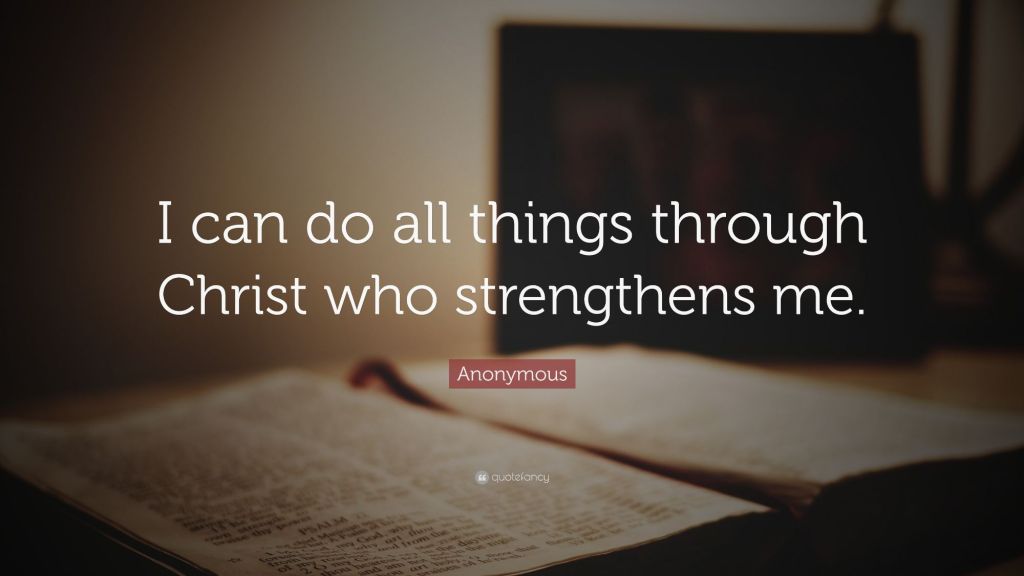
God is our Source in every area of life…
“Most Christians are being crucified on a cross between two thieves: yesterday’s regret and tomorrow’s worries.” Warren Wiersbe
Philippians 4 presents timeless lessons on living in harmony, finding true contentment, the importance of focused thought, and the assurance of God’s provision.
Paul here encourages us to focus our minds on what is good, to remain steadfast in our faith, to strive for unity, and to depend on God in ALL circumstances.
Regardless of the trials we face, we can find peace and contentment through Christ who strengthens us.
In these verses, PAUL is admonishing the Philippian Christians: DO NOT WORRY about the future, but pray about your concerns.
Only think about good things, and God will give you peace.
In EVERY circumstance, God is with us, offering grace, peace, and provision.
In verses 10-14, Paul is dealing with our learning contentment in every situation.
In these verses Paul acknowledges the Philippians’ concern for him and commends them for reviving their concern.
He also shares his secret to being content in all circumstances, whether well-fed or hungry, whether living in plenty or in want, through the strength he receives from Christ.
Philippians 4:10-14
The Message
Content Whatever the Circumstances
10-14 Paul speaking: I’m glad in God, far happier than you would ever guess—happy that you’re again showing such strong concern for me.
Not that you ever quit praying and thinking about me. You just had no chance to show it.
Actually, I don’t have a sense of needing anything personally.
I’ve learned by now to be quite content whatever my circumstances.
I’m just as happy with little as with much, with much as with little.
I’ve found the recipe for being happy whether full or hungry, hands full or hands empty.
Whatever I have, wherever I am, I can make it through anything in the One who makes me who I am.
I don’t mean that your help didn’t mean a lot to me—it did. It was a beautiful thing that you came alongside me in my troubles.
____
He goes on to say that the expressions of love from fellow believers encourage us, but contentment comes not from physical circumstances but from relying on divine strength.
Paul shows his attitude of gratitude by expressing joy over their gifts which Epaphroditus had delivered to him (Phil. 2:25), gifts which continued a long history of the Philippian church’s supporting Paul (see 4:16; 2 Cor. 11:8-9).
The gifts provided a problem for Paul.
He consistently refused to accept payment for his ministerial work, not wanting to burden the churches (1 Cor. 4:8-13; 9:1-18; 2 Cor. 11:7-10; 1 Thess. 2:5-12; 2 Thess. 3:7-12).
Thus he never used the term thank you as he wrote the Philippians, and he delayed using the term gift until verses 17-18.
He concentrated instead on the attitude of the Philippians and the relationship the gift represented.
He used a unique verb to express the freshness of their concern for him, saying it had blossomed afresh like a flower in springtime.
Paul makes clear that he was not hinting for another gift.
He has solved his economic problems. How?
Not with new resources but with a new attitude.
He is content no matter what his circumstances.
What is such contentment?
It is a term apparently taken over from Stoic philosophers describing an inner spirit of freedom and discipline, the ability to conquer circumstances and situations rather than be conquered by them.
Such an attitude is the exact opposite of worry and anxiety.
Paul spoke from experience. He had been through the extremes: surplus and poverty.
He knew how to weather the dangers of both.
This was his secret. Greek and Roman religions had secret initiation rites.
Some religions and philosophies prided themselves on secret knowledge.
Paul had a different kind of secret. His secret was his reliance on Christ, a reliance gained through his Christian experience.
Stoics relied on personal will to gain contentment.
Paul did not claim such personal inner strength. His strength came from Jesus living in him.
Paul was in Christ and thus content no matter what his circumstances. J. Vernon McGee writes:
“Whatever Christ has for you to do, He will supply the power.
Whatever gift He gives you, He will give the power to exercise that gift.
A gift is a manifestation of the Spirit of God in the life of the believer.
As long as you function in Christ, you will have power.
He certainly does not mean that he is putting into your hand unlimited power to do anything you want to do.
Rather, He will give you the enablement to do all things in the context of His will for you (McGee, Thru the Bible, V:327-8).
The Christian life is not only difficult; it is also impossible unless we acquire the power to live it through Christ.
To be sure, this truth does not come naturally to us but must be learned.
Paul was content because he could see life from God’s point of view.
He focused on what he was supposed to do, not what he felt he should have.
Paul had his priorities straight, and he was grateful for everything God had given him.
Paul had detached himself from the nonessential so that he could concentrate on the eternal.
Often the desire for something more or better indicates a longing to fill an empty place in a person’s life.
To what are you drawn when you feel empty inside?
How can you find true contentment? The answer lies in your perspective, your priorities, and your source of power.
Can we really do everything?
We receive all the power we need in union with Christ when we do his will and face the challenges that arise from our doing it.
He does not grant us superhuman ability to accomplish anything we can imagine without regard to his interests.
As we contend for the faith, we will face troubles, pressures, and trials.
What does God want you to do?
Step out in faith and do it, trusting him for the strength you will need.
The Philippians shared in Paul’s financial support while he was in prison.
They provided the means for him to get food and likely the materials he needed to write his letters, but in all these things Paul recognized that God himself is his Source.
SELAH (let us pause and calmly think about these things)
_____
Mon February 5, 2024
Faith Food Devotions
I CAN
“I can do all things through Christ which strengthens me.”
— Philippians 4:13
Many years have come and gone since I cast my cares upon the Lord, and although I will confess that I’ve been sorely tempted, I have not worried.
I have not fretted. I have not had the blues.
I have not been discouraged, no matter what.
(Some people said I didn’t have enough sense to worry. But, thank God, I had too much Bible-sense to worry!)
Worry was the most difficult sin for me to give up.
Worry is the greatest temptation you will ever face too. But you can resist it. And you must.
Your worst enemy is the flesh!
The flesh and natural human reasoning would limit you to your own ability.
You look at the circumstances, influences, problems, cares, tests, storms, and winds, and you say, “I can’t.”
The language of doubt, the flesh, the senses, and the devil is, “I can’t.
I don’t have the ability, the opportunity, or the strength. I’m limited.”
But the language of faith says, “I can do all things through Christ who strengthens me.”
Confession: I can! I can do all things through Christ who strengthens me.
Source: Faith Food Devotions by Kenneth E. Hagin.
____
Come join the Adventure!
Skip 🕊️
 SB SALT AND LIGHT MINISTRIES