Through Christ’s propitious sacrifice and shed blood on Calvary’s Cross, the Bible tells us that we can now boldly come into YHWH’s presence, in the Holy of Holies…

Thanks to Jesus, there is NOTHING that will ever separate us from the LOVE of God…

Hebrews 10:23-25
J.B. Phillips New Testament

Through Christ we can confidently approach God

19-25 So by virtue of the blood of Jesus, you and I, my brothers, may now have courage to enter the holy of holies by way of the one who died and is yet alive, who has made for us a holy means of entry by Himself passing through the curtain, that is, His own human nature.

Further, since we have a great High Priest set over the household of God, let us draw near with true hearts and fullest confidence, knowing that our inmost souls have been purified by the sprinkling of His blood just as our bodies are cleansed by the washing of clean water.

In this confidence let us hold on to the hope that we profess without the slightest hesitation—for He is utterly dependable—and let us think of one another and how we can encourage each other to love and do good deeds.

And let us not hold aloof from our church meetings, as some do.

Let us do all we can to help one another’s faith, and this the more earnestly as we see the final day drawing ever nearer.

Once the author told that Jesus’ death surpassed any earthly sacrifice, he encouraged the Hebrew Christians to have confidence. 

Jesus’ death not only provides salvation, but also great confidence for Christians.

We can now step boldly before the Lord in prayer, and boldly into the world in service and witness.

Jesus has already won the battle!

We have significant privileges associated with our new life in Christ:

(1) We have personal access to God through Christ and can draw near to him without an elaborate system (10:22);

(2) we may grow in faith, overcome doubts and questions, and deepen our relationship with God (10:23);

(3) we may enjoy motivation from one another (10:24);

(4) we may worship together (10:25).

To neglect Christian meetings is to give up the Encouragement and help of other Christians.

We gather together to share our faith and to strengthen one another in the Lord.

As we get closer to the day when Christ will return, we will face many spiritual struggles, and even times of persecution.

Anti-Christian forces will grow in strength.

Difficulties should never be excuses for missing church services. Rather, as difficulties arise, we should make an even greater effort to be faithful in attendance.

When people deliberately reject Christ’s offer of salvation, they reject God’s most precious gift.

They ignore the leading of the Holy Spirit, the one who communicates to us God’s saving love.

This warning was given to Jewish Christians who were tempted to reject Christ for Judaism, but it applies to anyone who rejects Christ for another religion or, having understood Christ’s atoning work, deliberately turns away from it (see also Numbers 15:30, 31 and Mark 3:28-30).

The point is that there is no other acceptable sacrifice for sin than the death of Christ on the cross.

If someone deliberately rejects the sacrifice of Christ after clearly understanding the gospel teaching about it, then there is no way for that person to be saved, because God has not provided any other name in all of heaven for people to call on to save them (see Acts 4:12).

If you are a child of God, claim your victory over sin!

Be confident. Nothing can ever take you out of God’s hand.

No one can ever take away your salvation. No matter what happens, you are always His.

And finally,

Romans 8:31-39 says,

“What then shall we say to these things? If God is for us, who can be against us? 

He who did not spare His own Son, but delivered Him up for us all, how shall He not with Him also freely give us all things?

Who shall bring a charge against God’s elect?

It is God who justifies.

Who is he who condemns?

It is Christ who died, and furthermore is also risen, who is even at the right hand of God, who also makes intercession for us.

Who shall separate us from the love of Christ?

Shall tribulation, or distress, or persecution, or famine, or nakedness, or peril, or sword?

As it is written:
“For Your sake we are killed all day long;

We are accounted as sheep for the slaughter.”

Yet in all these things we are more than conquerors through Him who loved us.

For I am persuaded that neither death nor life, nor angels nor principalities nor powers, nor things present nor things to come, nor height nor depth, nor any other created thing, shall be able to separate us from the love of God which is in Christ Jesus our Lord! Amen

SELAH (let us pause and calmly think about these things)

Come join the Adventure!

Skip 🕊️

David’s sin of presumption cost the life of his servant Uzzah…

David’s Failed Attempt at Moving the Ark…

Read 1 Chronicles 13:1-14

13:1-14 The parallel account of moving the Ark (2 Samuel 5–6) shows that David’s building projects were completed before he brought the Ark to Jerusalem.

The writer of Chronicles puts the moving of the Ark first in order to highlight David’s spiritual accomplishments and relationship to God.

However God had given specific instructions concerning the sacred objects (Numbers 4:15).

And God had already warned His people that He would put to death anyone who touched the Ark of the Covenant improperly.

David presumed to move the Ark of the Covenant, without first consulting God’s Word for instructions.

The sin of presumption is any time we take or do something without proper leave or allowance.

This story is a clear example of what the fear of the Lord means.

Often times a certain amount of fear, under certain circumstances, is wise and is necessary so as to preserve your life.

The following example shows what I’m talking about.

Transmission lines carry high voltage electricity, typically at 345,000 volts, over long distances between the power generation plant and customers.

The guys who work on these high tension power lines must always have a certain amount of fear, caution and respect for the power that they are working with, or else it would certainly cost them their lives, if they make a mistake.

This is what the Bible is talking about when it talks about our maintaining the fear of the Lord.

It doesn’t mean that we are afraid of Him, but it does mean that we don’t take Him for granted, especially when it comes to following His instructions and being obedient to His Word.

13:1 Even though David took the time to confer with all his officials; and even though, as king, David had the ultimate authority and could have given orders on his own, David’s oversight was that he failed to check first with the HIGHEST Authority, especially when it came with dealing with the sacred articles in the holy of holies, the most sacred of which is the Ark of the Covenant.

When in a position of power, we can be tempted to make unilateral decisions, pushing for our own opinions.

But effective leaders listen carefully to others’ opinions, and they encourage others to participate in making decisions.

Of course, we should always consult God first. We can run into big problems if we don’t talk with Him.

13:3 The Ark of God is also called the Ark of the Covenant.

The most sacred object of the Hebrew faith, it was a large box containing the stone tablets on which God had written the Ten Commandments (Exodus 25:10-22).

David had already made Jerusalem his political capital (1 Chronicles 11:4-9).

At this time, he brought the Ark there in order to make Jerusalem the nation’s center for worship.

13:3 The Ark of God had been in Kiriath-jearim for many years.

The neglect of the Ark symbolized Israel’s neglect of God.

Bringing the Ark back to the center of Israel’s life reflected David’s desire to remind the nation of its true foundation—God.

Neglecting the things that remind us of God—the Bible, the church, and relationships with Christians—causes us to also neglect God.

How would an observer know that God is at the center of your life?

13:6 Cherubim are mighty angelic beings.

13:8 Worship in the Old Testament was more than a sober religious exercise.

David’s exuberance as he worshiped God with dancing and music is approved of in Scripture.

Our worship should reflect a healthy balance:

Sometimes we should be reflective and serious (see Exodus 19:14-25), and sometimes we should show enthusiasm and jubilation.

What do you need—more serious reflection or more joyous celebration?

13:10-14 Uzzah died instantly for touching the Ark, but God blessed Obed-edom’s home, where the Ark was stored.

This demonstrates the two-edged aspect of God’s character:

He is both perfectly loving and perfectly just.

Great blessings come to those who obey his commands, but severe punishment comes to those who disobey Him.

This punishment may come swiftly or over time, but it will come.

Sometimes we focus only on the blessings God gives us, while forgetting that when we sin, “it is a terrible thing to fall into the hands of the living God” (Hebrews 10:31).

At other times, however, we concentrate so much on judgment that we miss God’s blessings.

Don’t fall into a one-sided view of God.

Along with His blessings comes the responsibility to live up to His standards regarding fairness, honesty, and justice.

13:10 Why did Uzzah die?

He touched the Ark, and that offense was punishable by death.

God had given specific instructions about how the Ark was to be moved and carried (Numbers 4:5-15), and those instructions had been neglected.

The Levites were responsible for moving the Ark (there is no record that Uzzah was a Levite), and it was to be carried on their shoulders with poles through its rings (Numbers 7:9).

It was never to be touched.

Bringing the Ark on a cart followed the Philistines’ example (1 Samuel 6:1-21).

Uzzah, though sincere in his desire to protect the Ark, had to face the consequences of his sin, and David was reminded that respect and obedience to God’s laws were more important than enthusiasm about moving the Ark.

Also, David had conferred with all his officials (1 Chronicles 13:1) but had neglected to consult God.

The advice of our friends and colleagues is no substitute for God’s direction.

13:11 David was angry at both God and himself.

David knew that he had done something wrong in transporting the Ark, and he was angry that his plans for the joyous return of the Ark had ended in a man’s death.

Once David’s anger cooled, it was replaced by fear as the king realized the importance God placed on the Ark, the symbol of His presence and covenant with Israel.

David left the Ark in Obed-edom’s home until he could consider how to get it to Jerusalem.

This allowed David to discover God’s instructions for transporting the Ark.

The next trip would be carried out according to God’s commands.
____

Thursday, Sept 19
The Berean: Daily Verse and Commentary for 1 Chronicles 13:9-11

Daily Verse and Comment

1 Chronicles 13:9-11

(9) “And when they came to Chidon’s threshing floor, Uzzah put out his
hand to hold the ark, for the oxen stumbled.

(10) Then the anger of the
LORD was aroused against Uzzah, and He struck him because he put his
hand to the ark; and he died there before God.

(11) And David became
angry because of the LORD’s outbreak against Uzzah; therefore that place
is called Perez Uzzah to this day.”
____

I Chronicles 13:1-3 introduces an episode containing a presumptuous act,
immediately followed by a sobering display of divine justice.

However, this time, one of the most respected names in Israelite history is directly
involved.

It is the story of Uzzah’s sudden death while moving the Ark of the Covenant, the most sacred and revered of Israelite objects. The Ark, representing the throne of God and containing the tablets of stone Moses
received from God on Mount Sinai, normally resided in the Holy of Holies.

David desired to move the Ark to Jerusalem to continue to consolidate the kingdom under himself.

As they were moving it on an oxcart, the oxen stumbled, and the Ark appeared to be toppling to the ground.

Uzzah, in what may have been pure reflex, put out his hand to steady the Ark, but upon
touching it, he was immediately struck dead (verses 9-10)!

At first, David was angry that God ruined his party (verses 8, 11) – as the whole atmosphere
of the Ark’s transfer was celebratory – but shortly after, he became extremely
fearful (verse 12).

The Bible shows God to be longsuffering and slow to anger.

Why did they not hear His voice from heaven saying, “Thank you, Uzzah, for keeping the
Ark from getting damaged and dirty”?

Instead, He exploded in anger and slew Uzzah on the spot!

However, God had given strict instructions for transporting the Ark, found in Numbers 4:4, 15, 17-20.

This is the service of the sons of Kohath in the tabernacle of meeting, relating to the most holy things: . . . And when Aaron and his sons have finished covering the sanctuary and all the furnishings of the sanctuary, when the camp is set to go, then the sons of Kohath shall come to carry them; but they shall not touch any holy thing, lest they die. These are the things in the tabernacle of meeting which the sons of Kohath are to carry. . . . Then the LORD spoke to Moses and Aaron, saying: “Do not cut off the tribe of the families of the Kohathites from among the Levites; but do this in regard to them, that they may live and not die when they approach the most holy things; Aaron and his sons shall go in and appoint each of them to his service and his task. But they shall not go in to watch while the holy things are being covered, lest they die.”

The Bible nowhere indicates that Uzzah was a Kohathite. If he was, what God did is even more understandable. Everyone in the whole procedure from David on down was guilty of disobeying God’s instructions regarding the most holy things. David failed to consult with the High Priest – or any priest, for that matter – regarding how the Ark should be moved. Evidently, no priest protested that proper procedures were not being followed.

The Kohathites were not even supposed to look on the uncovered Ark. To God, when Uzzah reached out and touched the Ark as it seemed about to topple off the cart, it was no act of heroism but the final act of desecration, arrogance, and presumption. The last thing presumed was that Uzzah’s hand was less defiling than the earth that he feared would contaminate the Ark.

God’s instruction in Exodus 20:24-25 regards building Him an altar. An altar made for His worship had to be constructed of earth or unhewn stones. No altar defiled by man’s sinful hand was suitable. Dirt cannot sin; it always follows the nature God established. God did not want the symbol of His throne contaminated by the evil that manifested itself in a whole string of rebellions against His specific instructions. There was nothing arbitrary, capricious, or whimsical in God’s action.

Jesus teaches us to address God as “Father,” a title suggesting familiarity, yet we are also to pray, “Hallowed be Your name.” God shows in these two incidents that, if reverence is due to the symbols used in His worship, how much greater reverence must be given to the realities of the New Covenant?

Those involved in this incident were well-intentioned, but it illustrates for all generations that God still requires conformity with His directives concerning holy objects. Deviation from orthodoxy can be deadly.

— John W. Ritenbaugh
___

Come join the Adventure!

Skip 🕊️

If God be for You, who can be against you” (Rom 8:31-33)…

We must learn to live our lives in the Spirit, following the Holy Spirit, allowing God’s Word to be a lamp unto our feet, and not our carnal nature, found in our flesh…

Read Romans 8:1-39

Life in the Spirit is a journey from condemnation to Glorious Hope.

“The Christian life is essentially life in the Spirit, that is to say, a life that is animated, sustained, directed and enriched by the Holy Spirit. Without the Holy Spirit true Christian discipleship would be inconceivable, indeed impossible.”

Paul’s three-chapter treatise on sanctification (Rom. 6-8) concludes with chapter 8.

The conflict between the Holy Spirit and the propensity to sin presented in chapter 7 is here answered with the presentation of another “law” (principle)— the law of the Spirit of life through Christ Jesus.

Paul explains the “new way of the Spirit” (Rom. 7:6) and reveals the benefits of the new life the Spirit gives.

Paul’s three-chapter treatise on sanctification (Rom. 6-8) concludes with chapter 8.

The conflict between the Holy Spirit and the propensity to sin presented in chapter 7 is here answered with the presentation of another “law” (principle)— the law of the Spirit of life through Christ Jesus.

Paul explains the “new way of the Spirit” (Rom. 7:6) and reveals the benefits of the new life the Spirit gives.

Romans 8 is a beacon of hope and reassurance, serving as a reminder of the power of the Spirit, the freedom we have in Christ, and God’s unending love.

Despite our current sufferings, we can find solace knowing that future glory awaits us and that nothing can separate us from God’s love!

SELAH (let us pause and calmly think about these things)
____

Sunday, Sept 15
cFaith Devotion

Faith Food Devotions
by Kenneth E. Hagin

LOVED

“I [Jesus] in them [believers], and thou [God the Father] in me, that they may be made perfect in one; and that the world may know that thou hast sent me, and hast loved them, as thou hast loved me.”
— John 17:23

When you know – really know – that God is your very own Father and you are His very own child, this knowledge will have the following effect on you:

You will have as much freedom and fellowship with the Father as Jesus had in His earth walk, because God the Father loves you even as He loved Jesus!

John 17:23 says so:

“…and hast loved them, as thou hast loved me.”

“I just can’t believe that God loves me as much as He loved Jesus,” some may say.

Thank God, I can! I believe it, because the Bible says it, and that settles it!

You and I can say with Jesus “…I am not alone, because the Father is with me” (John 16:32).

Because if God loves me as He loved Jesus— and He does—then He is with me as He was with Jesus.

I am never afraid, just as Jesus was never afraid.

There is nothing to fear. What can man do to the man or woman whom God loves and protects!

Confession:
God the Father is my very own Father. I am His very own child. And He loves me in my earth walk just as much as He loved Jesus in His earth walk.

I can fellowship with Him just as Jesus did. I am free from fear just as Jesus was, for I am not alone. My Father is with me.

[Source: Faith Food Devotions by Kenneth E. Hagin]
____

Come join the Adventure!

Skip 🕊️

The Parable of the Wedding Supper of the Lamb… 

The King Will Receive Honor from the Most Unlikely Subjects…

Read Matthew 22:1-14

In Jewish culture, two invitations were expected when banquets were given.

The first asked the guests to attend; the second announced that all was ready.

In this story the king invited his guests three times, and each time they rejected his invitation.

God wants us to join Him at His banquet, which will last for eternity.

That’s why He sends us invitations again and again.

Have you accepted His invitation?

It was customary for wedding guests to be given a garment to wear to the banquet.

It was unthinkable to refuse to wear these clothes.

That would insult the host, who could only assume that the guest was arrogant and thought he didn’t need a garment, or that he did not want to take part in the wedding celebration.

The garment is a picture of the “garment of righteousness” needed to enter God’s Kingdom—the total acceptance in God’s eyes that Christ gives every believer.

Christ has provided this garment for everyone, but each person must choose to put it on in order to enter the King’s banquet (eternal life).

There is an open invitation, but we must be ready.

God has extended this invitation to you , and the question is, have you fully accepted God’s invitation to enter into His kingdom, or are you still wearing your unholy garments?

SELAH (let us pause and calmly think about these things)
____

Thursday, September 12, 2024
Anchor Devotional

BRIDE IN COMMUNION

“Tell those who have been invited that I have prepared my dinner: My oxen and fattened cattle have been butchered, and everything is ready. Come to the wedding banquet.” 
— Matthew 22:4

The Living God desired to reveal Himself to a spiritually empty world through the children of Abraham.

A foreshadowing of God’s redemption plan to unite them with their Messiah Bridegroom was evident in the specific traditions for Jewish marriage planning. 

First, the lover agreed to the bride price the father required for giving up his daughter.

The young man proposed by offering a cup of wine to the one he desired saying,

“This cup I offer to you.”

If the woman drank from it, the two made plans to marry.

A marital contract was agreed on.

Gifts were given. A banquet followed. 

The price our heavenly Father gave for us, His bride, was the life of His Son.

Our marital contract is the New Covenant that brought salvation through His shed blood.

Our “wedding gift” is the Holy Spirit.

We wait with anticipation for the magnificent banquet to come.

All who have confessed their sin and their need of salvation will sit with Jesus at His table in heaven one day.

The bride and the Bridegroom will partake together in the first supper of eternal days!

INSIGHT
Our regular partaking of the Lord’s Supper is a small picture of our invitation to the wedding supper of the Lamb (see Revelation 19:9).

[From Haven Today Ministries]
____

Come join the Wedding Feast of the Lord!

Skip 🕊️

Jesus bids us to come follow Him…

Take this whole world, but give me Jesus… 

These are the words of a song that really emphasizes the true meaning of life… to know and follow Christ! 

Read 2 Peter 1:1-22 (NLT)

2 Peter 1 presents an inspirational and transformative journey, inviting us to partake in God’s divine nature and grow in faith and virtue.

Peter’s affirmation of Christ’s glory and his emphasis on the power of prophecy reminds us of the certainty of Christ’s return and the validity of our faith.

Peter’s relationship with Christ transformed his life.

You too can be transformed, which is the whole point of our being Christian and following Christ.

It all starts with REPENTANCE, which means we need to change the way we think.

Jesus calls us to be all we can be!

When Joey Barrow was a teenager, his schoolmates labeled him the class sissy.

At eighteen, while the other guys were involved in more “masculine” activities, Joey was taking violin lessons.

One day, they called him “sissy” one time too many. Joey smashed the boy who made fun of him smack on the head with (you guessed it) his violin.

It didn’t help. The story simply brought another round of laughter from Joey’s classmates.

One boy did not laugh. Big, strapping Thurston McKinney decided it was time Joey got involved in something with a little more muscle.

Thurston exercised regularly at a local gym and asked Joey to come along.

As always, Joey had his violin with him. “If you want to work out with me,” said Thurston, “you’ll have to rent a locker.”

Locker rental was fifty cents. The only money Joey had was what his mom had given him for that week’s violin lesson.

So Joey borrowed some gym trunks and some old tennis shoes from Thurston, rented the locker with his violin money, and put the violin inside.

The first time Thurston invited Joey to spar with him, Joey clobbered him. Flattened him.

The dazed response of Thurston McKinney, himself already a Detroit Golden Gloves Champion, was, “Boy, throw that violin away!”

With the money his mother had intended to finance weekly violin lessons, Joey kept a permanent locker.

In five years, Joey Barrow would turn twenty-three and be the heavyweight boxing champion of the world!


The anthologies of athletics say little about Thurston McKinney, but he took Joey Barrow under his wing.

Joey dropped his last name, Barrow, so his mother wouldn’t know the newspapers were talking about her son.

The world knew for years before she did that sissy Joey Barrow had been transformed into the unbeatable “Brown Bomber,” Joe Louis.

Another transformed man wrote 2 Peter. His name is Simon Peter.

His transformation did not produce a fighter, but just the opposite.

Peter was transformed from a fighter into a servant of Jesus Christ.

So dramatic was the change in Peter’s life that he wrote this letter to remind his readers that Christian faith was never intended to remain unchanged or static. Christian faith always adds something. It is always growing. Christians continually experience change or transformation in their lives.

On a side note, the above testimony about Joe Lewis is of interest to me, because I remember, as a young teenager, I spent most of my summer vacation time with my cousin in Chicago.

Joe Lewis’s son (Punchy was his nickname) lived across the street  and we used to play touch football in his backyard, and I actually had never heard this story about his father before.

This was in my before Jesus days and just hearing the story brings back fond memories of a time long ago, and I had lots of fun times back then.

It’s just interesting to me as I look back on my life, on how God truly does choreograph our life as we’re told in He does in Psalms 139:16, before we were even born.

Looking back in retrospect I do see his hand and His protection and guidance that has directed me to where I am today.

I think pretty much all of us, as we look back on our life, can say the same thing.

That’s why it’s so important that we not waste our lives, but that we keep our focus on Jesus, so that we can be all that we can be for Him.

I know that’s where my head is right now, I just want my life to count for Him and to make a difference, which brings me to verse 2 of the scripture we just read In 2 Peter 1…

“May God give you more and more grace and peace as you grow in your knowledge of God and Jesus our Lord.”

Many believers want an abundance of God’s gifts and provision in their lives, but they are unwilling to put forth the effort to get to know Him better through Bible study and prayer.

To enjoy the privileges God offers us freely, through our daily fellowship and relationship with Him, it’s worth more than all the gold and silver in this world and is the only thing that will fulfill our life.

We must all, as followers of Christ, seek to grow in our knowledge of God and of Jesus our Lord,

SELAH (let us pause and calmly think about these things)
____

Tuesday, Sept 3
cFaith Devotions

GO FOR REVELATION KNOWLEDGE
by Kenneth Copeland 
From Faith to Faith

“Grace and peace be multiplied unto you through the knowledge of God, and of Jesus our LORD.”
— 2 Peter 1:2

If you were to look up the Greek word that’s translated “knowledge” in that scripture, you’d find out that it means more than just a mental understanding of something, more than the kind of knowledge that can be gained through your senses.

It means exact knowledge.

Knowledge that’s been revealed directly to your heart by the Spirit of God.

I call it revelation knowledge.

The lack of that kind of knowledge has caused more faith failures than anything else I know.

That’s because most Christians believe the Word with their minds, but they haven’t meditated on it enough for it to “light up” in their hearts.

If they had, that Word would absolutely revolutionize their lives.

Nothing in heaven or earth would be able to shake them loose from it.

I know a widow who got hold of that kind of revelation one afternoon.

She’d been meditating in the scriptures that say if you’re a widow, God Almighty has taken His place as your provider and leader of your household.

She’d been feeling a little sorry for herself up until then.

But when she received the revelation that God was actually head of her household now, she started talking to Him like she would a husband.

“I’m telling You, Lord, the plumbing in this house is pitiful. Will You please get it fixed?” she said.

From that moment on, she never had any more trouble with her plumbing.

If you need something from God, determine right now that you’re going to do what that widow did.

Determine that you’re going to meditate the Word until you get a revelation like that.

Keep that Word before you until you receive a revelation of Jesus as your HEALER or your DELIVERER or your FINANCIER – whatever you need Him to be.

Don’t settle for a shallow mental understanding of Him. Get a deep revelation and His grace will be multiplied to you!

[Source: From Faith to Faith Devotional by Kenneth and Gloria Copeland]
____

Come join the Adventure,

Skip 🕊️

Doubt turned to faith…

Jesus and Thomas – Seeing and believing…

Thomas, who was not present when Jesus first appeared, refuses to believe until he can see and touch Jesus’ wounds.

Eight days later, Jesus appears again and invites Thomas to touch His wounds.

Thomas then  believes and confesses Jesus as “my Lord and my God.”

Read John 20:24-29

The account of Thomas appears immediately before John’s mission statement in verses 30-31.

The goal of John’s Gospel is always evangelistic. He wanted people to understand the truth about Jesus, to believe that He is the Son of God, and thereby to experience the life of which we have been reading in this Gospel.

Faith itself is not an end, but a means to an end.

Our faith is always defined as the substance of things which we hope for, regardless of any negative feelings and/or circumstances.

Our faith is always based upon our absolute trust and reliance upon the reliability and trustworthiness of  God and His Word.

Have you ever wished you could actually see Jesus, touch Him, and hear His words?

Are there times you want to sit down with Him and get His advice?

Thomas wanted Jesus’ physical presence. But God’s plan is wiser.

He has not limited Himself to one physical body; he wants to be present with you at all times.

Even now He is with you in the form of the Holy Spirit.

You can talk to Him, and you can find His words to you in the pages of the Bible.

He can be as real to you as He was to Thomas.

Jesus wasn’t hard on Thomas for his doubts. Despite his skepticism, Thomas was still loyal to the believers and to Jesus Himself.

Some people need to voice their doubts before they believe.

If doubt leads to questions, and questions lead to answers, and if the answers are accepted, then doubt has done good work.

It is when doubt becomes stubbornness and stubbornness becomes a prideful lifestyle that doubt harms faith.

When you doubt, don’t stop there. Let your doubt deepen your faith as you continue to search for the answers.

Jesus’ resurrected body was unique. It was not the same kind of flesh and blood Lazarus had when he came back to life.

Jesus’ body was no longer subject to the same laws of nature as before His death.

He could appear in a locked room, yet He was not a ghost or an apparition because He could eat and be touched.

Jesus’ resurrection was literal and physical—He was not a disembodied spirit.

Thomas, so often remembered as “DOUBTING THOMAS,” deserves to be respected for his faith.

He was a doubter, but his doubts had a purpose—he wanted to know the truth.

Thomas did not idolize his doubts; he gladly believed when he was given reasons to do so.

He expressed his doubts fully and had them answered completely.

Doubting was only his way of responding, not his way of life.

Although our glimpses of Thomas are brief, his character comes through with consistency.

He struggled to be faithful to what he knew, despite what he felt.

At one point, when everyone could see that Jesus’ life was in danger, only Thomas put into words what most were feeling,

“Let’s go, too—and die with Jesus” (John 11:16).

He didn’t hesitate to follow Jesus.

We don’t know why Thomas was absent the first time Jesus appeared to the disciples after the Resurrection, but he was reluctant to believe their witness that Jesus was alive.

Not even ten friends could change his mind!

We can doubt without having to live a doubting way of life.

Doubt encourages rethinking. Its purpose is more to sharpen the mind than to change it.

Doubt can be used to pose a question, get an answer, or push for a decision.

But doubt was never meant to be a permanent condition.

Doubt is one foot lifted, poised to step forward or backward.

There is no motion until the foot comes down.

When you experience doubt, take encouragement from Thomas.

He didn’t stay in his doubt but allowed Jesus to bring him to belief.

Take encouragement also from the fact that countless other followers of Christ have struggled with doubts.

The answers God gave them may help you, too.

Don’t settle into doubts; move on from them to decision and belief.

Find another believer you can share your doubts with.

Silent doubts rarely find answers.

I think it would do us all good to remember what Jesus said in Matthew:

Matthew 18:2-3 (NKJV)

2 “Then Jesus called a little child to Him, set him in the midst of them, 3 and said, “Assuredly, I say to you, unless you are converted and become as little children, you will by no means enter the kingdom of heaven.”

I know for myself, ever since I first got saved, I just made the commitment to the Lord that if I can find it in His Word I would believe it.

SELAH (let us pause and calmly think about these things)

____

Monday, Sept 2
cFaith Devotion

HEAD FAITH
by Kenneth E. Hagin

“The other disciples therefore said unto him (Thomas), We have seen the Lord. But he said unto them, Except I shall see in his hands the print of the nails, and put my finger into the print of the nails, and thrust my hand into his side, I will not believe.

“And after eight days…came Jesus, the doors being shut, and stood in the midst, and said, Peace be unto you. Then saith he to Thomas, Reach hither thy finger, and behold my hands; and reach hither thy hand, and thrust it into my side: and BE NOT FAITHLESS, BUT BELIEVING.

“And Thomas answered and said unto him, My Lord and my God. Jesus saith unto him, Thomas, because thou hast seen me, thou hast believed:

BLESSED ARE THEY THAT HAVE NOT SEEN, AND YET HAVE BELIEVED.”
— John 20:25-29

Thomas’ faith was head faith. And Jesus did not commend Thomas for it.

Jesus said, “You have believed because you have seen.”

Anyone can have that kind of faith, whether he be saint or sinner.

That’s head faith. Head faith is believing what your physical senses tell you.

Jesus commended heart faith. He said, “…blessed are they that have not seen, and yet have believed” (v.29).

To believe with the heart means to believe apart from what your physical body or physical senses may indicate.

The physical man believes what he sees with his physical eyes, hears with his physical ears, or feels with his physical senses.

But the heart, on the other hand, believes in the Word of God regardless of what the physical senses say.

Confession: I am not faithless; I am believing. I believe according to what God’s Word says, regardless of what I see, hear, or feel.

In Jesus’ name. Amen

Come join the Adventure!

Skip 🕊️

Jesus came to baptize us with Fire…

The King Is Introduced…

Read Matthew 3:1-17 (ESV)

In Matthew 3:11, John the Baptist makes a profound declaration about the coming Messiah:

“I baptize you with water, but He who is coming after me is mightier than I, whose sandals I am not worthy to carry.

He will baptize you with the Holy Spirit and fire” (ESV).

John baptized with water to signify repentance, but he was preparing the way for One who would baptize with the Holy Spirit and fire—a spiritual baptism, not a physical one.

John baptized people as a sign that they had asked God to forgive their sins and had decided to live as He wanted them to live.

Water baptism is an outward sign (public declaration) of our decision to follow Christ.

The first step in this process is to repent, which means to change the way we think.

True repentance prepares the way for Jesus in our lives.

And our baptism is an outward sign of our commitment to Christ.

To be effective, it had to be accompanied by an inward change of attitude leading to a changed life—the work of the Holy Spirit.

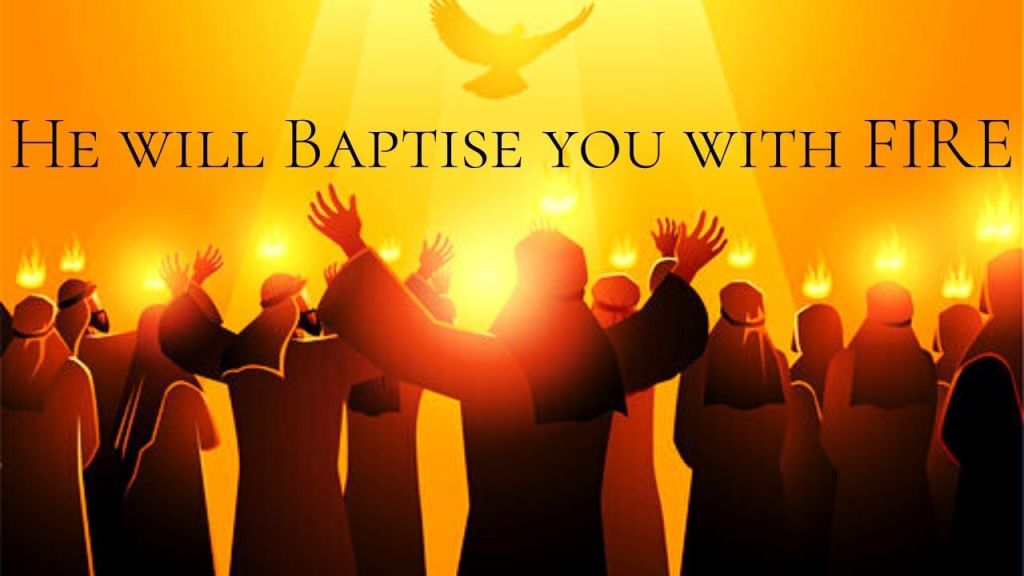
John said that Jesus would baptize with the Holy Spirit and fire.

This looked ahead to Pentecost (Acts 2), when the Holy Spirit would be sent by Jesus in the form of tongues of fire, empowering His followers to preach the gospel.

John’s statement also symbolizes the work of the Holy Spirit in bringing God’s judgment on those who refuse to turn from their sins.

Everyone will one day be baptized—either now by God’s Holy Spirit or later by the fire of his judgment.

SELAH (let us pause and calmly think about these things)
____

Sunday, Sept 01
cFaith Devotion

JESUS BAPTIZES ME WITH THE SPIRIT
by Tim Davidson

“As for me, I baptize you with water for repentance, but He who is coming after me is mightier than I, and I am not fit to remove His sandals; He will baptize you with the Holy Spirit and fire.”
— Matthew 3:11 (NASB)

John the Baptist said he could baptize with water but Jesus was going to be the one who would come to baptize with the Holy Spirit and fire.

This baptism with the Spirit immerses us into the person of the Holy Spirit.

He then fills us and empowers us.

The Message Bible says: “I’m baptizing you here in the river, turning your old life in for a kingdom life.

The real action comes next: The main character in this drama—compared to him I’m a mere stagehand—will ignite the kingdom life within you, a fire within you, the Holy Spirit within you, changing you from the inside out.”

We are born of the Spirit the moment we are born again.

We have the presence of the Holy Spirit in us. Yet, Jesus will totally saturate us in this baptism.

Another phrase for baptizing us with the Spirit is “filling us with the Spirit.”

We are to be filled to overflowing with the Spirit of God.

We must be baptized in the Holy Spirit to have the power to successfully live out our Christian life.

Life is better with God’s power.

Today’s Thought to Take With You:
Jesus, I look to you to fill me with your Spirit and to empower me for success.

[Source: A Verse A Day
by Tim Davidson]
____

Come join the Adventure!

Skip 🕊️