All born-again Believers have been bought with a price and our lives no longer belong to us, because of the Cross of Calvary…

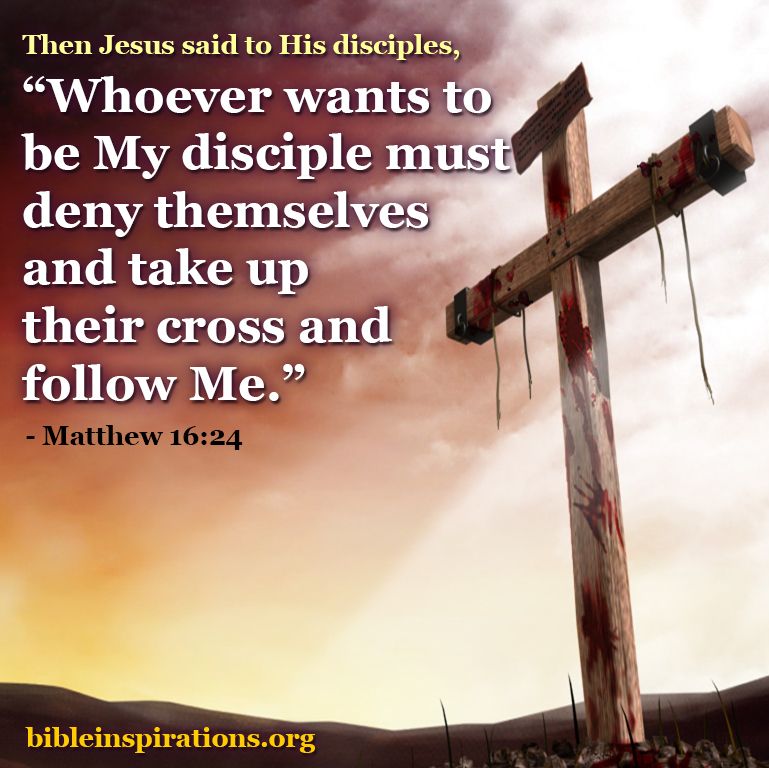
When Jesus tells us to pick up our cross daily and follow Him , the cross becomes the symbol of our death to self, in that our lives no longer belong to us

(Translated, this means that as followers of Christ, we must learn to surrender our ALL to GOD!)

1 Corinthians 6:19-20
Good News Translation

19 Don’t you know that your body is the temple of the Holy Spirit, who lives in you and who was given to you by God? You do not belong to yourselves but to God; 20 he bought you for a price. So use your bodies for God’s glory.
____

The Christian’s body is a temple of the Holy Spirit.

When we are born-again, the Holy Spirit takes up residence in our bodies and they become a holy place for the dwelling of God’s special presence.

That the Holy Spirit resides in believers points to the new nature of believers’ bodies.

Believers’ bodies are sanctified and holy, being in union with Christ.

Paul also reminded the Corinthians that they did not have rights to their own bodies.

They were not free to use their bodies any way they wished.

He insisted that Christ bought them at a price—His own blood.

As a slave was bought in the ancient world, Christ bought His followers, body and soul, through the price of His own death.

Because they belong to Him, believers do not have the right to rebel against Him by using their bodies in ways the Lord has prohibited.

Further, because this purchase results in redemption and salvation, it ought to inspire grateful obedience, not rebellion.

In this reminder, Paul chastised the Corinthians and pleaded with them to obey Christ eagerly and thankfully.

Verses 20 tells us that we are the Lord’s both by creation and redemption.

Here the latter is particularly in view. His ownership of us dates back to Calvary.

We were bought at a price. At the cross, we see the price tag which the Lord Jesus put on us.

He thought us to be of such value that He was willing to pay for us with the price of His own precious blood.

How greatly Jesus must have loved us to bear our sins in His body on the cross!

That being the case, I can no longer think of my body as my own.

If I am to take it and use it in the way I desire, then I am acting as a thief, taking that which does not belong to me.

Rather I must use my body to glorify God, the One to whom it belongs.

SELAH (let us pause and calmly think about these things)

____

Monday, February 24
The Winning Walk
by Dr Ed Young

GIVE YOURSELF FIRST

Paul held up the Christians at Macedonia as an example to his Corinthian friends.

The Macedonians (who had little) had given liberally to the Jerusalem church…and the Corinthians (who had much more) had promised aid, but done nothing.

But Paul’s most convicting description of these generous believers was not about money, but about heart. “They first gave themselves,” he said.

God is not honored when we “tip” Him with our money but withold from Him our selves.

The gift without the giver is bare. Those Macedonian givers climbed into the offering plate with their gift.

They didn’t just nod at God with a few coins…they put their very lives at His disposal.

What a radical act of faith! Jesus illustrated this best when He instructed His disciples to “render unto Caesar the things that are Caesar’s…and to God the things that are God’s.” Well, what is God’s? We are!

Jesus picked up a coin to drive home His point, saying, “Whose picture is on this coin?”

They answered the obvious: “Caesar’s.”

What has God’s picture on it? You and I do. We are made in the image of God, and His picture is etched on your life and mine in an indelible way.

When we give ourselves along with our gifts, our offering is sacrificial, spontaneous and spiritual. And we can be sure that God is honored by it.

Memory Verse

II CORINTHIANS 8:5
And this, not as we had expected, but they first gave themselves to the Lord and to us.

____

Come join the Adventure!

Skip 🕊️
Bob Dylan once wrote a song that said everybody gotta serve someone… the question is who are you serving today?

The Gospel Expects Sacrifice…

The problem with living sacrifices is that they keep crawling off the altar!” (Author Unknown)

Romans 12:1-2
J.B. Phillips New Testament

We have seen God’s mercy and wisdom: how shall we respond?

12 1-2 With eyes wide open to the mercies of God, I beg you, my brothers, as an act of intelligent worship, to give him your bodies, as a living sacrifice, consecrated to him and acceptable by him.

Don’t let the world around you squeeze you into its own mould, but let God re-mould your minds from within, so that you may prove in practice that the plan of God for you is good, meets all his demands and moves towards the goal of true maturity.
____

At the end of Romans 11, Paul completes his exposition of the gospel of Jesus Christ.

It was certainly the most thorough and systematic presentation of Christian truth up to that time in the church, and most would agree since that time as well.

Romans 1-11 forms the basic outline, or framework, on which a Christian understanding of sin, salvation, sanctification, and sovereignty have been based for nearly two thousand years. But now Paul turns his attention to the implications of the truth he has just presented.

Romans 12 is where Paul says, “In light of what God has done, here is how we should live.”

The primary theme is sacrifice—its expression and evidence in the life of the Christian and the church. Ministry to one another through spiritual gifts and love for one another form the two major emphases of Paul in this chapter.

Max Lucado puts it this way:

Paul told the Roman Christians how to live so that their behavior would be worshipful to God.

God desires you to surrender EVERY part of your life to Him.

Would you buy a house if you were only allowed to see one of its rooms?

Would you purchase a car if you were permitted to see only its tires and a taillight?

Would you pass judgment on a book after reading only one paragraph?

Nor would I.

Good judgment requires a broad picture. Not only is that true in purchasing houses, cars, and books, it’s true in evaluating life.

One failure doesn’t make a person a failure; one achievement doesn’t make a person a success.

“The end of the matter is better than its beginning,” penned the sage (see Ecc 7:8).

“Be patient when trouble comes,” echoed the apostle Paul (see Ro 12:12).

We only have a fragment. Life’s mishaps and horrors are only a page out of a grand book.

We must be slow about drawing conclusions. We must reserve judgment on life’s storms until we know the whole story.

“Do not worry about tomorrow, for tomorrow will worry about itself” (Mt 6:34).

He should know. He is the Author of our story. And He has already written the final chapter.

(From Lucado Encouraging Word)

Paul summarizes Christian living in a sentence:

“Take your everyday, ordinary life — your sleeping, eating, going-to-work, and walking-around life — and place it before God as an offering” (Romans 12:1).

God doesn’t throw out the past and tell us to forget about it. He uses all the material, but He rearranges it, and in His hands it becomes new.

The vocabulary in Romans 12:1 uses the same words from the sacrificial system of the past: life and offering. But each of those words is given a radically new orientation.

Substitute sacrifices will no longer do. It’s your life God wants, and it’s mine!

We are to offer our lives daily in service to Him!

Throughout chapter 12, Paul discusses what our faith looks like with “one another,” a phrase he uses four times here. But before we can have a dynamic, personal involvement with one another, we need a dynamic involvement with God.

Step one is responding to the mercies of God (explained in chapters 1–11) by presenting our bodies as a LIVING SACRIFICE, holy and pleasing to God.

That means complete and total surrender.

It’s the difference between what a chicken and a pig bring to a bacon-and-egg breakfast.

The chicken makes a contribution; the pig gives everything.

What we often try to do with God is give an egg here and an egg there, but God wants sacrifice—the ham and bacon.

Only total surrender can be called true worship.

12:2 Once we offer ourselves to God, our relationship to the world is altered.

Paul urges us not to be conformed to this age, meaning the world system that leaves God out, but to be transformed by the renewing of [our] mind.

Notice that both commands are passive.

We aren’t conforming or transforming our minds.

Someone else is.

When God has all of us, and when the world has none of us, God does the work of renewing our confused minds.

He brings our thoughts in line with His own so that we think God’s thoughts after Him (see 1 Cor 2:16).

God has a goal in renewing our minds. This renewal allows Him to merge His thoughts with our thoughts so that He can bring His plans into our lives.

He calls it the good, pleasing, and perfect will of God.

God has a purpose and a plan for each of our lives—one that finds us when we are fully surrendered.

SELAH (Let us pause and calmly think about these things!)

Come join the Adventure!

Skip 🕊️