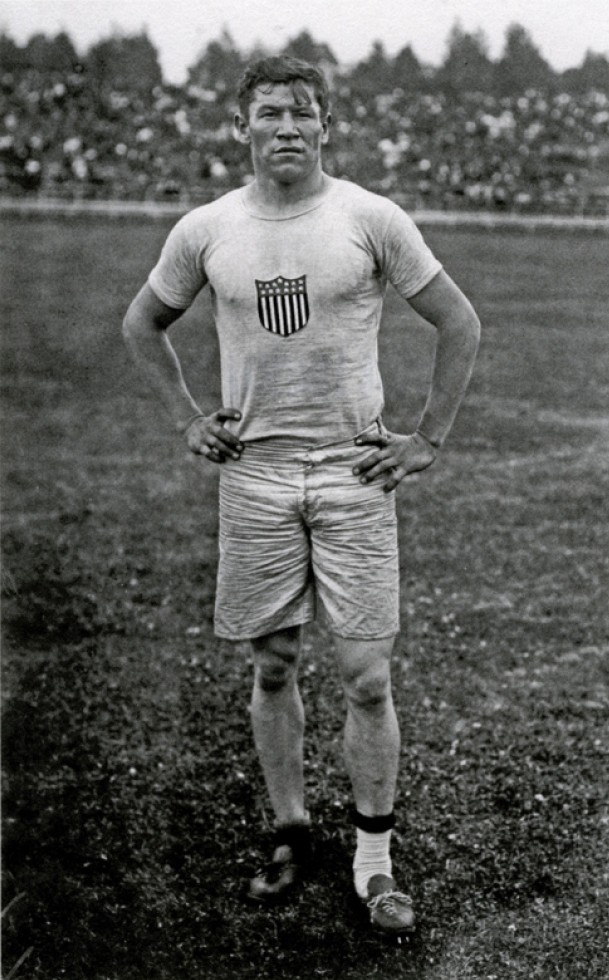
Look closely at the photo, you can see that he’s wearing different socks and shoes.
This wasn’t a fashion statement. It was the 1912 Olympics, and Jim, an American Indian from Oklahoma represented the U.S. in track and field.
On the morning of his competitions, his shoes were stolen.
Luckily, Jim ended up finding two shoes in a garbage can.
That’s the pair that he’s wearing in the photo. But one of the shoes was too big, so he had to wear an extra sock.
Wearing these shoes, Jim won two gold medals that day.
This is a perfect reminder that you don’t have to resign to the excuses that have held you back.
So what if life hasn’t been fair?
What are you going to do about it today?
Whatever you woke up with this morning; stolen shoes, ill health, failed relationships, don’t let it stop you from running your race.
You can experience more in life if you’ll get over the excuses and get on with living.
You can have reasons or you can have results, but you can’t have both!
____
Note: Jim Thorpe was restored as sole winner of 1912 Olympic Gold Medals in 2022.
After nearly 110 years after being stripped of those gold medals for violations of strict amateurism rules of the time.
On July 15, 2022, the International Olympic Committee announced the change on the 110th anniversary of Thorpe winning the decathlon and later being proclaimed by King Gustav V of Sweden as “the greatest athlete in the world.” ____
The Bible tells us also to run the race that has been set before us (Heb 12:1)….
In 1 Corinthians 9:24-27 (MSG), Paul tells us:
“You’ve all been to the stadium and seen the athletes race.
Everyone runs; one wins.
Run to win.
All good athletes train hard. They do it for a gold medal that tarnishes and fades.
You’re after one that’s gold eternally.
I don’t know about you, but I’m running hard for the finish line.
I’m giving it everything I’ve got. No lazy living for me!
I’m staying alert and in top condition. I’m not going to get caught napping, telling everyone else all about it and then missing out myself.”
So likewise let each one of us discipline ourselves in order that we may also run the race that has been set before us.
And since Jesus has already won this race, Paul instructs us to keep running and never quit! ____
The Bible says “Faith can move mountains” (Matt 17:20)…
So what exactly is faith?
It is when a person believes in the certainty of things that cannot be seen.
In order to be a believer and a Christian, faith is something which is absolutely necessary.
God will reward all those who cannot see Him, and yet still show a strong desire to find Him.
When we talk about faith it is referring to someone who is certain about something without actually seeing it.
As Jesus indicates, the more faith you have the more you can achieve.
So Jesus said to them,
“Because of your unbelief; for assuredly, I say to you, if you have faith as a mustard seed, you will say to this mountain, ‘Move from here to there,’ and it will move; and nothing will be impossible for you (Matthew 17:20).
So nothing would be impossible for the man who had faith.
But it can be argued that if we have faith then we should be able to achieve anything we wish.
But as John points out this depends on God’s will…
“Now this is the confidence that we have in Him, that if we ask ANYTHING according to His will, He hears us. And if we know that He hears us, WHATEVER we ask, we know that we have the petitions that we have asked of Him (1 John 5: 14-15).
If God’s will allows it then we can do amazing things with our faith.
But we must always remember that faith will never allow us to change God’s determined will.
However, we should always remember that without human faith many of the events in the Bible would not have happened.
The Bible even tells us that without faith it is IMPOSSIBLE to please God, for whoever comes to God must believe that He is, and that He is a rewarder of those who DILIGENTLY seek Him (Hebrews 11:6).
Read Matthew 9
Jesus as authority over both Life and Death…
He alone has the POWER to Heal the incurable and raise the dead (Matthew 9:18–26)…
After a stretch of non-miracle narratives in Matthew 8-9, Matthew recorded a flurry of miracle activity in 9:18-34.
And verse 18, we now learn about the ruler of the local synagogue, Jairus, whose daughter was at death’s door.
Not all religious leaders were hostile toward Jesus.
We do not know the attitude of this synagogue ruler before his daughter’s illness and death, but desperation can soften even the strongest critics.
This man, like all the rest of the seekers in Matthew 8-9, was at the end of his resources.
He had no place to turn except to the king.
The official showed reverence for Jesus.
Recognizing Him as a prophet from God, the official knelt before Him.
His request revealed great faith.
To this point, Jesus had performed all of His healing miracles on people who were still living.
This is the first instance in Matthew where He ministered to a dead person.
The official’s confidence in Jesus is evident in his bold assertion that Jesus’ touch would bring her back to life.
It was exceptional that this ruler should seek help from Jesus; most of the Jewish leaders would have feared the scorn and contempt of their associates for doing so.
Jesus honored his faith by starting out with His disciples toward the ruler’s home.
Then there was another interruption!
This time it was a woman who had suffered from a hemorrhage for twelve years.
Jesus was never annoyed by such interruptions; He was always poised, accessible, and approachable.
The problem was (for this woman) Medical science had been unable to help her; in fact, her condition was deteriorating (Mark 5:26).
In her extremity she met Jesus—or at least she saw Him surrounded by a crowd.
Believing that He was able and willing to heal her, she edged through the crowd and touched the fringe of His garment.
True faith never goes unnoticed by Jesus.
He turned and pronounced her healed; and instantly the woman was made well for the first time in twelve years.
In verse 23, the narrative now returns to the ruler whose daughter had died.
When Jesus reached the house, the professional mourners were wailing with what someone has called “synthetic grief.”
He ordered the room cleared of visitors, at the same time announcing that the girl was not dead but sleeping.
Then the Lord took the girl by the hand and the miracle occurred—she got up.
It didn’t take long for the news of the miracle to spread throughout the district.
After that Jesus departed from the ruler’s neighborhood, and two blind men followed Him, pleading for sight.
Though dispossessed of natural vision, these men had acute spiritual discernment.
In addressing Jesus as Son of David, they recognized Him as the long-awaited Messiah and rightful King of Israel.
And they knew that when the Messiah came, one of His credentials would be that He would give sight to the blind (Isa. 61:1).
When Jesus tested their faith by asking if they believed He was able to do this (give them sight), they unhesitatingly responded, “Yes, Lord!”
Then the Great Physician touched their eyes and assured them that because they believed, they would see.
Immediately their eyes became completely normal.
Man says, “Seeing is believing.” God says, “Believing is seeing.”
Jesus said to Martha, “Did I not say to you that if you would believe you would see?” (John 11:40).
The writer to the Hebrews noted, “By faith we understand …” (11:3).
The Apostle John wrote, “I have written to you who believe … that you may know …” (1 John 5:13).
God is not pleased with the kind of faith that demands a prior miracle. He wants us to believe Him simply because He is God. _________________________________
Thursday, Oct 13 God Calling by Two Listeners
THE SCULPTOR’S SKILL
“Then touched he their eyes, saying, ‘According to your faith be it unto you.’ ” — Matthew 9:29
Lord, we believe, help Thou our unbelief. Lord, hear our prayers and let our cries come unto Thee.
Along the road of praise, as I told you. Yes! I will indeed help your unbelief, and in answer to your prayers grant you so great a faith, such an increasingly great faith, that each day you will look back, from the place of your larger vision, and see the faith of the day before as almost unbelief.
The Beauty of My Kingdom is its growth.
In that Kingdom there is always progress, a going on from strength to strength, from glory to glory.
Be in My Kingdom, and of My Kingdom, and there can be no stagnation. Eternal Life, abundant Life is promised to all who are in it, and of it.
No misspent time over failures and shortcomings.
Count the lessons learnt from them but as rungs in the ladder.
Step up, and then cast away all thought of the manner of the making of the rung.
Fashioned of joy and sorrow, of failure or success, of wounds or healing balm, what matter, My children, so long as it served its purpose?
Learn another lesson.
The Sculptor who finds a faulty marble casts it aside.
Because it has no fashioning, it may regard itself as perfect; and it may look with scorn upon the marble the Sculptor is cutting and shaping into perfection.
From this, My children, learn a lesson for your lives.
Now unto Him who is able to keep you from stumbling, and to make you stand in the presence of His glory blameless with great joy, to the only God our Savior, through Jesus Christ our Lord, be glory, majesty, dominion and authority, before all time and now and forever. Amen. (Jude 1:24-25) ____
“Peter followed Him (Jesus) at a distance, right into the high priest’s courtyard. He was sitting with the temple police, warming himself by the fire.
The chief priests and the whole Sanhedrin were looking for testimony against Jesus to put Him to death, but they could find none.” — Mark 14:54-55
Peter, who later became a bold witness for Christ (after Pentecost), was not so valiant at the time of Jesus’ betrayal and crucifixion.
Although Peter claimed that even if everyone else abandoned Jesus, he would remain faithful,
Jesus however knew the truth. The truth was that Peter would deny Christ not once, but three times in one night.
Before Peter’s denials came, something else came: a widening space between Peter and Jesus.
Although Peter was a close companion of His, when Christ was suddenly arrested, Peter (like the other disciples) withdrew in fear.
Today’s key verse from Mark 14:54-55 clearly states where he stood, “Peter followed Him at a distance.”
To walk closely with Jesus we have to walk ourselves daily through God’s Word, and I would add also we must pray every day in the spirit; as it is through this process that we are putting on the mind of Christ.
Tethering our hearts to Scripture helps grow our friendship with Jesus.
As a result, He becomes more important to us than others or their opinions of us.
The more we learn about God’s character and His ways (through our study and meditation in Scripture) the more we fall in love with Him and the less likely we’ll be to turn from Him when the crowds tempt to sway us. Or when fear of judgment or persecution comes.
Have you been following Jesus at a distance?
Walking far enough behind that you can still see Him but others don’t see you right next to Him?
Grab a Bible. Crack it. Get into God’s Word and get His Word into you.
No more lagging behind. Let’s walk right beside the Lord, unashamedly, and allow others to see our desire to be near Jesus in hopes they will long to get to know Him too.
This is especially true in these days and times, where we need to walk closely with Jesus and stay in tune with the Holy Spirit (praying without ceasing – 1 Thes 5:17) because to do otherwise could actually be dangerous.
Selah (let us pause and calmly think about these things) ________________________________
Wednesday, Oct 12 The Winning Way by Dr Ed Young
GETTING LOST
How do you get lost?
How does lost-ness happen?
I’ve been lost in more cities than I can count, and I can tell you-I never intend to become lost.
It’s not planned.
A co-worker of mine tells the story of getting lost in Sears and Roebuck when she was about three years old.
She was in the toy department, and going from toy to toy and aisle to aisle.
When she looked up, she could no longer see her mom and dad.
She didn’t intend to get lost, but she did.
And when she did, she stood in the middle of the store and cried at the top of her lungs.
When an employee asked her what was wrong, she tearfully explained that she was lost.
He told her, “Just stand there and keep crying. They’ll find you quick.”
Sometimes we get lost through carelessness.
We just wander away, not considering the consequences.
We see something that looks attractive, and we gravitate toward it.
Then we wake up, look around, and say, “Where am I?
How did I get here?”
C. S. Lewis illustrates this in The Screwtape Letters, when experienced tempter Wormwood tells his young nephew Screwtape that a gradual approach is best to lure a Christian away from obedience.
“No crises,” he tells Screwtape. “Keep everything calm and placid.
The best and surest way to Hell is a quiet, steady slope.”
Are you lost? Are you far from God because of heedlessness or thoughtlessness or drifting?
If you are, the Holy Spirit is calling you to come home.
And God knows just where you are.
Cry out, and He will come to you and bring you home again.
Memory Verse
“For the Son of Man has come to save that which was lost.” (Matthew 18:11) ____
“Surround yourself with the best people you can find, delegate authority, and don’t interfere.” — Ronald Reagan
Whereas Jesus demonstrated his authority in the previous chapters, he now delegates that same authority to His disciples so that they may carry out His ministry to the world.
In this second of Matthew’s five discourses, Jesus instructs, prepares, empowers, and encourages the twelve disciples for the immediate and distant future.
Go with Confidence by Stuart K. Weber
Toward the end of my tour of duty in Vietnam, I was given a special assignment by our commanding officer.
The Green Berets were viewed with suspicion by certain career Army senior officers.
In particular, General Abrams (the commanding general of all U.S. military forces in Vietnam) had little regard for Special Forces (Green Berets).
He kept a close eye on the Fifth Special Forces Group of which I was a member.
So close, in fact, that he required the group (headquartered far to the north of the general’s location) to establish a second headquarters within shouting distance.
Just two months before I was scheduled to rotate home to the States, some special circumstances developed that required a change of command at this second location.
The group commander called me to his office and informed me that I was being named the new commanding officer there.
He stated that he had selected me because he had observed “a sense of integrity” in me.
He told me that, given my familiarity with him and how he operated, I would be his personal representative there.
He indicated he would expect me to act precisely as I anticipated he would do in my circumstances, and that the reputation of the group would be in my hands.
I was to be alert to any action that would embarrass the group or its commander.
His appointment was humbling and terrifying.
I would do my best. His confidence made it easier for me. And that is the way it is for the disciples in Matthew.
Jesus’ orders to them are humbling and terrifying.
Still, they are orders and the men will do their best.
At the end of Matthew 9, Jesus told his disciples to pray that the “Lord of the harvest” would send out workers into his fields.
Here in chapter 10, He called His disciples into His office, so to speak, and informed them that they were His personal representatives.
He gave them authority. They were to act in His name and speak His message.
Just as soldiers or any other public officials have authority derived from a higher authority (the law), kingdom servants, as the King’s personal representatives on earth, have authority delegated from the highest authority of all.
We will see in this passage how the King intended His disciples to use such power.
Read Matthew 10
(Note for the purpose of our study today, we will only be looking at the first 15 verses of chapter 10)
The King trains His disciples to carry out His ministry, giving them specific guidelines, realistic expectations of persecution, a clarified challenge, and hopeful reassurances.
This chapter is the second of Jesus’ five major addresses in Matthew (5-7; 10; 13; 18; 24-25).
The first four verses provide the setting for the discourse, and Jesus’ remarks actually begin in 10:5.
In Matthew 5-9, Jesus demonstrated His authority, first through His teaching (chs. 5-7), then through His actions (miracles; chs. 8-9).
Now He will delegate this same authority to do exactly the same kinds of ministry (preaching, healing, casting out demons; 10:1,7-8) that He had been doing (4:23; 9:35).
Jesus judged that the disciples were ready, for they had been with Him long enough, observing His ministry and hearing His teachings, and probably participating in the ministry to a limited extent.
Now it was time for their training to move to a new level. Because Matthew is arranged thematically rather than chronologically, we should not assume that everything recorded before Matthew 10 had actually happened when Jesus gave this discourse.
Then again, these stories are likely representative of a much larger number of such events, and there are certainly hundreds of other untold stories that the disciples had witnessed before the discourse of Matthew 10.
Twelve Disciples Called (10:1–4)
10:1 In the last verse of chapter 9, the Lord instructed His disciples to pray for more laborers.
To make that request sincerely, believers must be willing to go themselves.
So here we find the Lord calling His twelve disciples.
He had previously chosen them, but now He calls them to a special evangelistic mission to the nation of Israel.
With the call went authority to cast out unclean spirits and to heal all kinds of diseases.
The uniqueness of Jesus is seen here.
Other men had performed miracles, but no other man ever conferred the power on others.
10:2–4 The twelve apostles were:
1. Simon, who is called Peter. Impetuous, generous-hearted, affectionate man that he was, he was a born leader.
2. Andrew, his brother. He was introduced to Jesus by John the Baptist (John 1:36, 40), then brought his brother Peter to Him. He made it his business thereafter to bring men to Jesus.
3. James, the son of Zebedee, who was later killed by Herod (Acts 12:2)—the first of the twelve to die as a martyr.
4. John, his brother. Also a son of Zebedee, he was the disciple whom Jesus loved. We are indebted to him for the Fourth Gospel, three Epistles, and Revelation.
5. Philip. A citizen of Bethsaida, he brought Nathanael to Jesus. He is not to be confused with Philip the Evangelist, in the book of Acts.
6. Bartholomew. Believed to be the same as Nathanael, the Israelite in whom Jesus found no guile (John 1:47).
7. Thomas, also called Didymus, meaning “twin.” Commonly known as “Doubting Thomas,” his doubts gave way to a magnificent confession of Christ (John 20:28).
8. Matthew. The former tax collector who wrote this Gospel.
9. James, the son of Alphaeus. Little else is definitely known about him.
10. Lebbaeus, whose surname was Thaddaeus. He is also known as Judas the son of James (Luke 6:16). His only recorded utterance is found in John 14:22.
11. Simon, the Canaanite, whom Luke calls the Zealot (6:15).
12. Judas Iscariot, the betrayer of our Lord.
All of the disciples were probably in their twenties at this time. Taken from varied walks of life and probably young men of average ability, their true greatness lay in their association with Jesus.
10:5, 6 The remainder of the chapter contains Jesus’ instructions concerning a special preaching tour to the house of Israel.
This is not to be confused with the later sending of the seventy (Luke 10:1) or with the Great Commission (Matt. 28:19, 20).
This was a temporary mission with the specific purpose of announcing that the kingdom of heaven was near.
While some of the principles are of lasting value for God’s people in all ages, the fact that some were later revoked by the Lord Jesus proves they were not intended to be permanent (see Luke 22:35, 36).
Luke 22:35-36 New King James Version
Supplies for the Road 35 And He said to them, “When I sent you without money bag, knapsack, and sandals, did you lack anything?”
So they said, “Nothing.”
36 Then He said to them, “But now, he who has a money bag, let him take it, and likewise a knapsack; and he who has no sword, let him sell his garment and buy one.
____
First the route is given. They were not to go to the Gentiles or to the Samaritans, a mixed race detested by the Jews.
Their ministry was limited at this time to the lost sheep of the house of Israel. ____
10:7 The message was the proclamation that the kingdom of heaven was at hand.
If Israel refused, there would be no excuse because an official announcement was to be made exclusively to them.
The kingdom had drawn near in the Person of the King.
Israel must decide whether to accept or reject Him.
10:8 The disciples were given credentials to confirm their message.
They were to heal the sick, cleanse the lepers, raise the dead, and cast out demons.
The Jews demanded signs (1 Cor. 1:22) so God graciously condescended to give them signs.
As to remuneration, the Lord’s representatives were to make no charge for their services.
They had received their blessings without cost and were to dispense them on the same basis.
10:9, 10 They would not be required to make advance provision for the journey.
After all, they were Israelites preaching to Israelites, and it was a recognized principle among the Jews that the laborer deserves his food.
So it would not be necessary for them to take gold, silver, copper, food bag, two tunics, sandals, or staffs.
Probably the meaning is extra sandals or an extra staff; if they already had a staff, they were permitted to take it (Mark 6:8).
The idea is that their needs would be supplied on a day by day basis.
10:11 What arrangements were they to make for housing?
When they entered a city, they were to look for a worthy host—one who would receive them as disciples of the Lord and who would be open to their message.
Once they found such a host, they were to stay with him as long as they were in the city, rather than moving if they found more favorable living conditions.
10:12–14 If a household received them, the disciples were to greet the family, showing courtesy and gratitude in accepting such hospitality.
If, on the other hand, a house refused to host the Lord’s messengers, they were not obligated to pray for God’s peace on it, that is, they would not pronounce a benediction on the family.
Not only so, they were to dramatize God’s displeasure by shaking the dust off their feet.
In rejecting Christ’s disciples, a family was rejecting Him.
And also those who reject the Good News when they hear it will be worse off than the wicked people of these destroyed cities, who never heard the Good News at all.
10:15 He warned that such rejection would bring severer punishment in the day of judgment than the perversion of Sodom and Gomorrah.
This proves that there will be degrees of punishment in hell; otherwise how could it be more tolerable for some than for others? _________________________________
Max Lucado’s Life Lessons…
Matthew 10:1—11:19
The Jews viewed suffering as God’s punishment. The disciples could not understand Jesus’ message that they would suffer for being obedient.
Although believers will be persecuted, they can trust that God has a plan for all difficult circumstances.
Could you use some courage?
Are you backing down more than you are standing up?
If so, let the Master lead you up the mountain again.
Let Him remind you why you should “fear not.”
Listen to the time Jesus scattered the butterflies out of the stomachs of His nervous disciples and see if His words help you.
We need to remember that the disciples were common men given a compelling task.
Before they were the stained-glassed saints in the windows of cathedrals, they were somebody’s next-door-neighbors trying to make a living and raise a family.
They weren’t cut from theological cloth or raised on supernatural milk.
But they were an ounce more devoted than they were afraid and, as a result, did some extraordinary things. . . . Earthly fears are no fears at all.
All the mystery is revealed. The final destination is guaranteed.
Answer the big question of eternity, and the little questions of life fall into perspective.
(From The Applause of Heaven by Max Lucado)
Application Jesus promised hard times, but He also promised comfort.
Are you experiencing opposition for being a Christian but neglecting to accept His comfort?
Look forward to the day when you will no longer be persecuted but will be rewarded for persevering. Let the reality of that reward encourage you. _________________________________
The Berean
Daily Verse and Comment
Matthew 10:11-15 New King James Version
11 “Now whatever city or town you enter, inquire who in it is worthy, and stay there till you go out.
12 And when you go into a household, greet it.
13 If the household is worthy, let your peace come upon it. But if it is not worthy, let your peace return to you.
14 And whoever will not receive you nor hear your words, when you depart from that house or city, shake off the dust from your feet.
15 Assuredly, I say to you, it will be more tolerable for the land of Sodom and Gomorrah in the day of judgment than for that city! ____
This section’s main subject is how a minister should approach preaching the gospel.
But notice, when we distill His words down, Jesus is saying that, for a minister, preaching the gospel is non-negotiable.
In the vernacular, He says to His ministry,
“If you go into a town, and you find worthy people to stay with, preach the gospel to them.
If they accept it, great. Stay there and preach for as long as you need to.
If they reject it, great.
Pick up your belongings, dust off your pants, and go to the next town.
As a minister of God, you are not preaching for the sake of numbers, or to receive praise from the people, or to make money, or whatever. Preach the gospel. Period.”
The minister’s job is to preach the gospel.
If the people accept it – wonderful. If they do not accept it – well, they will get their reward.
The ministry does not have to waste its time in places where the gospel will not be accepted.
God does not want His ministers to throw pearls before swine, as it were.
He wants them to find those who accept the truth, who want to believe the truth, who are willing to support the truth, who want to help in getting the truth out.
And if none are to be found in a particular place, they are to move on.
Evidently, God has not called anyone there.
But the truth remains the same. The message must be preached, and it must not be changed.
Jesus is pretty hard-nosed about this.
A minister of God is not driven by numbers, nor by contributions.
He should not be driven by anything designed to make him look “good” because he should not be in it for his own glory.
He is in the ministry because he desires to preach the gospel and glorify God.
That is what his Master has told him to do, and he is a man, a servant, under authority.
— Richard T. Ritenbaugh _________________________________
The importance of prayer and daily communion with God…
The sons of Korah, in the Psalms, once spoke of our relationship with God, especially in times of trouble:
“Deep calls unto deep at the noise of Your waterfalls; All Your waves and billows have gone over me.” (Psalms 42:7)
In the above verse the writer viewed his troubles like waves cascading down on him, as if he were standing under a waterfall.
He compared the noise of the waves to his troubles, that he personified as calling to one another to come and overwhelm him.
In Psalms 46:1, we are told that God ALONE is our ever-present help in our times of trouble!
This is why Jesus alone should be the air (the Breath of Life) that we breathe every single day.
On a daily basis, we need to experience God. We live in a world that pulls us away from Him, and we need that daily time where we get alone with God to stay close to Him. It’s our time of devotions and daily communication with God where He can speak into our lives and meet our deepest needs.
Let Jesus be our example on how important daily communion with God is:
Read through the gospels and you’ll note that Jesus often heads off on his own to be alone with His Father. And even the Psalmist wrote about how much we need to have communication with God, saying, “As the deer pants for the water brooks, so pants my soul for You, O God.” (Psalm 42:1 NKJV).
Consistent Communion – The Most Important “Meal” of the Day
You’ve likely heard the old admonition – breakfast is the most important meal of your day. And there’s plenty of science to back that statement up.
Think of your daily communion with God as your “breakfast” or the most important “meal” of your day.
Spending time focused on prayer and time spent in God’s way should be the most critical “meal” that you consume daily.
“Blessed is the man who walks not in the counsel of the ungodly, nor stands in the path of sinners, nor sites in the seat of the scornful; but his delight is in the law of the Lord, and in His law he meditates day and night.” (Psalm 1:1-2 NKJV)
Listen to what David said on the subject of having daily communion with God:
“I will praise the Lord, who counsels me, even at night my heart instructs me, I have set the Lord always before me. Because he is at my right hand, I will not be shaken.” (Psalm 16:7-8)
We are invited to engage with God in ongoing conversation.
Night and day we listen as God counsels and instructs us.
Night and day we practice awareness of God’s loving, guiding presence.
Night and day we commune with God.
The prayer of communion with God is the prayer of praying “without ceasing.”
We are invited to engage with God in ongoing conversation. Night and day we listen as God counsels and instructs us.
Night and day we practice awareness of God’s loving, guiding presence.
Night and day we commune with God.
The prayer of communion with God is the prayer of praying “without ceasing”. It is the prayer of the “practice of the presence” that Brother Lawrence described when he said that it did not matter if he was kneeling in prayer in the chapel or washing dishes in the kitchen, he was engaged in the prayer of communion with God.
We may not think that such a prayer is real. We may think it is just for those who are in full time religious work of some kind.
But this kind of prayer is real. And it is meant for everyone. It is the expression of the deepest truth about prayer—that it is a relationship with God.
It is an ongoing, vital, personal, communicating, communing relationship with the living God.
Thomas Kelly says this about the prayer of communion:
“Deep within us all there is an amazing inner sanctuary of the soul, a holy place, a Divine Center, a speaking Voice, to which we may continuously return.
Eternity is in our hearts, pressing upon our time-torn lives, warming us with intimations of an astounding destiny, calling us home unto Itself.
Yielding to these persuasions, gladly committing ourselves in body and soul, utterly and completely, to the Light Within, is the beginning of true life.…How, then, shall we lay hold of that Life and Power, and live the life of prayer without ceasing?
By quiet, persistent practice in turning all our being, day and night, in prayer and inward worship and surrender, toward Him who calls in the deeps for our souls.…One can live in a well nigh continuous state of unworded prayer, directed toward God, directed toward people and enterprises we have on our heart.” (Thomas Kelly A Testament of Devotion, 1941, HarperCollins New York, New York, pages 3, 11, 98)
The prayer of communion with God is a way of life in which God becomes our most intimate Other.
God is the Light within us and around us.
God is our Breath, our Hope, our Wisdom, our Life.
We talk to God about everything. We consult with God about everything.
We listen to God’s counsel. We find strength in God’s constant presence with us.
We return again and again throughout each day and night to our heart’s true Home.
You are my Life. You are the Light within me. You are my Guide, my Joy, my closest Friend.
Thank you that you counsel me. Thank you for guiding me.
Awaken me each moment to awareness of you. May I live a life of communion with you.
Prayer suggestion:
Begin to practice turning your heart and mind toward God throughout the day and any time at night that you are awake.
You might find it helpful to gently move your focus from your head to your heart, even placing your hand over your heart, remembering the “amazing inner sanctuary of the soul—the Divine Center” within.
Continue this practice every day, asking God to help you live in awareness of God’s loving voice and presence with you. ____
“Put your hand in the hand of the man who stilled the water. Put your hand in the hand of the man who calmed the seas”…
These lyrics from a 1970’s pop song are wonderfully accurate for all times.
Is your hand currently in the hand of “the Man?”
Is your hand currently in the hand of Jesus?
It’s quite an image to picture, isn’t it?
Holding tightly to Jesus’ hand – especially when our life’s seas are rough and filled with fear.
Let’s learn a few lessons from King Solomon on the do’s and don’ts of how the navigate through the storms of life (1 Kings 3)…
The Bible admonishes us to read it in order that we may learn from the stories found there of the Old Testament Saints (1 Cor 10:11).
Quote “Seek wisdom. Wisdom starts in heaven, but works at street level, where we bump shoulders with others.
It isn’t satisfied with information retrieval:
You can’t access wisdom by the megabyte.
Wisdom is concerned with how we relate to people, to the world and to God.” — Edmund P. Clowney
At the beginning of his reign, Solomon showed his love for the Lord by leading his people in the worship of God.
The Lord gave Solomon permission to ask whatever he wished.
Solomon asked the Lord for a hearing heart, a heart of wisdom so he could govern his nation well.
The Lord not only promised Solomon wisdom; He promised him wealth and fame as well.
These chapters show the fulfillment of God’s promise to Solomon of wisdom, wealth, and fame.
1 Kings 3:5 “At Gibeon the LORD appeared to Solomon in a dream by night; and God said, ‘Ask! What shall I give you?’ “
Imagine that the sovereign God of the universe granted you this same opportunity.
What would your wish be?
For young King Solomon, this was not a theoretical scenario.
The Lord actually did appear to him, and He gave him an opportunity to ask for whatever he wanted—a divine blank check!
Here is Solomon’s response:
1 Kings 3:7-12 New King James Version
7 Now, O Lord my God, You have made Your servant king instead of my father David, but I am a little child; I do not know how to go out or come in.
8 And Your servant is in the midst of Your people whom You have chosen, a great people, too numerous to be numbered or counted.
9 Therefore give to Your servant an understanding heart to judge Your people, that I may discern between good and evil.
For who is able to judge this great people of Yours?”
Solomon didn’t seem to hesitate when he asked God for help discerning between right and wrong (v. 9).
This answer might not be the one we were expecting;
How many of us, if asked what we want by the Creator of the universe, would think to ask for wisdom above anything else?
But God “was pleased that Solomon had asked for this” (v. 10) and He answered Solomon, giving him wisdom, along with so much more.
Why is this story significant?
Well, it’s tempting to put the people of the Bible on a pedestal, thinking that they had special VIP access to God.
However, we have to remember that we serve the same God as Solomon – a God who cares enough to ask us what we need and to do “exceedingly abundantly above all that we ask or think, according to the power that works in us” (Ephesians 3:20).
What is it you need today?
Whatever it may be, know that you, just like Solomon, can bring it to God and He will provide.
Solomon is a puzzling man, as we shall discover, once we study his life. .
He accomplished great good and lived a life marked by massive achievements.
But the outcome of his life was tragic. He was a wise man who did some foolish things.
He was a godly man who did some ungodly things.
But he began well. At the beginning of his reign, we see him at his best.
Here’s where Solomon went wrong:
Marriage between royal families was a common practice in the ancient Middle East because it secured peace between people groups.
However God’s instructions for the king in Deuteronomy 17:17 warned…
“Not to multiply wives for himself, lest his heart turn away; nor shall he greatly multiply silver and gold for himself.”
Although Solomon’s marital alliances built friendships with surrounding nations, they were also the beginning of his downfall.
These relationships became inroads for idolatrous ideas and practices.
Solomon’s foreign wives brought their gods to Jerusalem and eventually lured him into worshiping false gods (11:1-6).
It is easy to minimize religious differences in order to encourage the development of a friendship or relationship.
What can seem small while dating, however, will have an enormous impact upon a marriage.
The early stages of falling in love easily lead to idealism, and it can be easy in this season to minimize religious differences as something that can be “worked out” later.
The reality, however, is that God gives us standards to follow for all of our relationships, including marriage, for our own good.
If we follow God’s will, we will not be lured away from our true focus.
You must be compatible in a relationship in what you and the other person believe and also in how you both practice those beliefs.
If not, compromising your own relationship with God is inevitable.
God’s laws said that the Israelites could make sacrifices only in specified places (Deuteronomy 12:13-14).
This was to prevent the people from instituting their own methods of worship and allowing pagan practices to creep in.
But many Israelites, including Solomon, made sacrifices at the surrounding hills.
Solomon loved God, but this act was sinful. It also took the offerings out of the watchful care of priests and ministers loyal to God and opened the way for false teaching to be tied to these sacrifices.
God appeared to Solomon to grant him wisdom at night, not during the sacrifice. God honored his prayer but did not condone his sacrifice.
When given the chance to have anything in the world, Solomon asked for wisdom—“an understanding heart”—in order to lead well and to make right decisions.
According to the New Testament, we can ask God for this same wisdom (James 1:5).
Notice that Solomon asked for understanding to carry out his job; he did not ask God to do the job for him.
We should not ask God to do for us what He wants to do through us.
Instead, we should ask God to give us the wisdom to know what to do and the courage to follow through on it.
Solomon asked for wisdom (“understanding”), not wealth, but God gave him riches, fame, and long life as well.
While God does not promise riches or fame to those who follow him, He gives us what we need if we put His Kingdom, His interests, and His principles first (Matthew 6:31-33).
Setting your sights on wealth and possessions will only leave you dissatisfied because even if you get the riches you crave, you will still want something more.
But if you put God and His work first, He will satisfy your deepest needs because He knows just what they are.
Solomon received “a wise and understanding heart” from God, but it was up to Solomon to apply that wisdom to all areas of his life.
Solomon was obviously wise in governing the nation, but he was foolish in running his household.
Wisdom is both the ability to discern what is best and the strength of character to act upon that knowledge.
While Solomon remained wise all his life, he did not always act upon his wisdom (11:6). ____
Max Lucado’s Life Lessons…
1 Kings 3:1—4:34
Solomon carefully lived by God’s rules, and God gave him success.
Solomon asked God for wisdom, and with it, God gave him economic prosperity and fame.
God expects all people to use their gifts to do His will.
When they do, everyone else benefits.
I recently flew to St. Louis on a commercial airline. The attendant was so grumpy I thought she’d had lemons for breakfast.
She made her instructions clear: sit down, buckle up, and shut up!
I dared not request anything lest she push the eject button.
Perhaps I caught her on the wrong day, or maybe she caught herself in the wrong career.
Two weeks later I took another flight. This attendant had been imported from heaven.
She introduced herself to each passenger, had us greet each other, and then sang a song over the intercom!
I had to ask her, “Do you like your work?”
“I love it!” she beamed.
“For years I taught elementary school and relished each day. But then they promoted me.
I went from a class of kids to an office of papers.
Miserable! I resigned, took some months to study myself, found this opportunity, and snagged it.
Now I can’t wait to come to work!” . . . You can do something no one else can do in a fashion no one else can do it.
Exploring and extracting your uniqueness excites you, honors God, and expands his kingdom.
So “make a careful exploration of who you are and the work you have been given, and then sink yourself into that” (Galatians 6:4 MSG).
Discover and deploy your knacks. (From Cure for the Common Life by Max Lucado)
If you were given Solomon’s opportunity to ask for anything, what would you choose?
Would your requests benefit others if God granted them?
In your prayers today, ask God for your heart’s desire.
Trust in God’s generosity to you. ____
Friday, Oct 6 God Calling by Two Listeners
A CHILD’S HAND
“And now, O Lord my God, thou hast made thy servant king instead of David my father: and I am but a little child: I know not how to go out or come in.” — 1 Kings 3:7
Dear Lord, we cling to Thee.
Yes, cling. Your faith shall be rewarded. Do you not know what it means to feel a little trusting hand in yours, to know a child’s confidence?
Does that not draw out your Love and desire to protect, to care?
Think what My Heart feels, when in your helplessness you turn to Me, clinging, desiring My Love and Protection.
Would you fail that child, faulty and weak as you are?
Could I fail you?
Just know it is not possible. Know all is well. You must not doubt. You must be sure.
There is no miracle I cannot perform, nothing I cannot do. No eleventh-hour rescue I cannot accomplish.
Now unto Him who is able to keep you from stumbling, and to make you stand in the presence of His glory blameless with great joy, to the only God our Savior, through Jesus Christ our Lord, be glory, majesty, dominion and authority, before all time and now and forever. Amen. (Jude 1:24-25) ____
“Only in acts of worship and praise can a person learn to believe in the goodness and the greatness of God. God wants us to praise Him, not because He needs or craves, in any sense, our flattery. But because He knows that praise creates joy and thankfulness.” — CS Lewis
Praise is not something that we do for God. Nor is it something that we do in order to get God’s approval so that He will grant our desires.
When we praise God, we are changed—even if our circumstances are not.
While God is present everywhere, all the time, He is present in a special way when His people praise Him.
The Christian walk is all about our committing ourselves totally and completely to Jesus and keeping our focus on Him each and every day.
Read Psalm 63
David’s Passion for God (63:1-5)…
Hiding from his enemies in the barren wilderness of Judah, David was intensely lonely.
He longed for a friend he could trust to ease his loneliness.
No wonder he cried out, “O God, you are my God; . . . My soul thirsts for you; my whole body longs for you in this parched and weary land where there is no water.”
If you are lonely or thirsty for something lasting in your life, remember David’s prayer. God alone can satisfy our deepest longings.
In these verses, David affirms his soul’s consuming passion to behold God.
David began by declaring, O God, you are my God. He identified God as “my God,” reflecting the intimate relationship he had with the Lord.
More than just believing in the existence of God, and more than just knowing about God, David actually knew him personally as “my God.”
Therefore, David stated, Earnestly I seek you, revealing his longing to pursue the knowledge of God by taking the initiative.
Finding himself in a barren wilderness, a dry and weary land where there is no water, David felt more than a physical thirst for water.
He experienced an intense inner longing for God:
“My soul thirsts for you, my body longs for you.”
He knew that he must maintain a close, vibrant walk with God to be sustained, strengthened, and satisfied.
His soul could no more live without God than his body could live without water (cp. Pss. 42:1-2; 84:2; 143:6; Matt. 5:6; John 7:37).
David’s passionate longing for God was intensified because of a past encounter he had back in Jerusalem in the sanctuary.
In this experience he beheld God in His power and glory.
Perhaps this was similar to Isaiah’s vision of God’s holiness (Isa. 6:1-8).
This high view of God, leading to a deeper knowledge of God, had gripped David’s soul at a time before his enemies drove him into the wilderness.
It was David’s experience of God’s glory in his life that led him to seek God so passionately.
He had beheld the great King of the universe, exalted in absolute power, undiminished in blazing glory, awesome and transcendent.
David’s Praise for God (63:3-5)…
David declares his commitment to praise God in whom his soul delights.
Having encountered God so dramatically, David was moved to praise Him. My lips will glorify you, he vowed, because your love is better than life.
This steadfast love by which God had committed Himself to David was more valuable to him than life itself.
He knew that God was not only with him but for him through thick and thin, in good times and bad times, both on and off the throne, in the royal court as well as in the rugged wilderness.
Because of God’s unconditional love, David pledged, I will praise you as long as I live.
God’s steadfast love for David prompted the same kind of love in David for God.
In the midst of this wilderness experience, his lips were active in praising God.
In your name I will lift up my hands, he declared, assuming a humble posture in prayer.
He was ready to receive every good gift through personal trust in God alone.
In God, David declared, my soul will be satisfied as with the richest of foods.
He used the metaphor of a royal banquet prepared with the choicest of foods.
David probably remembered the stately feasts he enjoyed as Israel’s king.
With this regal background, he reminded his own heart that only God could satisfy the true yearnings of his soul (John 4:13-14; 6:35).
As a result, David stated in jubilation, With singing lips my mouth will praise you.
David’s Pursuit of God (63:6-8)…
David remembers how his mind was consumed with thoughts of God.
On my bed I remember you, David declared, recalling what he had seen “in the sanctuary” (v. 2).
He thought of God through the watches of the night.
When David awoke in the night, his first and best thought was about God.
He was a man with a mind that sought the Lord.
No wonder he had a God-satisfied soul.
David explained why he was so preoccupied with God: Because you are my help.
Because of this, he was singing in the shadow of God’s wings.
David was surely baking under the hot sun of the wilderness.
He found occasional relief in the shade that brought comfort and peace.
This cooling shade was precisely what God was to his troubled soul.
Under the fiery heat of trials, he found relief in the shadow of God’s presence.
This divine shadow, able to shield him from all fear and anxiety, is compared to the way a mother bird shelters her young beneath her wings.
God was David’s strength and encouragement in this scorching trial.
David stated that his soul was clinging to God with a strong grasp of faith.
But at the same time, God’s right hand was holding him up.
Who was holding whom? While David was clinging to God, God was upholding him.
Selah (let us pause and calmly think about these things) ____
Tuesday, Oct 4 Faithit Daily Devotional
SING NOW, SING FOREVER!
“For you have been my help, and in the shadow of your wings I will sing for joy.” — Psalm 63:7
Oftentimes, we think only of singing when we’re happy and times are good, but singing bringing strength for trial comes out in Acts 16.
Paul and Silas are unjustly imprisoned for the sake of the Gospel, and what do they do while they’re in prison? Sing! (Acts 16:25)
Even in suffering, SING!
As you study Scripture on this point you’ll notice that sometimes singing gives birth to joy and sometimes joy gives birth to singing.
But persistently in Scripture, joy and singing are bound together.
You can’t study one of those two biblical themes without encountering the other.
If you struggle for joy – SING!
If you are joyful – SING!
In God’s perfect design and in His perfect understanding of the human condition He has bound joy and singing together for His people.
Singing has such a unique way of bringing your heart, soul, mind, and strength together to focus entirely and completely on God.
In an age of distraction, singing grabs the attention of all our senses and focuses us on God.
In Revelation 7:9-10, the Apostle John describes a glimpse of eternity with a great multitude of people from every tribe, peoples, and languages singing before the Lamb,
“Salvation belongs to our God who sits on the throne, and to the Lamb!”
Eternity awaits.
Will you on that day be one of the great multitude that no one could number, singing the song of the Lamb, singing His praises?
I hope you’ll be there, singing the song of our Savior, Jesus Christ.
PRAYER Dear God, please help me to turn to You with a song in my heart throughout the day. In Jesus’ name. Amen . ____
God’s preparation for Ministry, for all of us, comes by way of the cross, which Jesus tells us we are to pick up daily and follow Him (Mat 16:24-26)…
This necessitates are putting Christ first and living for Him each and every day!
Galatians 2:20-21 The Message
19-21 What actually took place is this: I tried keeping rules and working my head off to please God, and it didn’t work.
So I quit being a “law man” so that I could be God’s man.
Christ’s life showed me how, and enabled me to do it.
I identified myself completely with him.
Indeed, I have been crucified with Christ. My ego is no longer central. It is no longer important that I appear righteous before you or have your good opinion, and I am no longer driven to impress God.
Christ lives in me. The life you see me living is not “mine,” but it is lived by faith in the Son of God, who loved me and gave himself for me. I am not going to go back on that.
21 Is it not clear to you that to go back to that old rule-keeping, peer-pleasing religion would be an abandonment of everything personal and free in my relationship with God?
I refuse to do that, to repudiate God’s grace.
If a living relationship with God could come by rule-keeping, then Christ died unnecessarily.
Read Luke 4
The Backstory:
PREPARATION OF THE SON OF MAN TO MINISTER (3:1—4:30)
Preparation by His Forerunner (3:1–20)
Luke starts out in chapter 3 identifying the year that John began to preach by naming the political and religious leaders who were then in power—one emperor (Caesar), one governor, three with the title of tetrarch, and two high priests.
The political rulers mentioned imply the iron grip with which the nation of Israel was held in subjugation.
The fact that there were two high priests in Israel indicates that the nation was in disorder religiously as well as politically.
Though these were great men in the world’s estimation, they were wicked, unscrupulous men in God’s eyes.
Therefore when He wanted to speak to men, He by-passed the palace and the synagogue and sent His message to John the son of Zacharias, out in the wilderness.
John immediately traveled to all the region around the Jordan River, probably near Jericho.
There he called upon the nation of Israel to repent of its sins in order to receive forgiveness, and thus be prepared for the coming of the Messiah.
He also called upon the people to be baptized as an outward sign that they had truly repented.
John was a true prophet, an embodied conscience, crying out against sin, and calling for spiritual renewal.
His ministry was thus in fulfillment of the prophecy in Isaiah 40:3–5.
He was a voice of one crying in the wilderness.
Spiritually speaking, Israel was a wilderness at this time.
As a nation, it was arid and cheerless, bringing forth no fruit for God. In order to be ready for the coming of the Lord, the people had to undergo a moral change.
When a king was going to make a royal visit in those days, elaborate preparations were made to smooth the highways and to make his approach as direct as possible.
This is what John called upon the people to do, only it was not a matter of repairing literal Roads, but of preparing their own hearts to receive Him. ____
In Luke 4, we’re told about the Savior’s Ministry of Kingdom Good News: about Testing, Rejection, and Authority.
“It little matters where we are if we can pray; but prayer is never more real and acceptable than when it rises out of the worst places.
Deep places beget deep devotion.
Depths of earnestness are stirred by depths of tribulation.
Diamonds sparkle most amid the darkness.
He that prays in the depth will not sink out of his depth.
The one that cries out of the depths shall soon sing in the heights.” — Charles Haddon Spurgeon
After Jesus was baptized, the Holy Spirit led Him into the wilderness.
There Satan tempted Him to reject the Father’s plan for His ministry.
Triumphing over Satan’s temptations, Jesus returned to Galilee, where His own friends rejected Him.
Moving on to Capernaum, Jesus began to give evidence of His unique authority through signs and wonders.
Jesus passed earthly testing by the devil, and ministry rejection by hometown people, before He entered the ministry of kingdom good news.
Testing people who minister for Him is God’s way of preparing them to minister.
He wants to give us experience in relying on Scripture and experiencing Him rather than on human qualifications, methods, and abilities.
Chapter 4 starts out when John the Baptist disappears and Jesus takes center stage.
The One coming to baptize with the Spirit and with fire (3:16), and acknowledged by the dove-appearing Spirit (3:22), now followed the Spirit into ministry.
His first stop was the desert, a place of isolation and desolation, outside the urban life of the city, outside the cultivated life of the farm country.
It was on the stony, barren slopes of the Judean mountains toward the Dead Sea and lower Jordan River valley.
Here robbers and revolutionaries gathered.
Civilized people avoided the wilderness. But here Jesus followed the Spirit in faith.
The stay proved long and arduous—forty days without family, friends, fellowship, or food.
Only one other person ventured into the desert with Jesus: the devil,
Mr. Temptation himself. Jesus faced the slandering, tempting adversary for over a month with no physical resources.
He had to depend on spiritual strength.
Jesus did not fast because this was a religious requirement.
Jesus fasted to devote full time to God’s business and God’s presence rather than devote time to satisfying His personal needs.
Ministry and devotion took top priority over physical hunger and self-satisfaction.
Later, Jesus would teach people to make fasting an intensely personal relationship with God, hiding all signs of it from the outside world (Matt. 6:17).
Facing the devil is certainly the time to fast, to face God as intensely as possible at the same time the devil faces you.
So as Israel wandered forty years in the wilderness for disobeying God, so Jesus stayed forty days in the wilderness in complete obedience to God.
The devil, who tempted Adam and Eve in the Garden, also tempted Jesus in the wilderness.
Satan is a real being—a created but rebellious angelic being—and not a symbol or an idea.
He constantly fights against God and those who follow and obey God.
Jesus was a prime target for the devil’s temptations.
Satan had succeeded with Adam and Eve, and he hoped to succeed with Jesus as well.
Although Satan’s ultimate defeat is assured (Revelation 20:7-10), he is not to be trifled with; he still wields tremendous power on earth and will do so until the Day of Judgment, when Jesus will come again to set up his eternal Kingdom.
With Jesus’ help, stand firmly against him (see Ephesians 6:10-18).
Sometimes we feel that if the Holy Spirit leads us, it will always be “beside peaceful streams” (Psalm 23:2).
But that is not necessarily true. He led Jesus into the wilderness for a long and difficult time of testing, and he may also lead us into difficult situations.
When facing trials, first make sure you haven’t brought them on yourself through sin or unwise choices.
If you find no sin to confess or unwise behavior to change, then ask God to strengthen you for your test.
Finally, be careful to follow faithfully wherever the Holy Spirit leads. ____
Thanks to Jesus’ propitious sacrifice and shed blood, on Calvary’s Cross, Satan is already a defeated foe.
The greatest battle that ever took place on this earth is not written about in any of the world’s history-books.
It was on Calvary, when Jesus through His death defeated Satan, the prince of this world.
One verse that you should never forget in your whole life is Hebrews 2:14,15.
I am sure Satan would not like you to know this verse. No one likes to hear about his own defeat or failure, and Satan is no exception.
Here is the verse: “Since then the children have partaken of flesh and blood, He (Jesus) Himself likewise shared in the same, that through death (His death on Calvary’s cross), He might destroy him who had the power of death that is the devil, and release those who through fear of death were all their lifetime subject to bondage.”
When Jesus died He made the devil powerless. Why?
So that we might be forever free of Satan and the bondage of fear that he had put on us throughout our lifetime.
There are many types of fears that people in the world have – fear of sickness, fear of poverty, fear of failure, fear of people, fear of the future etc.,
The greatest of all fears however is the fear of death.
Every other fear is inferior to the fear of death. The fear of death leads on to the fear of what will happen after death.
The Bible teaches very clearly that those who live in sin will finally go to hell – the place that God has reserved for those who do not repent.
The devil also will spend eternity in the lake of fire, along with those whom he deceived and led into sin on this earth.
Jesus came to the earth to save us from that eternal hell, by taking the punishment from our sins. He also destroyed Satan’s power over us so that he can never harm us again.
The Bible tells us to resist the devil and he will flee from us (James 4:7).
When we are born-again, we become a new creation in Christ, old things are passed away and behold all things have become new (2 Cor 5:17).
To those who are born-again and know who they are in Christ, Satan now becomes a toothless tiger!
Colossians 2:11-15 New King James Version
11 In Him (Jesus) you were also circumcised with the circumcision made without hands, by putting off the body of the sins of the flesh, by the circumcision of Christ, 12 buried with Him in baptism, in which you also were raised with Him through faith in the working of God, who raised Him from the dead.
13 And you, being dead in your trespasses and the uncircumcision of your flesh, He has made alive together with Him, having forgiven you all trespasses,
14 having wiped out the handwriting of requirements that was against us, which was contrary to us.
And He has taken it out of the way, having nailed it to the cross.
15 Having disarmed principalities and powers, He made a public spectacle of them, triumphing over them in it. ____
Satan was permanently defeated at the Cross by Jesus, the crucifixion opened the door for all who believe to be forgiven of their sins and go to heaven.
Satan’s worst day is yet to come where he himself will be thrown into the lake of his own fire (Revelations 20:10)
Selah (let us pause and calmly think about these things) ____
July 6, 2021 Love Worth Finding Ministries Adrian Rogers
Spiritual Journey
HOW JESUS DEFEATED SATAN
“Then Jesus, being filled with the Holy Spirit, returned from the Jordan and was led by the Spirit into the wilderness, being tempted for forty days by the devil.
And in those days He ate nothing, and afterward, when they had ended, He was hungry… And Jesus answered and said to him,
“Get behind Me, Satan! For it is written, ‘You shall worship the Lord your God, and Him only you shall serve.’” — Luke 4:1-2, 8
Ponder This Jesus defeated Satan, but how?
He did not defeat Satan as God, though He was God.
He defeated Satan as a man should defeat Satan—as a man.
Jesus in the wilderness temptation did not pull rank on us.
He used the two weapons that were available to Adam in the garden of Eden and the two weapons that are available to us today: the Spirit of God and the Word of God.
The Bible says that God anointed Jesus with the Holy Spirit and with power; He went about doing good.
He was led of the Spirit into the wilderness. The Holy Spirit of God was upon Him and when Satan came to tempt Him, Jesus unsheathed the Word of God and ran Satan through with the sword.
Jesus defeated Satan by the Holy Spirit and the Holy Scriptures, the two weapons given to man by God.
Adam had those same weapons, but where the first Adam fell in a garden, the second Adam won in a wilderness.
Practice This Spend time in the Word and prayer today as a practical means of preparing for the attacks of Satan. ____
“The prayers of a righteous man availeth much” (James 5:16)…
The Bible teaches us to keep those lines of communication open with God 24/7 365 (1 Thes 5:17).
Paul also instructs us to…
“Pray in the Spirit at all times and on every occasion. Stay alert and be persistent in your prayers for all believers everywhere” — Ephesians 6:18
Prayer is not mentioned as a part of the armor; but we would not be overrating its importance if we say that it is the atmosphere in which the soldier must live and breathe.
It is the spirit in which he must don the armor and face the foe.
Prayer should be continual, not sporadic; a habit, not an isolated act.
Then too the soldier should use all kinds of prayer: public and private; deliberate and spontaneous; supplication and intercession; confession and humiliation; praise and thanksgiving.
And prayer should be in the Spirit, that is, inspired and led by Him, including the daily use of our spiritual prayer language, which the Bible tells us will edify us and build up our most holy faith (read Rom 8:26-27, 1 Cor 14:2-5 and Jude 1:20).
Formal prayers recited merely by rote (without giving thought to their meaning)—of what value are they in combat against the hosts of hell?
We are to WATCH and PRAY… remaining vigilant in our prayers, as we are watchful, meaning (like Gideon’s 300 – Judges 7), being aware of the enemy’s devices, movements and strategies.
When we pray for others, we are essentially asking God to bless them and help them.
We can pray for anyone we know- our friends, family members, co-workers, or even strangers.
Prayer is one of the most powerful things we can do to connect with God and His will for our lives.
When we pray for others, we are asking God to intervene on their behalf. We are bringing their needs before the throne of grace and asking for His help.
Praying for others is not only a selfless act, but it is also one that can have a profound impact on our own lives.
As we pray for the needs of others, we open our hearts to God’s love and compassion.
We become more aware of the needs of those around us, and we are better able to connect with them on a deeper level.
When we pray for others, it also allows us to experience the joy that comes from seeing someone else receive God’s blessings.
It is a wonderful feeling to know that we have played a part in someone else’s healing or salvation. ____
Max Lucado’s Life Lessons…
Ephesians 5:21—6:24
To fight effectively in their spiritual battle, the Ephesians must know Christ, obey His standards, and be prepared to fight.
Each Christian has a responsibility to love, honor, and respect.
If faithful to these duties, Christians will find themselves united against the spiritual power of evil.
We are urged to “take up the whole armor of God, that you may be able to withstand in the evil day, and having done all, to stand” (Ephesians 6:13).
Well we should, for they are organized.
“For we do not wrestle against flesh and blood, but against principalities, against powers, against the rulers of the darkness of this age, against spiritual hosts of wickedness in the heavenly places” (Ephesians 6:12).
Jesus spoke of the “gates of hell” (Matthew 16:18 KJV), a phrase that suggests the “council of hell.”
Our enemy has a complex and conniving spiritual army.
Dismiss any image of a red-suited Satan with pitchfork and pointy tail.
The devil is a strong devil. . . . For a toothless ol’ varmint, Satan sure has some bite!
He spooks our work, disrupts our activities, and leaves us thinking twice about where we step.
Which we need to do.
“Be sober, be vigilant; because your adversary the devil walks about like a roaring lion, seeking whom he may devour” (1 Peter 5:8).
Alertness is needed. Panic is not.
The serpent still wiggles and intimidates, but he has no poison.
He is defeated, and he knows it! “He knows that he has a short time” (Revelation 12:12).
“He who is in you is greater than he who is in the world” (1 John 4:4).
Believe it. Trust the work of your Savior.
“Resist the devil and he will flee from you” (James 4:7).
In the meantime, the best he can do is squirm. (From Next Door Savior by Max Lucado)
Suffice it to say, we are in a spiritual battle against the powers of the evil world.
Read about each piece of God’s armor as recorded in Ephesians 6, then mentally “put on” each piece of armor.
Then think about how that piece will help you in your battle.
When we pray we’re entering a spiritual zone. Our prayers penetrate a spiritual zone. We are communicating through the air over hostile territory.
The Bible teaches us the Rules of Engagement in spiritual warfare, and how we are to conduct such warfare, and it most definitely is NOT through our carnal minds, nor through our flesh.
2 Corinthians 10:3-6 New King James Version
3 For though we walk in the flesh, we do not war according to the flesh.
4 For the weapons of our warfare are not carnal but mighty in God for pulling down strongholds, 5 casting down arguments and every high thing that exalts itself against the knowledge of God, bringing every thought into captivity to the obedience of Christ, 6 and being ready to punish all disobedience when your obedience is fulfilled.
It’s through our time alone with God and through our daily devotional prayers and communion with Him that we are actually putting on the mind of Christ and are getting our battle instructions.
When we pray we’re setting ourselves in direct opposition to the demonic activity in this world. ____
Wednesday, Sept 28 Faithit Devotionals
“I’M PRAYING FOR YOU” by Kelsey Straeter
It’s one of the most common phrases Christians blurt out in response to a friend or family member’s hardships—but how often do we actually follow through?
“I’m praying for you” has almost become a colloquial cliché as commonplace as the “How are you?” we say to passing colleagues in the hallway and the “I’m sorry for your loss” we offer to hurting friends at a funeral.
The difference, however, is that the latter two phrases do not require action, whereas “I’m praying for you” does.
So often, I believe we fail to follow up on this promise to pray because we are not equipped with the knowledge of how we are supposed to pray.
As believers who desire to live with intention and purpose, it’s important that we learn how to pray well, both for our own personal good and on behalf of our fellow brothers and sisters.
So who better to look to as an example than our own Lord and Savior Jesus, who set the gold standard for praying to God boldly, believingly, and fervently in the face of a wide array of afflictions.
Here are 11 Bible verses that reflect on how our Savior prayed and teach us how God commanded us to pray both in our daily walks and in response to hardship:
1.) Matthew 6:9-13 “This, then, is how you should pray: ‘Our Father in heaven, hallowed be your name, your kingdom come, your will be done, on earth as it is in heaven. Give us today our daily bread. And forgive us our debts, as we also have forgiven our debtors. And lead us not into temptation, but deliver us from the evil one.’”
2.) Mark 1:35 “Very early in the morning, while it was still dark, Jesus got up, left the house and went off to a solitary place, where he prayed.”
3.) Philippians 4:3-7 “Rejoice in the Lord always! I will say it again: Rejoice! Let your gentleness be evident to all, for the Lord is near. Do not be anxious about anything, but in every situation, by prayer and petition with thanksgiving, present your requests to God. And the peace of God which transcends all understanding will guard your hearts and your minds in Christ Jesus.”
4.) Romans 12:12 “Be joyful in hope, patient in affliction, faithful in prayer.”
5.) Luke 22:42 “He withdrew about a stone’s throw beyond them, knelt down and prayed, ’Father, if you are willing, take this cup from me: yet not my will, but yours be done.’”
6.) 1 John 5:14 “This is the confidence we have in approaching God: that if we ask anything according to his will, he hears us.”
7.) James 1:6 “Ask boldly, believingly, without a second thought. People who ‘worry their prayers’ are like wind-whipped waves.”
8.) 2 Chronicles 7:14 “If my people, who are called by my name, will humble themselves and pray and seek my face and turn from their wicked ways, then I will hear from heaven, and I will forgive their sin and will heal their land.”
9.) Ephesians 6:18 “And pray in the Spirit on all occasions with all kinds of prayers and requests. With this in mind, be alert and always keep on praying for all the Lord’s people.”
10.) Mark 11:24 “Therefore I tell you, whatever you ask for in prayer, believe that you have received it, and it will be yours.”
11.) Matthew 6:7 “And when you pray, do not keep on babbling like pagans, for they think they will be heard because of their many words.” ____
God’s Word teaches us how to be prepared for the storms of life…
God Is All-Present
In Psalms 139:7, David is overcome that God is always with him.
Not only is God omniscient; He is omnipresent as well.
He is in all places at one and the same time.
The Bible teaches that God is a Person who is separate and distinct from His creation.
Is there any place where man can evade the Holy Spirit of God?
Is there any place where he can hide from the presence of the Lord?
Suppose man should ascend into heaven, would he elude God there?
Of course not; heaven is the throne of God (Matt. 5:34).
Even if he made his bed in Sheol, the disembodied state, he would find the Lord there as well.
The fact that God is omnipresent means He is present everywhere.
Because of this, you can never escape from His Spirit.
This is good news to those who know and love God, because no matter what we do or where we go, we can never be far from God’s guiding and comforting presence (see Romans 8:35-39).
How-be-it, nevertheless the Lord requires Obedience of His children, because when push comes to shove in your life, as it surely will, only those who have taken the time to build their faith on the solid rock of Jesus Christ will find that their house will stand.
Luke 6:46-49 New King James Version
Build on the Rock 46 Jesus speaking: “But why do you call Me ‘Lord, Lord,’ and not do the things which I say?
47 Whoever comes to Me, and hears My sayings and does them, I will show you whom he is like:
48 He is like a man building a house, who dug deep and laid the foundation on the rock.
And when the flood arose, the stream beat vehemently against that house, and could not shake it, for it was founded on the rock.
49 But he who heard and did nothing is like a man who built a house on the earth without a foundation, against which the stream beat vehemently; and immediately it fell. And the ruin of that house was great.”
THE PARABLE OF THE TWO BUILDERS
Selah (let us pause and calmly think about these things) ____
Wednesday, Sept 21 The Winning Walk by Dr Ed Young
MORNING IS COMING
“Where can I go from Your Spirit, or where can I flee from your presence?” — Psalm 139:7
When a storm hits, it will reveal whether your life is built on a solid foundation or on sand.
Storms give us an opportunity to honor God in a better way than at any other time.
We don’t invite storms, but we can face them because we know that God’s grace will be sufficient.
One night, a little girl became frightened because a terrible storm with lightning and strong winds was keeping her awake.
The next morning, at the breakfast table, she asked her father, “Where was God last night in the middle of that storm?”
Before her dad could answer her, she said, “I think I know. I think He was busy making a morning.”
In the worst of life’s storms, we too can be confident that God is making a morning. ____







 SB SALT AND LIGHT MINISTRIES