With all the pressures and hassles of life, we as Christians tend to be leaky vessels, and so we need to recharge our batteries from time to time…
The Need to Rest
Mark 6:30-31 The Message
The apostles then rendezvoused with Jesus and reported on all that they had done and taught.
Jesus said, “Come off by yourselves; let’s take a break and get a little rest.”
For there was constant coming and going. They didn’t even have time to eat.
SELAH (let us pause and calmly think about these things)
_________________________________
Monday, July 3 The Winning Walk Dr Ed Young
SOLITUDE AND REPLENISHMENT
Some people never really rest. They are so busy with the activities of life that they appear to be a blur: always on the way to somewhere; never slowing down.
Jesus did not have that problem. He purposely sought solitude for spiritual replenishment.
He seemed to know just how important such times were for “re-charging” His spiritual battery, and He took advantage of them at every opportunity.
What about you? How long has it been since you were quiet and still in the presence of God, with no agenda other than a desire to sit at His feet?
Many view solitude as a negative prospect, and are alone only if, and when, it is absolutely necessary.
But solitude rightly pursued and experienced energizes our interaction with others, and nurtures our soul.
When Iowans Bobbi and Kenny McCaughey became the parents of septuplets (that’s seven babies, folks!) they were exponentially overwhelmed with the responsibilities faced by every new mom and dad.
Seven to rock, seven to feed, seven to change, seven to bathe and cuddle and hold…what a challenge!
But this young, Christian couple said, while they appreciated the outpouring of help they received, they looked forward to the time they could be “alone” with their young family for an entire evening.
Once, after bringing the babies home, this husband and wife reported that they got in their car, drove to a nearby grain silo, parked behind it, and cried and prayed together.
They instinctively knew that stepping out of the fray for a few stolen moments away would strengthen them for the task at hand.
All of us have demands on our time and become weary of life’s grind.
Time alone with God without phones, pagers, prayer partners, portable cd players or other human or technological distractions, is critical for allowing His Spirit to fill us.
In solitude, we can receive from God His life-giving breath, emerging with renewed sensitivity and compassion for others, and intensified love for Him.
This is true replenishment from the source of all strength and truth.
Memory Verse
Mark 6:31 And He said to them, “Come away by yourselves to a lonely place and rest awhile.” ____
The Bible tells us that we all have been invited to the marriage supper of the Lamb…
And Jesus gave a parable on this subject that we need to read and understand.
Matthew 22:1-14 New King James Version
The Parable of the Wedding Feast 1 And Jesus answered and spoke to them again by parables and said:
2 “The kingdom of heaven is like a certain king who arranged a marriage for his son, 3 and sent out his servants to call those who were invited to the wedding; and they were not willing to come.
4 Again, he sent out other servants, saying, ‘Tell those who are invited, “See, I have prepared my dinner; my oxen and fatted cattle are killed, and all things are ready.
Come to the wedding.” ’
5 But they made light of it and went their ways, one to his own farm, another to his business.
6 And the rest seized his servants, treated them spitefully, and killed them.
7 But when the king heard about it, he was furious. And he sent out his armies, destroyed those murderers, and burned up their city.
8 Then he said to his servants, ‘The wedding is ready, but those who were invited were not worthy.
9 Therefore go into the highways, and as many as you find, invite to the wedding.’
10 So those servants went out into the highways and gathered together all whom they found, both bad and good. And the wedding hall was filled with guests.
11 “But when the king came in to see the guests, he saw a man there who did not have on a wedding garment.
12 So he said to him, ‘Friend, how did you come in here without a wedding garment?’
And he was speechless.
13 Then the king said to the servants, ‘Bind him hand and foot, take him away, and cast him into outer darkness; there will be weeping and gnashing of teeth.’
14 “For many are called, but few are chosen.” ____
Verse 14 has always gotten my attention here, what does it mean that “Many are called but few are chosen?”
If people know anything about Jesus, it is that He was a consummate storyteller.
Jesus’ parables have the remarkable ability of engaging our imaginations and challenging our assumptions.
Jesus did not teach in parables to provide blanket affirmation for the way we understand God, ourselves, and other people.
He taught in parables to invite us to reexamine some of our most cherished convictions about matters of eternal importance.
For this reason, Jesus’ parables often unsettle rather than reassure.
Jesus’ parable of the wedding feast does just that.
The Feast This parable is, like the others, about the kingdom of heaven (Matt. 22:2).
It tells the story of a king who gave a wedding feast for his son (Matt. 22:2).
The wedding feast has widespread significance in the Bible.
Ultimately, it is the day when God will gather all His redeemed and they will enjoy His presence in complete holiness and joy.
By the king’s order, banquet invitations go out.
The king’s servants are sent . . . to call those who were invited to the wedding feast, but they would not come (Matt. 22:3).
They offer a host of excuses and mistreat the servants, so the king punishes them (Matt. 22:57).
The king then dispatches His servants:
Go therefore to the main roads and invite to the wedding feast as many as you find (Matt. 22:9).
Jesus is describing here the offer of the gospel, first to the Jews and then to the Gentiles.
The Jewish nation had decisively rejected the offer God made to them through His prophets.
For that rejection, Jesus announces the judgment God will bring the Roman armies’ destruction of Jerusalem in AD 70.
But in God’s providence, that rejection is the occasion of the gospel being extended to Gentiles.
The result is that the wedding hall was filled with guests (Matt. 22:10).
But then something unexpected happens.
The king joins His guests and discovers a man who had no wedding garment (Matt. 22:12).
The man can give no reason why he has no garment.
In an act of eschatological judgment, the king orders His attendants to bind [the man] hand and foot and cast him into the outer darkness.
In that place there will be weeping and gnashing of teeth (Matt. 22:13).
Jesus ends His story by pronouncing the aphorism that summarizes the parables meaning:
“For many are called, but few are chosen” (Matt. 22:14).
G To understand this pithy closing statement is to understand the parable as a whole.
What does Jesus mean by For many are called, but few are chosen?
To answer, we must understand what Jesus means here by call and chosen.
The word call runs through the parable.
In the Greek text, the servants are said to call those who had been called to the feast (Matt. 22:3).
The Jewish invitees are the called ones (cf. Matt. 22:4, 8).
The servants are then commanded to call the Gentiles (22:9).
The word translated called in verse 14 belongs to the same word family as that translated called in verses 3, 4, 8, and 9.
This pattern helps us understand the nature of the call in this parable.
It is the summons or invitation of God through His servants, the prophets, in the Old Testament, and ministers in the New.
This call bids hearers to repent and believe the good news the servants proclaim.
It is possible to refuse, as many Jews did.
Jesus teaches that those who refuse the call are culpable for refusing it.
But it is also possible to respond to this call in a non-saving way.
The man without the wedding garment in 22:12 presumably responded to the invitation.
But his lack of the garment proves he doesn’t belong at the feast, and he is justly banished.
What is the wedding garment?
It likely pictures the gift of salvation freely offered in the gospel.
Only those who receive this gift will be seated at the wedding banquet of the Lamb at the consummation of all things.
The Chosen Who are they who sincerely respond to the call and receive Christ in faith?
Jesus calls them the chosen or, as the Greek word may be translated, the elect.
These are all whom the Father has chosen in Christ from before the foundation of the world to be holy and blameless in His sight (Eph. 1:4).
Only these chosen ones will constitute the company of the redeemed when Christ returns in glory.
God’s eternal choice ensures they will respond sincerely to the call.
Since the New Testament elsewhere joins calling with election (see 2 Tim. 1:9; Rom. 8:30), what does Jesus mean when He says there are some who are called but not chosen?
The external call goes to all people. But only the elect experience the internal call.
The answer lies in a distinction necessary to understand the way the biblical writers speak of call.
In this parable, Jesus speaks of call in an external sense.
It is the summons of God through the gospel message.
This call bids men and women to come to Christ by way of repentance and faith.
In other places the biblical writers speak of call in an internal sense.
For instance, Paul speaks of this internal call in 1 Corinthians 1:24, this is the effective, saving work of the Spirit of Christ in conjunction with the gospel’s outward call.
This internal call powerfully and effectively turns the sinner from his sin to Jesus Christ.
The external call goes to all people. But only the elect will, in God’s time, experience the internal call.
For them, the gospel is indeed the power of God unto salvation (Rom. 1:16).
What It Teaches Us What are the main lessons Jesus has for us in this surprising, unsettling parable?
First, it is not a slight thing to refuse the summons of God through His messengers.
God will hold those who refuse that summons responsible on Judgment Day.
,Jesus wants us to realize there is a more subtle way to refuse the summons.
One may pay lip service to the external call but never truly embrace Jesus as offered in that call.
Even this refusal subjects us to God’s just judgment.
The bad news is we have no power in ourselves to change our rebellious hearts.
The good news is God is pleased to change rebellious hearts by the invincible power of his Spirit.
[NOTE: God doesn’t repair the old heart, which is dead, absent the Holy Spirit; but rather He gives us a NEW heart (spirit) at our rebirth]
If we have responded to the external call in repentance and faith, it is only because God has first been at work in us to turn us to Himself in Christ.
Salvation is truly by grace alone.
[NOTE: Grace has ONLY been made available because the JUSTICE that was owed to us was poured on Christ, at Calvary’s cross.]
This truth is unsettling, but Jesus unsettles us for a reason.
He wants us to find salvation and life in Him alone, by grace alone.
And only in Christ may we find an everlasting, unshakeable foundation.
SELAH (let us pause and calmly think about these things) ____
In the following video, Billye Brim and Gloria Copeland discuss this subject further:
The Marriage Supper of the Lamb
Come join the Adventure while you still can, before the door closes!
And God’s grace was even extended to a Syrian General, by the name of Naaman (2 Kings 5:1-27)…
God’s compassion flows to those who follow His Word, but He resists those who disrespect it.
In the first seven verses of chapter 5, the scene shifts from Israel to Syria, and from Israelites to a Syrian general.
Everything about Naaman indicates that he was an exceptional person.
His name, which means “pleasantness,” suggests that he had a pleasant personality.
As commander of the army of the king of Aram (Syria), he carried a heavy responsibility.
The terms used about him indicate that his reputation was impeccable: a great man… highly regarded … a valiant soldier.
He was a pagan, yet even his relation to the Lord is unusual: through him the LORD had given victory to Aram.
The specific victory intended is not indicated, but God is the Lord of the nations, not just Israel.
In spite of all these attributes, Naaman had leprosy.
Although the term was used for a variety of illnesses and does not correspond to a modern clinical term, leprosy was an extremely serious condition.
The disease was progressive, and Naaman was clearly in the early stages, since he could still move about in public.
It was, however, terminal, with no known cure.
Most of all, this disease was isolating. It bore a stigma and aroused fear, as AIDS does in many places today.
Serving in the home of Naaman was a young girl from Israel, the victim of one of Syria’s raiding parties into Israel.
She was everything Naaman wasn’t: a slave, a girl, a Hebrew, and a believer in God.
She was probably in her early teens.
Learning of her master’s illness, she responded with compassion for him and with confidence in God’s prophet: If only my master would see the prophet who is in Samaria! He would cure him of his leprosy.
Desperately ill people are willing to do desperate things.
On the basis of a foreign girl’s wish, Naaman was willing to approach the king, who apparently already knew of his condition.
The king valued Naaman enough to approve and authorize the expedition, going so far as to write a letter to the king of Israel.
So Naaman set out, equipped with two things that would assure him of healing.
First, he would buy what he wanted from Israel’s God, with his gift of ten talents of silver (about 750 pounds), six thousand shekels of gold (about 150 pounds), and ten sets of clothing.
This was a huge amount of money. Naaman could hire the prophet to do what he wanted.
His second resource was power and position, in the form of a letter from the king.
Kings generally got what they wanted.
The king of Syria made his desires clear: I am sending my servant Naaman to you so that you may cure him of his leprosy.
In the presence of such a demand, the unnamed king of Israel came unglued.
The last thing he would think of was to call upon the Lord or his prophet.
All he could read in the letter was a pretense for war:
See how he is trying to pick a quarrel with me. He was totally out of touch with what was happening and was blind to the hand of God.
Elisha, on the other hand, knew God and His purposes.
What the king could not do, He could.
He told the king of Israel to send Naaman to him, and Naaman came, with his horses and chariots.
Samaria was not a large city; a retinue like this would stand out like a presidential motorcade in a middle-class neighborhood.
But Naaman did not get down from his chariot.
He stopped at the door of Elisha’s house.
A great man like him deserved respect and deference.
But Elisha sent a messenger to tell him,
Go, wash yourself seven times in the Jordan, and your flesh will be restored.
Naaman was enraged by such treatment.
He pulled away from the prophet’s home, only to pour out his anger to his men:
I thought that he would surely come out to me.
Naaman was actually saying, “Doesn’t this guy know who I am?”
He also betrayed his expectation that healing was all about a prophet’s special technique, not his God:
I thought that he would… wave his hand over the spot and cure me of my leprosy.
And there was also a matter of national pride:
Are not Abana and Pharpar, the rivers of Damascus, better than any of the waters of Israel?
Couldn’t I wash in them and be cleansed?
It would have been hard to argue with Naaman. The Jordan River was muddy and unimpressive.
Naaman was the epitome of a man who knew what he wanted from God, but he thought it was a business arrangement that could be purchased or a mechanical arrangement that could be manipulated.
The thought that his healing involved humble submission to God, on His terms alone, did not occur to him.
The way of God was too simple and too silly: “dip seven times in the Jordan.”
Fortunately, Naaman’s men read him like a book.
They challenged his foolish response.
Their appeal cut through his bluster:
if the prophet had told you to do some great thing, would you not have done it?
How much more, then, when he tells you, “Wash and be cleansed!”
They were telling him, “What have you got to lose, except a little pride?”
Their words pierced the general’s armor. He made the twenty-five-mile journey to the river and dipped himself in the Jordan seven times.
The effect was instantaneous. His flesh was restored and became clean like that of a young boy.
Following the word of God’s prophet brought the healing he had longed for.
Naaman did not return directly to Damascus to display his healing but to the prophet in Samaria to confess his faith.
He had a new relation to the Lord, declared in a grand confession of faith:
There is no God in all the world except in Israel.
The miracle, done in Elisha’s absence, had pointed him to Elisha’s God.
Naaman was not just saying the right thing.
A few moments later he would insist on the depth of his transformed view of reality:
Your servant will never again make burnt offerings and sacrifices to any other god but the LORD.
This is the language of conversion.
He also had a new relation to God’s prophet.
Earlier he had stormed at Elisha’s failure to defer to him.
Now he called himself, the formerly arrogant general, your servant.
Naaman offered a gift to express his appreciation, but Elisha rejected it.
This was about God and His glory:
As surely as the LORD lives… I will not accept a thing.
Naaman suddenly had a new set of values.
Hours before he had despised the muddy Jordan River. Now the most valuable thing he could imagine was as much earth as a pair of mules can carry.
He apparently intended to build an altar on soil from God’s land, where he would worship the Lord.
His theology was obviously immature, with a faulty understanding of God, the Lord of all nations.
He linked God to the physical land of Israel.
Faulty as his theology was, his desire to honor the Lord was honorable.
Naaman also had a new sensitivity to his responsibilities.
As the right-hand man of the king of Syria, there would be ceremonial occasions when he would be expected to accompany his master into the temple of the god,
Rimmon, the Syrian equivalent of Baal.
He recognized the inappropriateness of such an action (may the LORD forgive your servant for this one thing, repeated twice, showing his distress).
He would bow alongside the king, but his heart would be given to God. He would be there out of loyalty to his king, not his king’s god.
Lesson to be learned here is:
Humility and Obedience to God’s Word, not pride, is what God requires; and when we are ready to listen to God’s prescription for healing, trusting Him with all our heart and not leaning on our own understanding, our humility and our obedience is what releases the POWER for God’s Word to accomplish the purpose wherein it was sent (see Isa 55:11).
God already knows everything about each one of us, and He loves us anyway and accepts us, just as we are.
Don’t let your dumb pride interfere with what God is wanting to do in your life.
God’s church is intended to be a hospital, where people come when they recognize they need help. You’ll never go to a hospital and find them saying get yourself well and then come back and see us.
Just humble yourself before Him and He will lift you up.
The invitation is for us to come just as we are, and God’s love and grace (unmerited favor) will take care of the rest.
SELAH (let us pause and calmly think about these things)
But our faith lacks sincerity if it doesn’t reach out to others.
In watering others, we water ourselves.
God says,
“I cannot bless a life that does not act as a channel. My Spirit brooks no stagnation, not even rest. Its Power must flow on. Pass on everything, every blessing. Abide in Me. See how many you can bless each day. Dwell much in My Presence.” ― Two Listeners (from God Calling)
Proverbs 11:25 say,
“The generous man [is a source of blessing and] shall be prosperous and enriched, And he who waters will himself be watered [reaping the generosity he has sown].”
Freely we have received and freely we must learn to give.
To that person, who is a compassionate and generous giver God promises,
Isaiah 58:9-12 Legacy Standard Bible
9 Then you will call, and Yahweh will answer;
You will cry, and He will say, ‘Here I am.’
If you remove the yoke from your midst,
The pointing of the finger and speaking wickedness,
10 And if you offer your soul to the hungry And satisfy the soul of the afflicted,
Then your light will rise in darkness And your thick darkness will become like midday.
11 And Yahweh will continually guide you, And satisfy your soul in scorched places,
And fortify your bones; And you will be like a watered garden, And like a spring of water whose waters do not fail.
12 Those from among you will rebuild the ancient waste places;
You will raise up the foundations of past generation upon generation;
And you will be called the repairer of the breach,
The restorer of the paths for one to inhabit. ____
58:9–12 The godly one is assured that whenever he calls, the LORD will answer … “Here I am.”
If he will eliminate oppression, stop pointing … the finger in accusation or in scoffing, and cease from mud-slinging and slander, if he will alleviate human need, both spiritual and physical, then God promises that his night will turn to day.
He will enjoy guidance, abundant supply of good things, health and strength, beauty and fruitfulness, and national restoration.
“Your sons will rebuild the long-deserted ruins of your cities, and you will be known as ‘The People who Rebuild their Walls and Cities’ ” (v. 12, TLB).
In other words, as Philippians 2:5 tells us, in putting on the mind of Christ, we should count others as more important than ourselves.
And we should always seek God with pure motives, and the good works that we do, we do all out of our love for God, and then we become the channels to distribute His Agape-love to all those around us.
SELAH (let us pause and calmly think about these things) _________________________________
Tuesday, June 27 Worthy Brief
DON’T DRY UP!
“And the LORD shall guide thee continually, and satisfy thy soul in drought, and make fat thy bones: and thou shalt be like a watered garden, and like a spring of water, whose waters fail not.” — Isaiah 58:11
One of the great marvels of the Roman Empire was the invention of the aqueduct system to provide water over vast distances.
It was an absolutely ingenious method which made use of gravity, with stone arches to support the water channels.
An aqueduct was built in 109 AD which carried water to the city of Segovia for eighteen hundred years.
For nearly sixty generations this aqueduct provided cool water from the mountains above. But fairly recently, it collapsed.
A well-intentioned citizen, observing the ancient structure, remarked,
“This aqueduct is so great a marvel that it ought to be preserved for our children, as a museum piece. We shall relieve it of its centuries-long labor.”
So the city decided to construct a modern water system with iron pipes to carry the water, intending to give the aqueduct a long-deserved rest.
What they failed to realize, of course, was that attempting to preserve the aqueduct by stopping the flow of water through it, assured its rapid disintegration!
As the sun beat down on the now dry mortar and stone, the centuries old structure quickly began to fall apart.
Amazingly, nearly two millenia of service would not accomplish the destructive work of less than a century of idleness!
This story ought to really encourage us in Kingdom work…since, continuing to allow Yeshua’s living water to flow through us, we are constantly renewed and preserved, rather than drying up with idleness and atrophy.
So…with so much work to be done, let us do it with the life-giving stream: the ever-renewing vitality of Yeshua’s living water!
Psalm 23… written by David of whom the Bible says he was a man after God’s heart.
David began this psalm by introducing the first metaphor that describes the relationship between the Lord and His people with the tender analogy of a shepherd and his flock.
During his youth David had been a shepherd watching his father’s flock (1 Sam. 16:11,19; 17:15), so he was very familiar with this picture.
Transferring the image to God, he declared, The LORD is my shepherd.
The word my emphasizes how deeply personal and close was his individual relationship with God.
Everything in the next four verses flows out of this shepherd motif.
What is so amazing is that in ancient Israel, a shepherd’s work was considered the lowest of all work.
A shepherd would actually live with his sheep twenty-four hours a day with unwavering devotion, day and night, both in fair weather and bad, to nurture, guide, and protect his sheep.
The shepherd would assume full responsibility for the needs and safety of his flock, even risking his own life for their protection.
This is what God has chosen to be to His people (cp. Pss. 28:9; 74:1; 77:20; 78:52; 79:13; 80:1; 95:7; 100:3).
He is their everything, their constant protector.
Because of the greatness of God and His constant, loving care over His flock, David concluded, I shall not be in want.
Left to themselves, sheep lack everything, being totally helpless and defenseless animals who cannot care for themselves.
But under the shepherd’s care, all their needs are abundantly met.
So it was for David, as well as for all believers who are under the watchcare of Him who is all-sufficient, inexhaustible, and unchanging.
All God’s sheep, precious to Him, shall not be in want. They will lack nothing that is good and necessary for enjoying life to the fullest.
Continuing the shepherd’s theme, David boasted, He makes me lie down in green pastures.
Sheep are fearful animals, easily panicked and, when scared, will not lie down to rest.
Only the shepherd can provide the calm assurance to make them lie down in green pastures or grassy meadows.
This speaks of the peace and true satisfaction that only God can provide His sheep.
What is more, David said, He leads me beside quiet waters.
Literally, this refers to waters that have been stilled, further expanding this peaceful scene.
Weary and worn sheep need a long, refreshing drink from the rapid stream.
But being instinctively afraid of running water, the shepherd must pick up a few large stones and dam up a place, causing the rushing stream to slow its current and create quiet waters.
Then the flock may drink with no fear.
God gives true, abiding peace to believers who abide in Him and drink of His grace.
Moreover, this Good Shepherd restores my soul.
This statement is subject to different interpretations. It may picture the straying sheep being brought back to the fold (cp. Isa. 49:5; Ps. 60:1).
In Hebrew vernacular these words can mean “brings to repentance” or “brings to conversion” (cp. Hos. 14:1-3; Joel 2:12).
Psalm 19:7 uses this same wording to picture the spiritual renewal or revival of a believer.
But since the word for soul (Heb. nephesh) is accurately translated “life,” this may mean that the Lord restores the psalmist to physical health.
Either interpretation is certainly true.
Furthermore, David wrote, the Lord guides me in paths of righteousness.
Unlike other animals sheep lack a sense of direction and can become easily lost, even in the most familiar environment.
They easily go astray as they are prone to wandering.
The shepherd must continually guide them to paths of righteousness, or “the right path,” if they are to be moved from field to field without falling into deep crevices or off ragged cliffs.
Likewise, God by His Word and Spirit guides His flock effectively in the right way.
All this God does for His name’s sake, meaning for the honor of His own glory, which is the highest of all His motives.
Even when believers sin, God is committed to leading them back to the right path.
Taking this image a step further, David portrayed the shepherd as being able to protect His sheep in their moments of greatest danger.
Even though I walk through the valley of the shadow of death, David stated, I will fear no evil, for You are with me.
The shepherd would lead His flock from one grazing place to another, a move which would often involve passing through a narrow valley between high jagged cliffs, often filled with potential dangers such as wild animals.
The sun would be obstructed from shining into the valley, creating darkness or a shadow.
Such a shadow in the valley would often become a place of death for wandering sheep, hence a “shadow of death.”
Yet even in such danger, the Lord was present to guard and guide His flock, dispelling all fear of evil as He led them into paths of righteousness (v. 3).
Keeping with this shepherd imagery, David declared, Your rod and Your staff, they comfort me.
The shepherd’s rod was usually an oak club about two feet long. It was used to defend the flock against wild animals such as lions or bears, as well as for counting, guiding, and protecting his sheep.
And the shepherd’s staff was his crook. Bent or hooked at one end, it was used to pry sheep loose from thickets, to push branches aside, to pull fallen sheep out of holes, to lead them along narrow paths, and to drive off snakes.
Such tools were sources of comfort for fearful sheep and for David.
He lived his life often surrounded by multiple dangers, yet God’s Word and loving hand were the most effective means of guiding and guarding His faithful servant David.
In verse 5, David shifts metaphors from the shepherd/flock motif to the host imagery.
As a gracious host would attend to the needs of his guests, so David said to God, You prepare a table before me in the presence of my enemies.
Though surrounded by many enemies who sought to harm him, David recognized that God was with him for his good, supplying his needs as a host would care for a guest.
Again, the same central theme of this psalm is reinforced.
Even under the most adverse circumstances, in the face of threatening enemies, David would lack nothing (cp. v. 1). 23:5b.
It was the custom of a loving host to provide oil for the head of his honored guest to refresh him after his travels.
Thus David added, You anoint my head with oil, speaking of the Lord’s ministry to revive his heart, especially when surrounded by many foes who threatened him.
The presence of God invigorated him, renewing him for all the demands of life. 23:5c.
Further, David testified, my cup overflows, referring to the constant supply of drink provided by an attentive host.
His cup was always more than filled to the brim, overflowing with the most satisfying drink imaginable.
This pictures the abundant supply of divine grace in David’s life which was more than sufficient to strengthen and sustain him in the most dangerous circumstances.
God is an infinite source of all that believers need to live victoriously in difficult situations.
Finally, David concluded, Surely goodness (Heb. tob, that which is pleasant, beautiful, i.e., God’s presence and grace) and love will follow me all the days of my life, even when he found himself in life-threatening situations.
Through thick and thin, in every extremity of life, God’s blessings were chasing David.
Thus, on a triumphant note David wrote, I will dwell in the house of the LORD forever.
Even death would serve David’s greater good, which would usher him into God’s immediate presence where he would enjoy the goodness and love of God forever, or literally “throughout the years.”
Nothing can separate the believer from the love of God, not even death (cp. Rom. 8:38-39).
Prayer
God, we declare our dependence on You for our spiritual and physical needs.
You are the Lord and Shepherd who has provided all that pertains to our life and godliness.
For this we bless Your name. We know that when death’s dark shadows cover us, we have nothing to fear because You are with us.
Lord, like a host You provide above and beyond all we could ask or think.
Continue to saturate our lives with your goodness and love.
The Holy Spirit is a person, and you are either indwelt by Him or you are not…
We are told to be “filled” with the Holy Spirit – Ephesians 5:18 – and even a cursory reading will reveal the context is to be controlled by the Holy Spirit, in the same way as a drunk can be regarded as being controlled by alcohol, so we are exhorted to be controlled by the Holy Spirit. _________________________________
Friday, June 23, 2023 Inspiration Ministries Daily Devotional
FILL ME NOW
“Do not get drunk with wine, in which there is debauchery, but be filled with the Spirit.” —Ephesians 5:18
For Jesus’ disciples, the Holy Spirit changed everything.
Waiting in the Upper Room, weak and uncertain, “they were all filled with the Holy Spirit and began to speak with different tongues, as the Spirit was giving them the ability to speak out” (Acts 2:4).
Suddenly, God’s power flowed in their lives. Their weakness was replaced with supernatural strength and boldness.
The Spirit changed the apostle Paul when Ananias laid hands on him and told him he was to be filled with the Holy Spirit (Acts 9:17).
Initially he may not have known what that meant, but he was to discover that all believers need the Spirit and should be “filled with the Holy Spirit.”
This message gripped the heart of Elwood Haines Stokes, who wrote a hymn called “Fill Me Now.”
In the form of a prayer, Stokes asked Jesus to “fill me with Thy hallowed presence.”
His prayer was that the Spirit would “bathe my trembling heart and brow,” and that he would be filled with His presence.
Stokes did not understand how this happened but knew that he needed the Spirit.
He cried out for the Spirit to “cleanse and comfort” him, bless and save him.
Remember your flesh is weak, but the Spirit is willing (Matthew 26:41).
He can do amazing things if you wait on Him.
Seek to be filled with the Spirit, to live in the Spirit, and to be controlled and empowered by the Spirit.
Prayer Dear Lord Jesus, I need Your Spirit in my life. Fill me with Your Spirit. Overwhelm me with Your presence.
The Bible has already given us the signs of the times just before Jesus returns…
God many times in the past has warned us that a reckoning day is coming.
“God sent Noah to warn the world that His judgment was coming.
He sent angels to warn Sodom and Gomorrah that judgment was coming.
He sent prophets to Israel to warn them judgment was coming. And He told the whole church of the signs that judgment is coming.
The world may not like to hear it, but part of the gospel message we are to take to the world is that judgment is coming, so repent!
Tell someone about Jesus today. He is the only way to escape the things that are coming upon the whole world.”
— Amir Tsarfati
God often allows evil to run its course, sometimes to the seeming detriment of His people, before He judges it.
In Genesis 15, God told Abram that there would come a time when your descendants will be strangers in a land that is not theirs, and will serve them; and that this nation would afflict them four hundred years.
He also said that the nation whom they serve He will judge; and afterward they shall come out with great possessions.
And He goes on to say “But in the fourth generation they shall return here, for the iniquity of the Amorites is not yet complete.”
This would indicate that God has a predetermined time for the Nations, after which He says enough is enough, and His judgment falls.
In 2nd Peter 3:9, we are told that,
The Lord is not slack concerning His promise, as some count slackness, but is longsuffering toward us, not willing that any should perish but that all should come to repentance.
However there eventually comes a predetermined time when God says that’s enough!
He often allows evil to come to its fruition so that the awful consequences of wickedness can be clear to all. Thus His wrath is demonstrated to be completely righteous.
God is slow to anger and merciful, but He eventually reaches the place, as He did with the Amorites, where He draws a line in the sand and He says enough!
God’s judgment will eventually follow upon all nations, unless they repent!
And so in Hebrews 4:16 we are told,
“Let us therefore come boldly to the throne of grace, that we may obtain mercy and find grace to help in time of need.”
The nation of Israel is the center of God’s prophetic time clock, which started ticking on May 14th, 1948.
And so Jesus tells us in Luke 21:28-33,
“Now when these things begin to happen, look up and lift up your heads, because your redemption draws near.”
Then He spoke to them a parable:
“Look at the fig tree, and all the trees.
When they are already budding, you see and know for yourselves that summer is now near.
So you also, when you see these things happening, know that the kingdom of God is near.
Assuredly, I say to you, this generation will by no means pass away till all things take place.
Heaven and earth will pass away, but My words will by no means pass away. ____
All we have to do is look at the signs of the times that have already been prophesied, and we can know that Jesus’ return is soon.
“There was never miracle wrought by God to convert an atheist, because the light of nature might have led him to confess a God: but miracles have been wrought to convert idolaters and the superstitious, because no light of nature extendeth to declare the will and true worship of God.”
— Sir Francis Bacon
Freedom at last The people of Israel are now only a few months into their journey and reach a dead end.
Worse yet, Pharaoh has again changed his mind and is coming after them.
These chapters show us the power of God as the Red Sea is parted and the people again rejoice over God’s victory over the enemy. But bitter waters are ahead.
Read Exodus 14
Crossing the Red Sea (Chap. 14)
14:1–9 Chapter 14 is one of the most dramatic in the whole Bible. The Lord directed the children of Israel southward to Pi Hahiroth, somewhere west of the Red Sea.
This made escape seem impossible, but made the subsequent miracle more marvelous.
Pharaoh thought they were trapped and set out after them with his army of six hundred choice chariots, and all the chariots of Egypt with captains over every one of them.
Pharaoh’s overtaking the two million apparently helpless Israelites camping by the sea and shut in between the two is probably the origin of the popular idiom for a terrible dilemma:
“Between the devil (Pharaoh) and the deep blue (Red!) sea.”
14:10–14 When the children of Israel raised their eyes and saw the Egyptian army marching after them they were naturally petrified, but wisely cried out to the LORD.
Yet they quickly complained to the Lord’s leader, Moses, as they had once before (5:21), saying it would have been better for them to serve the Egyptians than to die in the wilderness.
This was sheer unbelief on their part, and not the last instance, by any means.
Moses then tells them in verse 14,
“The LORD will fight for you, and you will keep silent.”
No longer timid, Moses told them to “stand still, and see the salvation of the LORD.”
14:15–18 One of the greatest miracles in all history was about to occur:
The LORD said to Moses, …
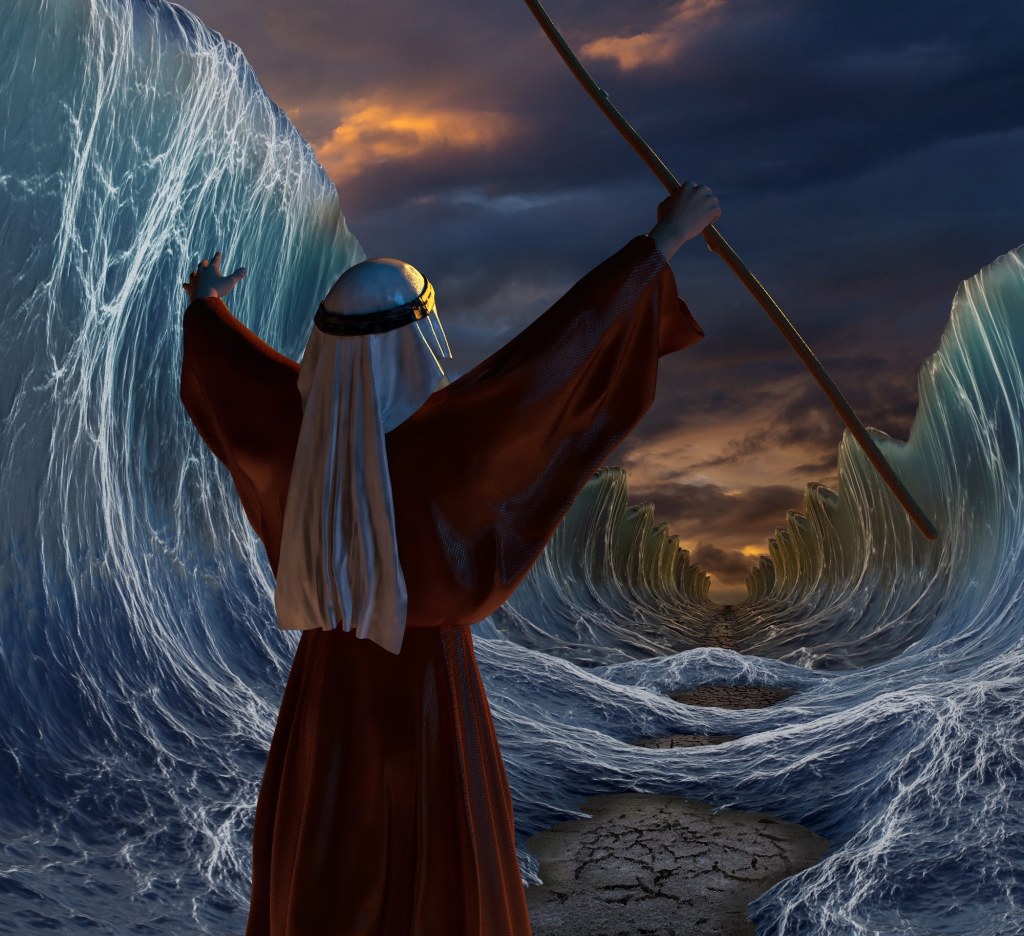
“Tell the children of Israel to go forward. But lift up your rod, and stretch out your hand over the sea and divide it. And the children of Israel shall go on dry ground through the midst of the sea.”
Regarding God’s hardening of the hearts of the Egyptians, and gaining honor over Pharaoh and over all his military might, Matthew Henry writes:
“It is a righteous thing with God to put those under the impressions of His wrath who have long resisted the influences of His grace.”
It is spoken in a way of triumph over this obstinate and presumptuous rebel.
14:19–28 The Angel of God took His place as a pillar of cloud at the rear of the host of Israel, protecting them from the Egyptians.
The pillar of cloud provided light for the Israelites and darkness for the Egyptians.
At Moses’ bidding the Red Sea parted, forming two walls of water with a path of dry land between.
The Israelites passed through safely, but when Pharaoh’s army tried to follow, the LORD … troubled them and disabled their chariots so that they drove them with difficulty.
Before they could retreat, the sea closed in on them at Moses’ command.
Not so much as one of them remained.
The same faith that opened up the Red Sea enables us to do the impossible when we are moving forward in the will of God.
14:29–31 The crossing of the Red Sea is set forth as the greatest display of God’s power in the OT, but the greatest power of all time is that which raised Christ from the dead.
Note that the same Pharaoh who had said that Moses would never again see his face and live (see 10:28) now asked for Moses to come and see him.
Just as God had predicted, Pharaoh then ordered the Israelites to leave his land.
Israel . . . believed in the LORD.
The same wording is used of Abraham’s saving faith in Genesis 15:6 (see also Ro 4).
The people were transformed spiritually even as they were delivered physically.
Pharaoh implicitly recognized the Lord’s power as he asked Moses to bless him.
However he never formally admitted that the Lord is God and that he, Pharaoh, was not.
Life Application Do you sometimes get impatient with God when He takes you the longer route?
Accept the path He has placed you on and be content with God’s purpose in your life.
Encourage others who are dissatisfied in their own circumstances to do the same—even if it all seems wet and wild right now!
Remember that God oversees and knows of every detail in our life – and that includes The Good, The Bad and The Ugly!
And His promise, in Romans 8:28, is that He will work EVERY DETAIL together for our good, to all those who love Him and are called according to His purpose.
SELAH (let us pause and calmly think about these things) _________________________________
Tuesday, June 13, 2023 Worthy Brief
BEHOLD THE GOD OF BREAD AND WAR!
“The LORD will fight for you, and you have only to be silent.” — Exodus 14:14
The Hebrew language contains numerous words that have the same root yet vast differences in meaning.
On deeper examination however, these words can be related in illuminating ways.
For example, the three Hebrew letters –“Lamed”, “Chet”, and “Mem”– which spell, “lechem”, or “bread” in English, are also the root letters for “fight” (lehilachem) and “war” (milchama).
For centuries Rabbis have discussed and debated the connection between these three words.
Some Rabbis wrote that ancient wars were primarily fought over bread (economic/sustenance).
Others wrote that in order to make bread, you have to beat or kneed the dough.
Still others suggested that man first has to sweat and struggle for his daily bread from the ground [Genesis 3:19], and then again, struggle with his fellow man to keep it.
These explanations begin to establish a possible connection…
Interestingly, the book of Exodus contains these root-related words within a span of three chapters.
As the children of Israel were leaving Egypt they found themselves surrounded, with the Red Sea before them and the army of Egypt behind.
At this critical point Exodus 14:14 declares,
“YHVH will fight for you (yilachem lachem); and you will be silent.”
Then, Moses and Miriam’s victory song in chapter 15 exults,
“YHVH is a man of war,” “YHVH Milchama.”
Further on in Exodus 16, we read that God provided bread (lechem) from heaven!
We can begin to observe that the root letters of words in the Hebrew language are not haphazard or accidental.
And while it may seem obscure, what we find in these chapters in Exodus, words derived from the the same root,
(“lamed”, “chet”, “mem”) actually foreshadow a New Testament reality in the life, identity and work of Yeshua the Messiah, who is the perfect image and expression of YHVH.
John 6:48 reveals Yeshua’s (Jesus’) identity as our bread (“lechem”) of life; then, Revelation 19:11 reveals a “rider… called Faithful and True.
With justice he judges and wages war (milchama”).
Know that the Lord has you covered in every way!
He is the one who FIGHTS for you, and the one who PROVIDES for your every need.
The “root connection” between these two words can be no accident when we realize that the Living Word Himself gave them as a testimony to these essential aspects of His love and care for us.
Your family in the Lord with much agape love,
George, Baht Rivka, Obadiah and Elianna (Dallas, TX) (Oklahoma City, Oklahoma) ____
Jesus Prays in Gethsemane 36 Then Jesus *came with them to a place called Gethsemane, and *said to His disciples,
“Sit here while I go over there and pray.”
37 And He took with Him Peter and the two sons of Zebedee, and began to be grieved and distressed.
38 Then He *said to them, “My soul is deeply grieved, to the point of death; remain here and keep watch with Me.”
39 And He went a little beyond them, and fell on His face and prayed, saying, “My Father, if it is possible, let this cup pass from Me; yet not as I will, but as You will.”
40 And He *came to the disciples and *found them sleeping, and *said to Peter,
“So, you men could not keep watch with Me for one hour?
41 Keep watching and praying that you may not enter into temptation; the spirit is willing, but the flesh is weak.”
42 He went away again a second time and prayed, saying,
“My Father, if this cannot pass away unless I drink it, Your will be done.”
43 And again He came and found them sleeping, for their eyes were heavy.
44 And He left them again, and went away and prayed a third time, saying the same thing once more.
45 Then He *came to the disciples and *said to them,
“Are you still sleeping and resting? Behold, the hour is at hand and the Son of Man is being betrayed into the hands of sinners. 46 Get up, let us go; behold, the one who betrays Me is at hand!” ____
No one can approach this account of the Garden of Gethsemane without realizing that he is walking on holy ground.
Anyone who attempts to comment on it feels a tremendous sense of awe and reticence.
As Guy King wrote, “The supernal character of the event causes one to fear lest one should in any way spoil it by touching it.”
26:36–38 After entering Gethsemane (meaning olive vat or olive press), Jesus told eight of the eleven disciples with Him to sit and wait, then took Peter and the two sons of Zebedee deeper into the garden.
Might this suggest that different disciples have different capacities for empathizing with the Savior in His agony?
He began to be sorrowful and deeply distressed.
He frankly told Peter, James, and John that His soul was exceedingly sorrowful, even to death.
This was doubtless the unspeakable revulsion of His holy soul as He anticipated becoming a sin-offering for us.
We who are sinful cannot conceive what it meant to Him, the Sinless One, to be made sin for us (2 Cor. 5:21).
26:39 It is not surprising that He left the three and went a little farther into the garden.
No one else could share His suffering or pray His prayer:
“O My Father, if it is possible, let this cup pass from Me; nevertheless, not as I will, but as You will.”
Lest we think this prayer expressed reluctance or a desire to turn back, we should remember His words in John 12:27, 28:
“Now My soul is troubled, and what shall I say? ‘Father, save Me from this hour?’ But for this purpose I came to this hour. Father, glorify Your name.”
Therefore, in praying that the cup might pass from Him, He was not asking to be delivered from going to the cross.
That was the very purpose of His coming into the world!
The prayer was rhetorical, that is, it was not intended to elicit an answer but to teach us a lesson.
Jesus was saying in effect, “My Father, if there is any other way by which ungodly sinners can be saved than by My going to the cross, reveal that way now!
But in all of this, I want it known that I desire nothing contrary to Your will.”
What was the answer? There was none; the heavens were silent.
By this eloquent silence we know that there was no other way for God to justify guilty sinners than for Christ, the sinless Savior, to die as our Substitute.
26:40, 41 Returning to the disciples, He found them sleeping.
Their spirits were willing; their flesh was weak.
We dare not condemn them when we think of our own prayer lives; we sleep better than we pray, and our minds wander when they should be watching.
How often the Lord has to say to us as He said to Peter,
“Could you not watch with Me one hour? Watch and pray, lest you enter into temptation.”
26:42 Again, a second time, He went away and prayed, expressing submission to the Father’s will.
He would drink the cup of suffering and death to the dregs.
He was necessarily alone in His prayer life.
He taught the disciples to pray, and He prayed in their presence, but He never prayed with them.
The uniqueness of His Person and work precluded others from sharing in His prayer life.
26:43–45 When He came to the disciples the second time, they were asleep again.
Likewise the third time: He prayed, they slept.
It was then He said to them,
“Are you still sleeping and resting? Behold, the hour is at hand, and the Son of Man is being betrayed into the hands of sinners.”
26:46 The opportunity of watching with Him in His vigil was gone.
The footsteps of the traitor were already audible.
Jesus said, “Rise, let us be going”—not in retreat but to face the foe.
Before we leave the garden, let us pause once more to hear His sobs, to ponder His sorrow, and to thank Him with all our hearts.
Do you really want to follow Christ’s example by doing the will of the Father?
Are you ready and willing to submit your plans, thoughts, and behavior to Him?
If submitting is difficult for you in a particular area, pray specifically that God will help you.
_______________________________________
Tuesday, June 06 Streams in the Desert by L. B. Cowman
“Watch and pray so that you will not fall into temptation.” — Matthew 26:41
Dear friend, never go out into the danger of the world without praying first.
There is always a temptation to shorten your time in prayer.
After a difficult day of work, when you kneel at night to pray with tired eyes, do not use your drowsiness as an excuse to resign yourself to early rest.
Then when the morning breaks and you realize you have overslept, resist the temptation to skip your early devotion or to hurry through it.
Once again, you have not taken the time to “watch and pray.”
Your alertness has been sacrificed, and I firmly believe there will be irreparable damage.
You have failed to pray, and you will suffer as a result.
Temptations are waiting to confront you, and you are not prepared to withstand them.
Within your soul you have a sense of guilt, and you seem to be lingering some distance from God.
It certainly is no coincidence that you tend to fall short of your responsibilities on those days when you have allowed your weariness to interfere with your prayer life.
When we give in to laziness, moments of prayer that are missed can never be redeemed.
“We may learn from the experience, but we will miss the rich freshness and strength that would have been imparted during those moments.” (Frederick William Robertson)
Jesus, the omnipotent Son of God, felt it necessary to rise each morning before dawn to pour out His heart to His Father in prayer.
Should we not feel even more compelled to pray to Him who is the giver of “every good and perfect gift” (James 1:17) and who has promised to provide whatever we need?
We do not know all that Jesus gained from His time in prayer, but we do know this—a life without prayer is a powerless life.
It may be a life filled with a great deal of activity and noise, but it will be far removed from Him who day and night prayed to God. selected
[Lettie B. Cowman worked as a pioneer missionary with her husband in Japan and China from 1901 to 1917, during which time they helped found the Oriental Missionary Society.] ____
SELAH (let us pause and calmly think about these things)
“Faith is action that we take, based upon our belief in God and the TRUTH of His Word, which action is sustained by confidence that when God promises something, God is well able to perform what He promises and that He will keep ALL of His promises.”
We’re told in Isaiah 55:10-11 (New King James Version)”
10 “For as the rain comes down, and the snow from heaven, And do not return there, But water the earth, And make it bring forth and bud, That it may give seed to the sower And bread to the eater,
11 So shall My word be that goes forth from My mouth; It shall not return to Me void, But it shall accomplish what I please, And it shall prosper in the thing for which I sent it.
The Bible speaks of Abraham as the father of faith…
In Romans 4, speaking of Abraham who was called the father of faith, starting in verse 13 to 23, we read (NLT) :
13 Clearly, God’s promise to give the whole earth to Abraham and his descendants was based not on his obedience to God’s law, but on a right relationship with God that comes by faith.
14 If God’s promise is only for those who obey the law, then faith is not necessary and the promise is pointless.
15 For the law always brings punishment on those who try to obey it. (The only way to avoid breaking the law is to have no law to break!)
16 So the promise is received by faith. It is given as a free gift. And we are all certain to receive it, whether or not we live according to the law of Moses, if we have faith like Abraham’s.
For Abraham is the father of ALL who believe.
17 That is what the Scriptures mean when God told him,
“I have made you the father of many nations.”
This happened because Abraham believed in the God who brings the dead back to life and who creates new things out of nothing.
18 Even when there was no reason for hope, Abraham kept hoping—believing that he would become the father of many nations.
For God had said to him,
“That’s how many descendants you will have!”
19 And Abraham’s faith did not weaken, even though, at about 100 years of age, he figured his body was as good as dead—and so was Sarah’s womb.
20 Abraham never wavered in believing God’s promise.
In fact, his faith grew stronger, and in this he brought glory to God.
21 He was fully convinced that God is able to do whatever He promises.
22 And because of Abraham’s faith, God counted him as righteous.
23 And when God counted him as righteous, it wasn’t just for Abraham’s benefit. It was recorded 24 for our benefit, too, assuring us that God will also count us as righteous if we believe in Him, the one who raised Jesus our Lord from the dead.
In the spirit and in God’s economy many things have to be believed first, in order to be seen.
SELAH (let us pause and calmly think about these things) ________________________________
Friday, May 26 God At Eventide by Two Listeners
A DAY AT A TIME
The problems of tomorrow cannot be solved without the experience of today.
There is a plan for your lives dependent upon the faithful work of each day.
You frustrate that plan if you leave today’s task incomplete, while you bestir and fret yourself over tomorrow’s happenings.
You will never learn the Law of Supply if you do this, and the learning of that Law is the lesson for now.
Now unto Him who is able to keep you from stumbling, and to make you stand in the presence of His glory blameless with great joy, to the only God our Savior, through Jesus Christ our Lord, be glory, majesty, dominion and authority, before all time and now and forever. Amen. (Jude 1:24-25) ____








 SB SALT AND LIGHT MINISTRIES