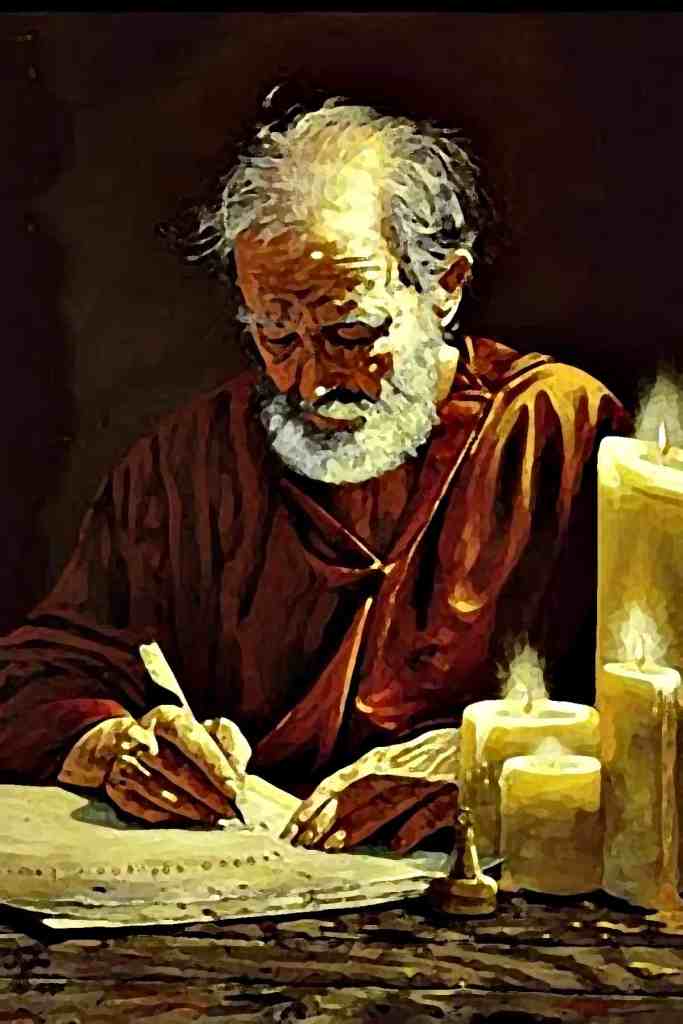
Belief in the Lord Jesus Christ is the ONLY condition necessary for salvation… 

As the Apostle Paul said to the jailer, in Acts 16:31, when he kept him from committing suicide…

“Believe on the Lord Jesus Christ, and you will be saved, you and your household.”

Read Acts 16

Here’s the backstory

This is Paul’s Second Missionary Journey (49-52 A.D.) as recorded in Acts 15:30 – 18:21.

Paul is accompanied by Silas (15:37-38), and they are later joined by young Mark (16:1).

Because of the “we” passages in 16:10-16, some scholars believe that Luke (the author of this book) is also part of Paul’s party.

This missionary journey has taken Paul from Jerusalem north to Antioch of Syria and then westwards through the interior of Asia Minor (modern-day Turkey).

A vision of a man from Macedonia (modern-day Greece) caused Paul and Silas to cross the Aegean Sea to go there (16:9-12).

This introduced the Gospel to the continent of Europe for the first time (Turkey is in Asia and Greece is in Europe).

Paul and his companions found a “place of prayer” outside the city of Philippi on the sabbath (16:13).

They met Lydia, a seller of purple, there, and baptized her and her family (16:11-15).

Lydia, a seller of purple (and probably affluent), offered them the hospitality of her home, which they accepted (16:15).

As the story continues, the disciples are still in Philippi, where they will be for the balance of chapter 16.

This chapter records Paul’s encounter with Lydia, the successful businesswoman (16:11-15) and his encounter with a slave-girl (16:16-18) ­—women from opposite ends of the social and economic scale.

It also records the conversion of a Roman jailer and his household (16:29-34), demonstrating the ability of the Gospel to penetrate into the hearts of people from all walks of life.

These three recipients of Paul’s ministry (Lydia, the slave-girl, and the Roman jailer) “epitomized all whom the Jews held in contempt—women, slaves, and Gentiles.”

In verses 20- 24 we read that after having been beaten by the local authorities, Paul and Silas were thrown into a dungeon.

But instead of murmuring and complaining about their situation, Paul and Silas instead went on the offensive:

“But about midnight Paul and Silas were praying and singing hymns to God” (v. 25a).

At midnight, the darkness would be all-encompassing.

Luke gives us no information concerning the content of these prayers, but the hymn-singing makes it clear that Paul and Silas are anything but depressed, defeated prisoners.

It seems likely that their prayers are prayers of praise and petitions for guidance rather than prayers for release.

“and the prisoners were listening to them” (v. 25b).

Some of these prisoners have probably spent many days in this terrible place, and this would surely be the first time that they have heard anyone praying and singing hymns.

The actions of Paul and Silas, therefore, constitute a powerful witness to the rest of the prisoners.

“Suddenly there was a great earthquake, so that the foundations of the prison were shaken” (v. 26a).

Philippi is in a seismically active area, so it would not be unusual to experience an earthquake there—although an earthquake this violent would be unusual.

“and immediately all the doors were opened, and everyone’s bonds were loosened” (v. 26b).

This is the point.

Using an earthquake for His purposes, God opens the prison doors and unfastens the prisoners’ chains so that Paul and Silas are free to escape.

Luke has told us about two occasions in the past when God opened prison doors, allowing disciples to escape.

In the first instance, Peter and other disciples were healing large numbers of people in the temple when the high priest had the disciples arrested and put in public prison.

“But during the night an angel of the Lord opened the prison doors, brought them out, and said, ‘Go stand and speak in the temple to the people all the words of this life’” (5:20).

In the second instance, Herod arrested Peter “and delivered him to four squads of four soldiers each to guard him” (12:4)—an extraordinary measure of security.

However, even though Peter was bound with chains and sleeping between two soldiers, an angel freed him (12:6-11).

These stories are intended to show that even powerful men, using their utmost to stifle the Gospel, cannot defeat the people whom God has sent to proclaim the Gospel.

“The jailer, being roused out of sleep and seeing the prison doors open, drew his sword and was about to kill himself, supposing that the prisoners had escaped”

(v. 27). It might seem odd that this jailer did not examine the cells carefully before deciding to kill himself, but people under great stress often panic—and this jailer is certainly panicked.

When the angel delivered Peter from prison in an earlier instance, Herod executed the guards for dereliction of duty (12:19).

In this latest instance, the jailer knows that his life is forfeit if even one prisoner has escaped—and all the prison doors are open, so surely more than one prisoner has escaped.

There is another reason, too, why the jailer would contemplate suicide.

Not only can he expect to be killed if a prisoner has escaped, but he will also be humiliated before his peers, who will carry out his execution.

Very often, fear of humiliation is a significant factor in suicide.

“But Paul cried with a loud voice, saying, ‘Don’t harm yourself, for we are all here“‘ (v. 28).

Not only have Paul and Silas remained in prison, but the other prisoners have done the same.

Perhaps God caused the prisoners to delay their escape.

Perhaps Paul and Silas persuaded them to stay.

Paul understands the pressure that the jailer is under and the possibility that he will commit suicide.

He calls out to reassure the jailer that all the prisoners are still present.

The miracle that God has worked is not just for the deliverance of Paul and Silas, but also for the deliverance of the jailer.

“He called for lights and sprang in, and, fell down trembling before Paul and Silas” (v. 29).

The jailer understands that Paul has saved his life, so he falls down before them—signaling his obeisance.

“and brought them out” (v. 30). A lesser manuscript (known as the Western text of Acts) says that the jailer secured the other prisoners before bringing Paul and Silas outside, but the better manuscripts say nothing about this.

“Sirs, what must I do to be saved?” (v. 30).

The jailer’s panic and his relief on discovering that the prisoners are still present has made him receptive to guidance from Paul and Silas, whom he surely regards as his saviors in this present crisis.

The jailer’s question reminds us of the people’s response to Peter’s sermon at Pentecost, where they asked, “Brothers, what shall we do?” (2:37).

The jailer’s question can be understood on two levels.

He could be asking what he must do to be saved from execution by the authorities.

But, as we will see in the next verse, Paul and Silas hear the jailer’s question as having to do with his eternal salvation.

“Believe in the Lord Jesus Christ, and you will be saved” (v. 31).

Paul and Silas use the jailer’s question as an opportunity to proclaim the Gospel to him.

This verse probably summarizes a longer proclamation. It is similar to Peter’s salvation formula at Pentecost, “Repent, and be baptized, every one of you, in the name of Jesus Christ for the forgiveness of sins, and you will receive the gift of the Holy Spirit” (2:38).

“you and your household” (v. 31a).

Paul and Silas make it clear to the jailer that his household can enjoy the same salvation that they are offering him.

“They spoke the word of the Lord to him, and to all who were in his house” (v. 32).

The proclamation of the Gospel continues, this time to the jailer and “all who were in his house”—his family and possibly servants as well.

Luke has already told us about the baptism of Cornelius and all those who were with him (10:44-48) and of Lydia and her household (16:15).

“He took them the same hour of the night, and washed their stripes, and was immediately baptized, he and all his household” (v. 33).

The jailer demonstrates his new faith by taking care of their wounds and by being baptized.

His family is also baptized, in keeping with a tradition that the head of a family can make a decision that is binding on the whole family.

Then it says, “He brought them up into his house, and set food before them, and rejoiced greatly, with all his household, having believed in God” (v. 34).

Like Lydia earlier (v. 15), these new converts extend genuine hospitality to Paul and Silas.

The message here is for us to allow God to use the leaven of our faith, to spread the Good News of the Gospel to our entire house.

SELAH (let us pause and calmly think about these things)
_________________________________

Tuesday, May 23
The Spirit Filled Believer
by Dick Mills

“Salvation for You and Your Household
Tell your children about it, let your children tell their children, and their children another generation.”
— Joel 1:3

Here is a word covering four generations, from us to our children, to our grandchildren, to our great-grandchildren.

It is a blessed word showing how the truth of God’s Word can remain in a family for a long, long time.

In Deuteronomy 5:9, Moses stated that the sins of the fathers would be passed down through the family to the third and fourth generation.

This verse in Joel is a positive assurance that the blessing of the Lord will also reach to the fourth generation.

It might be that very few people who read this message are great-grandparents. (My wife and I don’t even come that close.)

However, despite our age or situation, there is a resident truth in Joel 1:3 for each of us.

Your Family is Included

The truth is that our family is included in the promises of salvation.

Again and again we read in Scripture the familiar phrase, “you and all your household.”

Truth resident in one’s life has the potential for spreading through a family, and even through a whole family tree.

If you happen to be the only one in your family serving the Lord, rejoice!

The Lord has chosen you to introduce salvation to all your loved ones.

A little leaven leavens the whole lump (Gal. 5:9). You will live to see your entire family serving the Lord.

It’s just a matter of time!

(Source: The Spirit-Filled Believer’s Daily Devotional by Dick Mills)
____

Come join the Adventure!

Skip 🕊️

God always finishes what He starts…

The Lord tells us exactly what to do when our nation is being flooded with evil:

2 Chronicles 7:14

Expanded Bible

“Then if My people, who ·are called by My name [belong to Me], will humble themselves, if they will pray and seek ·Me [My face] and stop their evil ways, I will hear them from heaven. I will forgive their sin, and I will ·heal [restore] their land.”

When we FAITHFULLY do our part, God always does His!

ISN – It’s Supernatural Network

“I Saw Jesus Say THIS WORD Over America!”

Bonnie Chavda was taken into a heavenly vision atop Mt. Rushmore, where she saw Jesus say this power word over America

Come join the Adventure!

Skip 🕊️

Interesting message for the last days…

Jesus told John to write a letter to His people in seven churches in Asia…

Each message has the same six parts:

1. Jesus says the name of each church,

2. Jesus tells each church what it is doing right or wrong,

3. Jesus tells each church what to do to fix its problems,

4. Jesus tells the churches to obey the Holy Spirit, and

5. Jesus makes promises to His people who win the war against sin.

The seven churches are believed to represent seven church ages or types that have existed since the church began and will exist until Christ returns.

6. Each of the seven letters is a prophetic word from Jesus, through the Spirit, who is inspiring John to write.

The seven churches are Ephesus, Smyrna, Pergamos, Thyatira, Thaddeus, and Laodicea.

____

Wednesday, May 10
Forerunner “Bible Study”

The Seven Churches (Part One)
by Richard T. Ritenbaugh

The letters to the seven churches of Revelation 2-3 have been the subject of much debate, both in secular commentaries and God’s church.

Were they only historical churches along a Roman mail route with no present-day significance?

Should we understand them prophetically as successive church eras from the first century to the present?

Does the Bible provide any evidence that all seven might exist together in the end-time—right now—just as they did in the apostle John’s day?

Could they describe attitudes present within the church at any time during its history?

Within these short epistles, the glorified Jesus Christ gives each of the seven churches specific instructions to overcome.

In this initial study, we will examine the time element of the seven churches, and in future issues, we will analyze Christ’s message to each church individually.

1. How does the book of Revelation view the seven churches?

Does it recognize that they have future meaning as types of the end-time church? (Revelation 1:4, 7, 10, 19; 22:7, 10, 16)

Comment: Granted, Christ specifically addresses the book of Revelation to the seven churches in Asia.

However, it is essential to note that the introductory chapter places it in the context of the Day of the Lord and Christ’s return.

The visions John sees are of “things which are, and . . . will take place after this” (Revelation 1:19).

Since the Day of the Lord is yet to occur, we can conclude the seven messages are spiritually valid not only for John’s day but also for ours.

Revelation 22 accents this by declaring that Jesus’ servants would teach this prophecy in the churches until He returns.

2. Do the seven churches exist successively—as eras—from the days of the apostles to Christ’s return?

Comment: Though history and experience of the modern church of God indicates such a partial fulfillment, no internal evidence from the Bible supports this concept. We will cover this possibility in greater detail in Part Two.

3. Does internal evidence suggest another type of fulfillment? Do all seven churches exist concurrently at the end? Revelation 2-3.

Comment: Notice these intriguing facts:

» Grammatically, Jesus presents His seven messages as if the churches exist simultaneously.

» Jesus ends each of the letters with, “He who has an ear, let him hear what the Spirit says to the churches,” plural (emphasis ours throughout).

» In Revelation 2:23, addressed specifically to Thyatira, Christ says that, by what happens to her, “all the churches shall know” He is the Judge and Head of the church.

Every church must exist concurrently with her to observe her calamity—especially those that had supposedly preceded her.

» The epistles’ language indicates an end-time frame of reference:

To Ephesus and Pergamos, He says He will “come to [them] quickly.”

To Thyatira, He will “cast her into great tribulation,” and her faithful should “hold fast . . . till I come” and “[keep] My works to the end.”

To Sardis, He will “come . . . as a thief” (see Matthew 24:43).

To Philadelphia, He mentions “the hour of trial” and “I come quickly.”

To Laodicea, He says they will be “tried in the fire,” a symbol of tribulation, and He “[stands] at the door,” indicating immediacy.

4. Could the church’s scattering into many small groups imply all seven churches currently exist? Leviticus 26:14-16, 33; Zechariah 4:2-4, 11-14; Revelation 1:12, 20.

Comment: The sins, lacks, and needs of each give the seven churches distinct personalities and attitudes.

All the problems Jesus describes exist in the various branches of the church today.

Remember, Christ addresses them individually, but advises all “the churches” to heed His advice.

The parallel prophecies of Zechariah 4 and Revelation 1 show the seven churches, distinct but existing together, at the time of the Two Witnesses.

5. Are the messages relevant to us individually? Revelation 2:7, 11, 17, 26-29; 3:5-6, 12-13, 21-22; II Timothy 3:16.

Comment: If we compare these seven brief messages to the epistles of Paul, who also wrote extensively to various churches around the Mediterranean Sea, we can see a great deal of similarity.

Paul’s letters address each church’s strengths and weaknesses, providing criticism, exhortation, and encouragement to help the members of those congregations overcome and prepare for Christ’s return.

Jesus’ epistles in Revelation 2-3 perform the same task—except that it is the awesome, glorified Judge and High Priest who is writing personally to His churches to get them ready for the Kingdom of God! Time is short!

A careful, humble self-examination will reveal that each of us has, to some degree, every problem described in every message.

All seven messages apply—today—to us, the elect of God in the end time.

As we overcome, grow, and mature—as we become more like Christ—we should see less and less of each negative point in ourselves.

Christ’s advice to all seven is the same:

Overcome!

If we heed His counsel, we will avoid the threatened judgments and receive the magnificent rewards He offers.

SELAH (let us pause and calmly think about these things)
____

Come join the Adventure!

Skip 🕊️

Those whom God calls, He enables to do the assignment He has called them to perform…

The Call of Moses (Ex. 3, 4)…

Exodus 3:1-12
New Living Translation

Moses and the Burning Bush
3 One day Moses was tending the flock of his father-in-law, Jethro, the priest of Midian.

He led the flock far into the wilderness and came to Sinai, the mountain of God.

2 There the angel of the Lord appeared to him in a blazing fire from the middle of a bush.

Moses stared in amazement. Though the bush was engulfed in flames, it didn’t burn up.

3 “This is amazing,” Moses said to himself. “Why isn’t that bush burning up?

I must go see it.”

4 When the Lord saw Moses coming to take a closer look, God called to him from the middle of the bush, “Moses! Moses!”

“Here I am!” Moses replied.

5 “Do not come any closer,” the Lord warned.

“Take off your sandals, for you are standing on holy ground.

6 I am the God of your father—the God of Abraham, the God of Isaac, and the God of Jacob.”

When Moses heard this, he covered his face because he was afraid to look at God.

7 Then the Lord told him, “I have certainly seen the oppression of my people in Egypt.

I have heard their cries of distress because of their harsh slave drivers.

Yes, I am aware of their suffering. 8 So I have come down to rescue them from the power of the Egyptians and lead them out of Egypt into their own fertile and spacious land.

It is a land flowing with milk and honey—the land where the Canaanites, Hittites, Amorites, Perizzites, Hivites, and Jebusites now live.

9 Look! The cry of the people of Israel has reached me, and I have seen how harshly the Egyptians abuse them.

10 Now go, for I am sending you to Pharaoh. You must lead my people Israel out of Egypt.”

11 But Moses protested to God, “Who am I to appear before Pharaoh? Who am I to lead the people of Israel out of Egypt?”

12 God answered, “I will be with you. And this is your sign that I am the one who has sent you:

When you have brought the people out of Egypt, you will worship God at this very mountain.”

The Revelation of Jehovah to Moses

3:1–4 In tending the flock of Jethro, Moses learned valuable lessons about leading God’s people.

When he went to Horeb (Mount Sinai), the Lord appeared to him in a bush that burned with fire but … was not consumed.

The bush suggests the glory of God, before which he was told to stand with unshod feet.

It might also foreshadow Jehovah’s dwelling in the midst of His people without their being consumed.

And some have even seen in it the destiny of Israel, tried in the fires of affliction but not consumed.

We also should all be like the burning … bush—burning for God, yet not consumed.

3:5 The Lord promised Moses that He would deliver His people from Egypt and bring them into a land of abundance—that is, Canaan—inhabited by the six heathen nations listed in verse 8.

The word “holy” occurs here for the first time in the Bible.

By removing his sandals, Moses acknowledged that the place was holy.

3:6 God reassures Moses that He is the God of his forefathers—Abraham and Isaac and Jacob.

And these verses, Moses brings no new or unknown god to his people, but a fuller revelation of the One whom they have known.

Not even Paul’s words to the Athenians on the Areopagus are a fair parallel here (Acts 17:23).

The only true parallel is the continuing Self-revelation made by God in later centuries, culminating in the coming of Christ.

Yet in its day the Mosaic revelation, while a fulfilment of patriarchal promises, was as new and shattering to Israel as the coming of the Messiah was later to prove to be.

3:7–12 Moses protested God’s sending him to Pharaoh, citing his own inadequacy.

But the Lord assured Moses of His presence and promised that he would yet serve God on this mountain (Mount Sinai) with a liberated people.

Moses’ inventory of his disqualifications covered,

~ lack of capability (3:11),

~ lack of special adaptation (4:13),

~ lack of message (3:13),

~ lack of.authority (4:1),

~ lack of eloquence (4:10),

~ lack of previous success (5:23),

~ lack of previous acceptance (6:12).

A more complete list of disabilities would be difficult to conjure up.

But instead of pleasing God, his seeming humility and reluctance stirred His anger.

“The anger of the Lord was kindled against Moses” (4:14).

In point of fact, the excuses Moses advanced to show his incapacity were the very reasons for God’s selection of him for the task.

Moses made excuses because he felt inadequate for the job God asked him to do.

It was natural for him to feel that way. He was inadequate all by himself.

But God wasn’t asking Moses to work alone. He offered other resources to help (God himself, Aaron, and the ability to do miracles).

When God calls us to tasks that seem too difficult, he doesn’t ask us to do them alone.

God offers us His resources, just as He did to Moses.

We should not hide behind our inadequacies, as Moses tried to do, but look beyond ourselves to the great resources available.

Then we can allow God to use our unique contributions.

Jesus tells us in the New Testament that our God given assignment, in life, is to learn to cooperate with Him, with the help of the Holy Spirit, who now lives within us.

By our putting on the Yoke of God, Jesus helps us navigate through ALL of our trials and tribulations, and He does so by carrying the bulk of the weight.

Our job is to take the yoke upon us and learn of Him, by learning His ways.

Matthew 11:28-30
New King James Version

28 Come to Me, all you who labor and are heavy laden, and I will give you rest.

29 Take My yoke upon you and learn from Me, for I am gentle and lowly in heart, and you will find rest for your souls.

30 For My yoke is easy and My burden is light.”

SELAH (let us pause and calmly think about these things)
________________________________


Saturday, May 6
The Berean
Daily Verse and Comment

Exodus 3:10-11

10 “Come now, therefore, and I will send you to Pharaoh that you may bring My people, the children of Israel, out of Egypt.”

11 But Moses said to God, “Who am I that I should go to Pharaoh, and that I should bring the children of Israel out of Egypt?”
____

The time had come. Previously, Moses thought he was ready, and he impetuously promoted himself to do the job. He did it without waiting for God.

Look at the difference:

Before, Moses promoted himself, but now he says, “God, who am I?”

What a change took place in his thinking!

He not only hesitated about going, but he almost seems petrified about the prospects of going.

This is a true principle of those who have been humbled in their field of expertise.

The young foolishly think, in their vanity, that their strength will allow them to sail through any problem.

They are deceived by their own ignorance.

Like Moses, they foolishly rush in where angels fear to tread.

When they come to understand, usually after years of experience, they realize how very little they know.

This principle is clearly shown in the way a student of science might be humbled.

He may have graduated from high school, then from college, and may have even obtained a master’s degree and now works on a doctorate.

He has learned a great deal. However, after maybe twenty years of experience in the field of chemistry or biology, he realizes there is a great deal more that he does not know, more than his accumulation of schooling and experience.

If he is a Christian, he begins to see God’s creation and the Creator’s mind in a much different light.

That is what has happened to Moses.

In those forty years, his impetuous spirit had been dissolved, and he saw the power of Egypt in its true light.

He may have feared execution, imprisonment, or embarrassment by the powerful Egyptians.

Does this not encumber and constrain us as well?

We worry and fear that we will look foolish before friends and relatives if we obey God—if we keep the Sabbath or tithe.

How many of our relatives have castigated us because of tithing?

It seems awfully dumb to them, but how do we feel?

Do we fear what they think?

Moses more fully recognizes his weaknesses in comparison to Egypt, and he quails at the thought.

God has to overcome Moses’ resistance.

What a change! Moses was going to do it on his own before, but God now has to overcome his resistance.

All of the testing God had put Moses through produces right faith and right conviction.

— John W. Ritenbaugh
____

Come join the Adventure!

Skip 🕊️

The safest place for any of us to be is in God’s perfect will…

We each have to learn to trust God’s timing and His plan for our life…

God told Jeremiah…

“I knew you before I formed you in your mother’s womb. Before you were born I set you apart and appointed you as my prophet to the nations.” (Jer 1:5)

Then David says in Psalms 139, verses 15 and 16 (speaking of God our Creator, who is the Author of our lives):

15 “You watched me as I was being formed in utter seclusion,
as I was woven together in the dark of the womb.

16 You saw me before I was born.
Every day of my life was recorded in your book.

Every moment was laid out
before a single day had passed.”

In the New Testament, we read in Paul’s letter to the church at Ephesus:

9 “God has now revealed to us His mysterious will regarding Christ—which is to fulfill His own good plan.

10 And this is the plan: At the right time He will bring everything together under the authority of Christ—everything in heaven and on earth.

11 Furthermore, because we are united with Christ, we have received an inheritance from God, for HE CHOSE US in advance, and He makes EVERYTHING work out according to His plan. (Eph 1:9-11 NLT)

Note that in the New King James Bible it says, in verse 11:

“… (that we having) been predestined according to the purpose of Him who works all things according to the counsel of His will.

And again Paul writes in Romans 8:2830:

28 “And we know that God causes EVERYTHING to work together for the good of those who love God and are called according to His purpose for them.

29 For God knew His people in advance, and He chose them to become like His Son, so that His Son would be the firstborn among many brothers and sisters.

30 And having chosen them, He called them to come to Him. And having called them, He gave them right standing with Himself. And having given them right standing, He gave them His glory.”

This life that we ALL, who are BORN-AGAIN IN CHRIST, are called to live is called LIVING BY FAITH AND NOT BY Sight (2 Cor 5:7)!

This means that God expects EACH OF US to cast the whole of our life and our life’s circumstances on the reliability and trustworthiness of God and His Word

So what does that look like and how do we do that in real life?

The answer to that question is given in Proverbs:

Proverbs 3:5-6
New Living Translation

5 Trust in the Lord with ALL YOUR HEART;
DO NOT depend on your own understanding.

6 Seek His will in all you do,
and He will show you which path to take.

SELAH (let us pause and calmly think about these things)

_________________________________

Monday, May 01
Worthy Brief

DO YOU HAVE A SAFE PLACE?

“The LORD is on my side; I will not fear: what can man do unto me?”
— Psalm 118:6

As some of you may know, a bomb exploded in a bus within blocks of our Jerusalem apartment when we first moved to Israel.

That morning, my wife and I, along with our newborn baby, were heading to the city center to run a few errands when suddenly we heard the explosion.

Within minutes, the sirens were screaming from every part of the city as officials quickly made their way to the scene.

Later that month, the bus I was supposed to be on drove away as I watched it carry away the 50 or so people who would be critically injured and the 8 who would be dead seconds later, when that bus exploded before my very eyes.

So, to put it mildly, we have seen firsthand how terrorism works and how it affects people.

People ask us all the time — “Aren’t you afraid to be living in Israel these days?”

Truth be told, there aren’t too many safe places in this world anymore, are there?

However, there is one very safe place we have found, and it’s the very safest place there is.

You may have heard of it — it’s called “God’s perfect will”.

We should all be striving to make our home there for the rest of our earthly days.

We may be afraid to go to those places or do those things that God may be calling us today.

It could be to share your God-given talents in some far away land, and it could be across the street to help a neighbor.

Whatever the case may be, it’s easy to get wrapped up in other people’s fear, anxiety and criticism.

But we have a choice. We can either give in to those fears or stand for the Lord and choose what he called us to do.

Let’s submit all our fears to the Lord today and choose the latter.

I want to live in the will of God, don’t you?

He will not leave our side when we step forward to do great things for Him!

Your family in the Lord with much agape love,

George, Baht Rivka, Obadiah and Elianna (Going to Christian College in Dallas, Texas)
Arad, Israel
____

Come join the Adventure!

Skip 🕊️

Three Hebrew children face the fiery test of their faith…

God never promises to keep us from the fire, rather He does promise to meet us and go with us through the fires of life (see Isa 43:1-2)...

Daniel’s three friends would rather die than compromise their faith.

Here’s the Backstory


Daniel and His Friends Chosen to Be Court Officials (1:1-7).

In 605 b.c. the Babylonians marched against Judah and besieged Jerusalem.

They took some temple articles to Babylon, as well as some of Judah’s finest young men.

Nebuchadnezzar ordered Ashpenaz, his chief court official, to choose the very best of these men and train them for the king’s service.

Among this group were Daniel, Hananiah, Mishael, and Azariah.

They were given Babylonian names, trained in Babylonian language and literature, and placed on a special diet.

Daniel and His Friends Refuse Unclean Food (1:8-16).

Daniel regarded the food offered by the Babylonians to be defiling.

The Mosaic law forbade God’s people to eat unclean animals or flesh that had not been drained of blood.

Portions of the wine and meat presented by Ashpenaz may have been offered to idols.

Daniel convinced the Babylonians to allow him and his three friends to follow a different diet, consisting only of vegetables and water.

After a ten-day trial period they looked even healthier than those who were following the diet prescribed by the king.

Consequently they were not forced to eat the king’s food or drink his wine.

God Rewards Daniel and His Friends (1:17-21).

In response to Daniel’s and his friends’ faithfulness, the Lord gave them superior intellect and gave Daniel the ability to interpret dreams and visions.

When the king interviewed the trainees, he found Daniel and his friends to be the cream of the crop and appointed them to his service.

Their abilities far surpassed those of the king’s wise men and diviners.

Then comes the real test of their faith…

3:1-18 Nebuchadnezzar made a huge, gold image. The image may have represented his sovereign authority or one of his gods.

The king ordered all of his subjects to attend a dedication ceremony for the image.

At a designated time they were to bow down to the image.

All who refused to worship the image would be thrown into a fiery furnace.

When Daniel’s friends refused to bow down to the image, the angry king gave them an ultimatum and warned them of the consequences of disobedience.

They explained that their loyalty to the Lord prevented them from worshiping images.

They also told the king that the Lord was able to deliver them from the furnace if He so desired.

Daniel’s Friends Delivered from the Furnace (3:19-30).

After ordering the furnace to be heated to its maximum temperature, Nebuchadnezzar had Daniel’s friends tied up and thrown in.

The fire was so hot that its flames killed the soldiers who threw them in.

However, when Nebuchadnezzar looked into the furnace, he saw the three men walking around unbound, accompanied by an angelic being.

When the king ordered them out of the furnace, they were completely unharmed.

Nebuchadnezzar praised the Lord for delivering His faithful servants, decreed that anyone who slandered the Lord be executed, and promoted the three men.

Shadrach, Meshach, and Abednego were ordered to deny God, but they chose to be faithful to Him no matter what happened.

They were confident that God could deliver them, but they were determined to be faithful regardless of the consequences, even if it threatened their personal safety.

Today, many Christians believe that if we just have enough faith, God will protect us, rescue us, or answer our prayers in the way we desire.

But Jesus taught that His followers would often find trouble while in this world for their faithfulness (John 16:33).

Only in heaven, before God, will we finally have complete peace and healing.

Remain faithful as these three men did, and cling to the hope that God will walk with you through the fire.

Our eternal reward will be the confirmation that any suffering we had to endure in this earthly life was worth it.

The enemy is always trying to apply pressure in order to get us to compromise our faith.

These three young Hebrew men made the decision that they would rather die than compromise their faith in God.

What say you?

Are you going to give in to the enemy’s pressure, or are you going to stand on God’s Word and trust Him for whatever the outcome?

Let us always resist the urge to allow the world around us to press us into its mould.

SELAH (let us pause and calmly think about these things)

_________________________________

Saturday, April 29
The Winning Walk
by Dr Ed Young

A HILL WORTH DYING FOR

The sergeant has received his orders. “At any cost, take that hill.” He turns to his men and says, “Check your rifles…affix your bayonets. At my signal we charge and take the hill!”

The men in his company have been in the trenches for days. They’ve seen other men try to take the hill and fail.

They know the enemy is heavily entrenched and determined to hold their ground. And each man, as he waits for the command from his sergeant, is asking himself one question: “Is this a hill worth dying for?”

Those of us who have never been to war cannot completely understand the anguish of such a moment where life hangs in the balance, but we have asked the same question in different, if less threatening, terms.

“Is this principle worth risking my job?”

Or,

“Is this argument worth the damage it might cause in my marriage?”

On what basis do we choose which hills are “worth dying for?”

I believe if we have made the right life commitments, the question answers itself when it arises.

Our problem is we don’t nail down the big questions at the outset, and so we waver on the smaller ones.

The book of Daniel records the story of four young men who were kidnapped and carried into a foreign land.

As the prevailing powers in this new country tried to “assimilate” them, they received a shock!

These young men had made up their minds not to defile themselves or turn their back on their God, so when the questions of diet and prayer practices came up, their decisions were already made.

When we nail down the big choices, the other decisions fall more readily into place.

Memory Verse

Daniel 3:17

“If it be so, our God whom we serve is able to deliver us from the furnace of blazing fire; and he will deliver us out of your hand.”
____

Come join the Adventure!

Skip 🕊️

Do not let the world around you press you into its mould…

Be ye transformed…

We have seen God’s mercy and wisdom: how shall we respond?

“With eyes wide open to the mercies of God, I beg you, my brothers, as an act of intelligent worship, to give Him your bodies, as a living sacrifice, consecrated to Him and acceptable by Him.

Don’t let the world around you squeeze you into its own mould, but let God re-mould your minds from within, so that you may prove in practice that the plan of God for you is good, meets all his demands and moves towards the goal of true maturity.”

— Romans 12:2 (J.B. Phillips New Translation)


Paul appealed for the dedication of the whole of life to God.

The basis of the appeal rested in the mercy of God.

As believers are transformed in their minds and conformed to the image of Christ, they will be able to discern, desire, and approve the will of God.

God’s will is good and holy; it is sufficient for every need.

Only through spiritual renewal can believers do the will of God.

Jesus’ followers must possess a strong passion to honor Him in every aspect of life.

Out of gratitude to God for his mercy and salvation, we should be completely devoted to loving Him, living by His standards and serving His purposes for our lives.

(1) Our goal should be to show God’s holiness (i.e., moral purity, spiritual wholeness, separation from evil and complete dedication to God) in all we do.

This requires separation from the patterns and practices of the world so we can pursue a deeper relationship with God.

As we consider His sacrifice for us, offering ourselves to Him as “living sacrifices” is good and pleasing as our spiritual act of worship (v. 2).

(2) We must offer our bodies to God as dead to sin and alive to God (see 6:11; 8:10, notes on being “dead to sin”) and as the temple of the Holy Spirit (see next note; cf. 1Co 6:15, 19).

(3) We must realize that true godly worship involves a lifestyle that brings honor to Christ in words and actions.

It is not necessarily a great sacrifice to voice our worship to God in a church service where people are gathered for that very purpose (cf. Eph 5:2; Heb 13:15).

Worship becomes a true sacrifice when we take it outside of the church by living in a way that truly honors, exalts and brings positive attention to God.

SELAH (let us pause and calmly think about these things)
____

Come join the Adventure!

Skip 🕊️

Jesus came to set the captives free…

Jesus saves through God’s Amazing Grace… 

Only God has the power to recycle men and women’s lives and to make all things new.

There are two types of people in jail or prison:

1. those who were wrongfully accused and victimized by an unjust system, and

2. those who are guilty and whose punishment is just according to the system of law they have broken.

The Bible has something to say to both the innocent and guilty who are in jail / prison.

To the guilty, the Bible recommends truth and submission to the laws of the government, and it offers freedom from the spiritual prison of sin—freedom that comes through the person of Christ (Romans 6:18).

To the innocent and wrongfully accused, the Bible offers peace, patience, and hope in difficult circumstances, as well as the hope of heavenly reward.

There are also many outside the Prison Walls who are also in a jail of their own making, who are bound by the chains of their own life’s circumstances, the consequences of their upbringing and the mistakes of the past.

2 Corinthians 5:17 says…

Therefore if any man be in Christ, he is a new creature: old things are passed away; behold, all things have become new.
____

When Jesus first started His earthly ministry, in Luke 4:18, He gave us the reason for His God-given mission:

“The Spirit of the LORD is upon Me, Because He has anointed Me To preach the gospel to the poor; He has sent Me to heal the brokenhearted, TO PROCLAIM LIBERTY TO THE CAPTIVES and recovery of sight to the blind, To set at liberty those who are oppressed.”

In the above verse, Jesus boldly announced,

“The Scripture you’ve just heard has been fulfilled this very day!”

Jesus was proclaiming Himself as the Messiah, the one who would bring the Good News to pass, but He would do so in a way that the people were not yet able to grasp.

His neighbors could hardly believe such a remarkable claim.

And yet this is the very reason why the Father sent Jesus to Earth, to pay the penalty for ALL of our SINS, through His propitious sacrificial death on Calvary’s Cross and to bring His lost children home.

No matter how dark your past, or how many grievous sins you may have committed in your life, the promise of the Cross is that Jesus will wipe all your sins away!

Listen to what God is saying to each of us in the following verse:

Isaiah 1:18

“Come now, let us settle the matter,” says the LORD. ‘Though your sins are like scarlet, they shall be as white as snow; though they are red as crimson, they shall be like wool.’ “

All we have to do is repent, renounce our sins and turn back to God; and these are the benefits for all who do, their sins are forgiven, through Jesus’ shed blood on the cross, and God now puts our sins in the deepest part of the ocean, with a sign that says no more fishing!

Psalm 103:1-14

1 Let all that I am praise the Lord;
with my whole heart, I will praise his holy name.

2 Let all that I am praise the Lord;
may I never forget the good things he does for me.

3 He forgives all my sins
and heals all my diseases.

4 He redeems me from death
and crowns me with love and tender mercies.

5 He fills my life with good things.
My youth is renewed like the eagle’s!

6 The Lord gives righteousness
and justice to all who are treated unfairly.

7 He revealed his character to Moses
and his deeds to the people of Israel.

8 The Lord is compassionate and merciful,
slow to get angry and filled with unfailing love.

9 He will not constantly accuse us,
nor remain angry forever.

10 He does not punish us for all our sins;
he does not deal harshly with us, as we deserve.

11 For his unfailing love toward those who fear him
is as great as the height of the heavens above the earth.

12 HE HAS REMOVED OUR SINS AS FAR FROM US
AS THE EAST IS FROM THE WEST.

13 The Lord is like a father to his children,
tender and compassionate TO THOSE WHO FEAR (REVERENCE) HIM.

14 For he knows how weak we are;
he remembers we are only dust.

SELAH (let us pause and calmly think about these things)

_________________________________

Saturday, April 15
The Winning Walk
by Dr Ed Young

KISSED AND TUCKED IN

Bob McAllister met Rusty Wellborn on death row.

Bob was the Assistant to the Governor of South Carolina; Rusty was an inmate.

Bob was a Christian man who routinely visited death row to talk to prisoners. And Rusty was one of the worst.

He had been physically and emotionally abused, and had never known a loving home.

He had been on death row for ten years for a brutal crime spree that involved four murders.

The first few times Bob visited, Rusty never spoke.

He lay curled up on the floor, broken, filthy and unresponsive.

Gradually, Bob got him to talk, and eventually, to read the Bible with him.

Weeks and months passed, but finally God broke through-and Rusty Wellborn received Jesus Christ.

When all appeals for Rusty’s life were exhausted, an execution day was set.

Bob visited him the night before, and Rusty asked him to read from the Bible until he fell asleep.

When Rusty’s breathing was even and his eyes closed, Bob closed the Bible, crept over to Rusty’s bunk, pulled up the blanket and gently kissed him on the cheek.

The next day as he was led to his death, Rusty turned to the guard who was escorting him, and said,

“It’s sad, isn’t it, that a man has to wait until his last night on earth to be kissed and tucked in?”

When we receive Jesus Christ, it is as if we are kissed and tucked in each night by the Holy Spirit.

He watches over us, and makes our sleep sweet. But we are also to “kiss and tuck in” one another-as Bob did for Rusty.

To show the love and compassion of Christ at every opportunity.

Rusty was right: no one should have to wait until his last night on earth to be kissed and tucked in.

Memory Verse

PSALMS 121:3
He will not allow your foot to slip; He who keeps you will not slumber.
____

Come join the Adventure!

Skip 🕊️

“But you will receive POWER when the Holy Spirit has come upon you; and you shall be My witnesses both in Jerusalem, and in all Judea and Samaria, and even to the remotest part of the earth” (Acts 1:8)…

Paul’s Prayer for Power…

In Ephesians chapter 3, Paul informs the Ephesian Christians:

“God has revealed to me a great mystery, namely that both Jews and Gentiles are united as one in the body of Christ, and He has called me to proclaim this message.

For this reason, I pray that you might be strengthened with POWER through His Spirit in the inner man so that you might mature spiritually, be able to comprehend the magnitude of God’s love, and be filled with the fullness of God.”

Ephesians 3:1-21

Paul’s Doxology (An expression of praise to God)

3:20 This prayer closes with a soul-inspiring doxology.

The preceding requests have been vast, bold, and seemingly impossible.

But God is able to do more in this connection than we can ask or think.

The extent of His ability is seen in the manner in which Paul pyramids words to describe superabundant blessings:

• Able
• Able to do
• Able to do what we ask
• Able to do what we think
• Able to do what we ask or think
• Able to do all that we ask or think
• Able to do above all that we ask or think
• Able to do abundantly above all that we ask or think
•Able to do exceedingly abundantly above all that we ask or think

The means by which God answers prayer is given in the expression according to the power that works in us.

This refers to the Holy Spirit, who is constantly at work in our lives, seeking to produce the fruit of a Christlike character, rebuking us because of sin, guiding us in prayer, inspiring us in worship, directing us in service.

The more we are yielded to Him, the greater will be His effectiveness in conforming us to Christ.

SELAH (let us pause and calmly think about these things)
_________________________________


Wednesday, April 12
God Calling
by Two Listeners

GOLDEN OPPORTUNITY

Now unto him that is able to do exceeding abundantly above all that we ask or think, according to the power that worketh in us.
— Ephesians 3:20

I am your Guide. Strength and help will come to you; just trust Me wholly.

Fear not. I am evermore ready to hear than you to ask. Walk in My ways, and know that help will come.

Man’s need is God’s chance to help.

I love to help and save. Man’s need is God’s golden opportunity for him of letting his faith find expression.

That expression of faith is all that God needs to manifest His Power.

Faith is the Key that unlocks the storehouse of God’s resources.

My faithful servants, you long for perfection and see your bitter failures.

I see faithfulness, and as a mother takes the soiled, imperfect work of her child and invests it with perfection because of the sweet love, so I take your poor faithfulness and crown it with perfection.

Now unto Him who is able to keep you from stumbling, and to make you stand in the presence of His glory blameless with great joy, to the only God our Savior, through Jesus Christ our Lord, be glory, majesty, dominion and authority, before all time and now and forever. Amen. Jude 1:24-25
_____

Come join the Adventure!

Skip 🕊️
The Apostle Paul’s life and ministry…

I always enjoy studying the life and ministry of Paul…

The Apostle Paul was truly God’s Champion!

So let’s take a look at Paul’s life and ministry:

Paul the Apostle, original name Saul of Tarsus, (born 4 BC?, Tarsus in Cilicia [now in Turkey]—died 62–64 AD in Rome [Italy]),

The Apostle Paul was one of the leaders of the first generation of Christians, often considered to be the most important person after Jesus in the history of Christianity.

In his own day, although he was a major figure within the very small Christian movement, he also had many enemies and detractors, and his contemporaries probably did not accord him as much respect as they gave Peter and James.

Paul was compelled to struggle, therefore, to establish his own worth and authority.

His surviving letters, however, have had enormous influence on subsequent Christianity and have secured his place as one of the greatest religious leaders of all time.

Of the 27 books in the New Testament, 13 are attributed to Paul, and approximately half of another, Acts of the Apostles, deals with Paul’s life and works.

Thus, about half of the New Testament stems from Paul and the people whom he influenced.

Paul was a Greek-speaking Jew from Asia Minor. His birthplace, Tarsus, was a major city in eastern Cilicia, a region that had been made part of the Roman province of Syria by the time of Paul’s adulthood.

Two of the main cities of Syria, Damascus and Antioch, played a prominent part in his life and letters.

Although the exact date of his birth is unknown, he was active as a missionary in the 40s and 50s of the 1st century AD.

From this it may be inferred that he was born about the same time as Jesus (c. 4 BC) or a little later.

He was converted to faith in Jesus Christ about 33 AD, and he died, probably in Rome, circa 62–64 AD.

In his childhood and youth, Paul learned how to “work with his own hands” (1 Corinthians 4:12).

His trade, tent making, which he continued to practice after his conversion to Christianity, helps to explain important aspects of his apostleship.

He could travel with a few leather-working tools and set up shop anywhere. It is doubtful that his family was wealthy or aristocratic, but, since he found it noteworthy that he sometimes worked with his own hands, it may be assumed that he was not a common labourer.

His letters are written in Koine, or “common” Greek, rather than in the elegant literary Greek of his wealthy contemporary the Jewish philosopher Philo Judaeus of Alexandria, and this too argues against the view that Paul was an aristocrat.

Moreover, he knew how to dictate, and he could write with his own hand in large letters (Galatians 6:11), though not in the small, neat letters of the professional scribe.

Until about the midpoint of his life, Paul was a member of the Pharisees, a religious party that emerged during the later Second Temple period.

What little is known about Paul the Pharisee reflects the character of the Pharisaic movement.

Pharisees believed in life after death, which was one of Paul’s deepest convictions.

They accepted nonbiblical “traditions” as being about as important as the written Bible; Paul refers to his expertise in “traditions” (Galatians 1:14).

Pharisees were very careful students of the Hebrew Bible, and Paul was able to quote extensively from the Greek translation.

(It was fairly easy for a bright, ambitious young boy to memorize the Bible, and it would have been very difficult and expensive for Paul as an adult to carry around dozens of bulky scrolls.)

By his own account, Paul was the best Jew and the best Pharisee of his generation (Philippians 3:4–6; Galatians 1:13–14), though he claimed to be the least apostle of Christ (2 Corinthians 11:22–3; 1 Corinthians 15:9–10) and attributed his successes to the grace of God.

Paul spent much of the first half of his life persecuting the emerging Christian movement, an activity to which he refers several times.

Paul’s motivations are unknown, but they seem not to have been connected to his Pharisaism.

The chief persecutors of the Christian movement in Jerusalem were the high priest and his associates, who were Sadducees (if they belonged to one of the parties), and Acts depicts the leading Pharisee, Gamaliel, as defending the Christians (Acts 5:34).

It is possible that Paul believed that Jewish converts to the new movement were not sufficiently observant of the Jewish law, that Jewish converts mingled too freely with Gentile (non-Jewish) converts, thus associating themselves with idolatrous practices, or that the notion of a crucified messiah was objectionable.

The young Paul certainly would have rejected the view that Jesus had been raised after his death—not because he doubted resurrection as such but because he would not have believed that God chose to favour Jesus by raising him before the time of the Judgment of the world.

Whatever his reasons, Paul’s persecutions probably involved traveling from synagogue to synagogue and urging the punishment of Jews who accepted Jesus as the messiah.

Disobedient members of synagogues were punished by some form of ostracism or by light flogging, which Paul himself later suffered at least five times (2 Corinthians 11:24), though he does not say when or where.

Paul was on his way to Damascus when he had a vision that changed his life: according to Galatians 1:16, God revealed his Son to him.

More specifically, Paul states that he saw the Lord (1 Corinthians 9:1), though Acts claims that near Damascus he saw a blinding bright light.

Following this revelation, which convinced Paul that God had indeed chosen Jesus to be the promised messiah, he went into Arabia—probably Coele-Syria, west of Damascus (Galatians 1:17).

He then returned to Damascus, and three years later he went to Jerusalem to become acquainted with the leading apostles there.

After this meeting he began his famous missions to the west, preaching first in his native Syria and Cilicia (Galatians 1:17–24).

During the next 20 years or so (c. mid-30s to mid-50s), he established several churches in Asia Minor and at least three in Europe, including the church at Corinth.

During the course of his missions, Paul realized that his preaching to Gentiles was creating difficulties for the Christians in Jerusalem, who thought that Gentiles must become Jewish in order to join the Christian movement.

To settle the issue, Paul returned to Jerusalem and struck a deal.

It was agreed that Peter would be the principal apostle to Jews and Paul the principal apostle to Gentiles.

Paul would not have to change his message, but he would take up a collection for the Jerusalem church, which was in need of financial support (Galatians 2:1–10; 2 Corinthians 8–9; Romans 15:16–17, 25–26), though Paul’s Gentile churches were hardly well off.

In Romans 15:16–17 Paul seems to interpret the “offering of the Gentiles” symbolically, suggesting that it is the prophesied Gentile pilgrimage to the Temple of Jerusalem, with their wealth in their hands (e.g., Isaiah 60:1–6).

It is also obvious that Paul and the Jerusalem apostles made a political bargain not to interfere in each other’s spheres.

The “circumcision faction” of the Jerusalem apostles (Galatians 2:12–13), which argued that converts should undergo circumcision as a sign of accepting the covenant between God and Abraham, later broke this agreement by preaching to the Gentile converts both in Antioch (Galatians 2:12) and Galatia and insisting that they be circumcised, leading to some of Paul’s strongest criticism against the old school Judaizers, who were in opposition to the New covenant message that we are saved by faith alone (galatians 1:7–9; 3:1; 5:2–12; 6:12–13).

In the late 50s Paul returned to Jerusalem with the money he had raised and a few of his Gentile converts.

There he was arrested for taking a Gentile too far into the Temple precincts, and, after a series of trials, he was sent to Rome.

Later Christian tradition favours the view that he was executed there (1 Clement 5:1–7), perhaps as part of the executions of Christians ordered by the Roman emperor Nero following the great fire in the city in 64 AD.

Paul believed that his vision proved that Jesus lived in heaven, that Jesus was the Messiah and God’s Son, and that He would soon return.

Moreover, Paul thought that the purpose of this revelation was his own appointment to preach among the Gentiles (Galatians 1:16).

By the time of his last existing letter, Romans, he could clearly describe his own place in God’s plan.

The Hebrew prophets, he wrote, had predicted that in “days to come” God would restore the tribes of Israel and that the Gentiles would then turn to worship the one true God.

Paul maintained that his place in this scheme was to win the Gentiles, both Greeks and “barbarians”—the common term for non-Greeks at the time (Romans 1:14).

“Inasmuch then as I am an apostle to the Gentiles, I glorify my ministry in order to make my own people jealous, and thus save some of them” (Romans 11:13–14).

In two other places in Romans 11—verses 25–26 (“the full number of the Gentiles [will] come in” and thus “all Israel will be saved”) and 30–31 (“by the mercy shown to you, they too may now receive mercy”)—Paul asserts that he would save some of Israel indirectly, through jealousy, and that Jews would be brought to Christ because of the successful Gentile mission.

Thus, Paul’s view reversed the traditional understanding of God’s plan, according to which Israel would be restored before the Gentiles were converted.

Whereas Peter, James, and John, the chief apostles to the circumcised (Galatians 2:6–10), had been relatively unsuccessful, God had led Paul through Asia Minor and Greece “in triumph” and had used him to spread “the fragrance that comes from knowing him [God]” (2 Corinthians 2:14).

Since in Paul’s view God’s plan could not be frustrated, he concluded that it would work in reverse sequence—first the Gentiles, then the Jews.

During the first two centuries of the Roman Empire, travel was safer than it would be again until the suppression of pirates in the 19th century.

Paul and his companions sometimes traveled by ship, but much of the time they walked, probably beside a donkey carrying tools, clothes, and perhaps some scrolls.

Occasionally they had plenty, but often they were hungry, ill-clad, and cold (Philippians 4:11–12; 2 Corinthians 11:27), and at times they had to rely on the charity of their converts.

Paul wanted to keep pressing west and therefore only occasionally had the opportunity to revisit his churches.

He tried to keep up his converts’ spirits, answer their questions, and resolve their problems by letter and by sending one or more of his assistants (especially Timothy and Titus).

Paul’s letters reveal a remarkable human being: dedicated, compassionate, emotional, sometimes harsh and angry, clever and quick-witted, supple in argumentation, and above all possessing a soaring, passionate commitment to God, Jesus Christ, and his own mission.

Fortunately, after his death one of his followers collected some of the letters, edited them very slightly, and published them.

They constitute one of history’s most remarkable personal contributions to religious thought and practice.

Despite Paul’s intemperate outburst in 1 Corinthians—“women should be silent in the churches” (14:34–36)—women played a large part in his missionary endeavour.

Chloe was an important member of the church in Corinth (1 Corinthians 1:11), and Phoebe was a “deacon” and a “benefactor” of Paul and others (Romans 16:1–2).

Romans 16 names eight other women active in the Christian movement, including Junia (“prominent among the apostles”), Mary (“who has worked very hard among you”), and Julia.

Women were frequently among the major supporters of new religious movements, and Christianity was no exception.

Although in his own view Paul was the true and authoritative apostle to the Gentiles, chosen for the task from his mother’s womb (Galatians 1:15–16; 2:7–8; Romans 11:13–14), he was only one of several missionaries spawned by the early Christian movement.

Some of the other Christian workers must have been quite important; indeed, an unknown minister of Christ established the church at Rome before Paul arrived in the city.

Paul treated some of these possible competitors—such as Prisca, Aquila, Junia, and Andronicus—in a very friendly manner (Romans 16: 3, 7), while he looked on others with suspicion or hostility.

He was especially wary of Apollos, a Christian missionary known to the Corinthians (1 Corinthians 3:1–22), and he vilified competitors in Corinth as false apostles and ministers of Satan (2 Corinthians 11).

He called down God’s curse on competing preachers in Galatia (Galatians 1:6–9) and asserted that some of the Christians in Jerusalem were “false brothers” (Galatians 2:4; compare 2 Corinthians 11:26).

Only in the latter two cases, however, is the nature of the disagreement known:

Paul’s competitors opposed his admitting Gentiles to the Christian movement without requiring them to become Jewish.

The polemical sections of Paul’s letters have been used in Christian controversies ever since.

Paul’s Basic Message

In the surviving letters, Paul often recalls what he said during his founding visits.

He preached the death, resurrection, and lordship of Jesus Christ, and he proclaimed that faith in Jesus guarantees a share in His life.

Writing to the Galatians, he reminded them “it was before your eyes that Jesus Christ was publicly exhibited as crucified” (Galatians 3:1), and writing to the Corinthians he recalled that he had known nothing among them “except Jesus Christ, and Him crucified” (1 Corinthians 2:2).

According to Paul, Jesus’ death was not a defeat but was for the believers’ benefit.

In accord with ancient sacrificial theology, Jesus’ death substituted for that of others and thereby freed believers from sin and guilt (Romans 3:23–25).

A second interpretation of Christ’s death appears in Galatians and Romans:

Those who are baptized into Christ are baptized into His death, and thus they escape the power of sin (e.g., Romans 6).

In the first case, Jesus died so that the believers’ sins will be purged.

In the second, He died so that the believers may die with Him and consequently live with Him.

These two ideas obviously coincide.

The resurrection of Christ was also of primary importance, as Paul revealed in his Letter to the Thessalonians, the earliest surviving account of conversion to the Christian movement.

Written to Thessalonica in Macedonia possibly as early as 41 AD and no later than 51—thus no more than 20 years after Jesus’ death—the letter states (1 Thessalonians 1:9–10),

“For the people of those regions report about us what kind of welcome we had among you, and how you turned to God from idols, to serve a living and true God, and to wait for his Son from heaven, whom he raised from the dead—Jesus, who rescues us from the wrath that is coming.”

Since Jesus was raised and still lives, He could return to rescue believers at the time of the Final Judgment.

The resurrection is connected to the third major emphasis, the promise of salvation to believers.

Paul taught that those who died in Christ would be raised when He returned, while those still alive would be “caught up in the clouds together with them to meet the Lord in the air” (1 Thessalonians 4:14–18).

These and many other passages reveal the essence of the Christian message:

(1) God sent his Son;

(2) the Son was crucified and resurrected for the benefit of humanity;

(3) the Son would soon return; and

(4) those who belonged to the Son would live with Him forever.

Paul’s gospel, like those of others, also included

(5) the admonition to live by the highest moral standard:

“May your spirit and soul and body be kept sound and blameless at the coming of our Lord Jesus Christ” (1 Thessalonians 5:23).

SELAH (let us pause and calmly think about these things)
____

Come join the Adventure!

Skip 🕊️