In Matthew 3:11, John the Baptist makes a profound declaration about the coming Messiah:
“I baptize you with water, but He who is coming after me is mightier than I, whose sandals I am not worthy to carry.
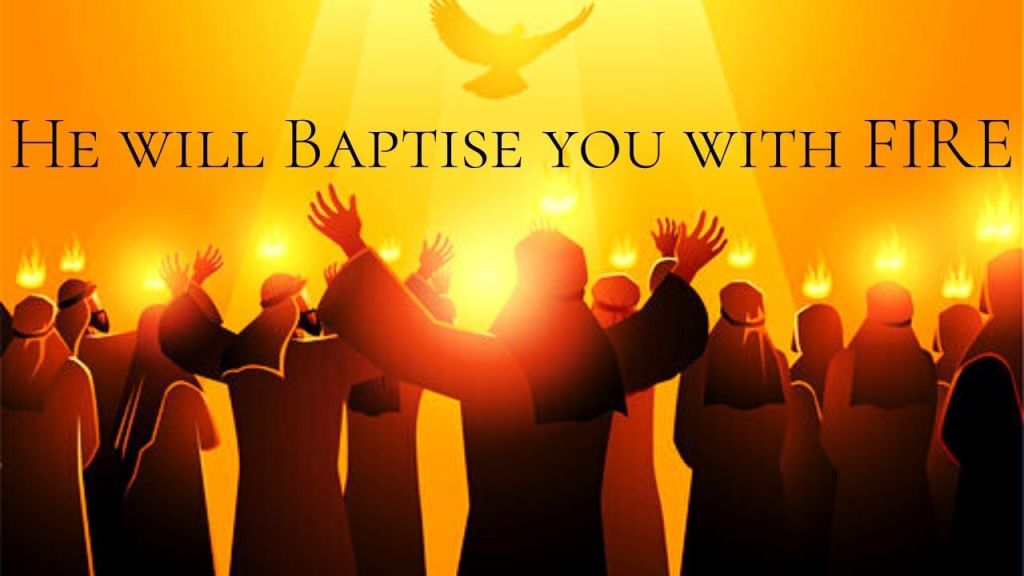
He will baptize you with the Holy Spirit and fire” (ESV).
John baptized with water to signify repentance, but he was preparing the way for One who would baptize with the Holy Spirit and fire—a spiritual baptism, not a physical one.
John baptized people as a sign that they had asked God to forgive their sins and had decided to live as He wanted them to live.
Water baptism is an outward sign (public declaration) of our decision to follow Christ.
The first step in this process is to repent, which means to change the way we think.
True repentance prepares the way for Jesus in our lives.
And our baptism is an outward sign of our commitment to Christ.
To be effective, it had to be accompanied by an inward change of attitude leading to a changed life—the work of the Holy Spirit.
John said that Jesus would baptize with the Holy Spirit and fire.
This looked ahead to Pentecost (Acts 2), when the Holy Spirit would be sent by Jesus in the form of tongues of fire, empowering His followers to preach the gospel.
John’s statement also symbolizes the work of the Holy Spirit in bringing God’s judgment on those who refuse to turn from their sins.
Everyone will one day be baptized—either now by God’s Holy Spirit or later by the fire of his judgment.
SELAH (let us pause and calmly think about these things) ____
Sunday, Sept 01 cFaith Devotion
JESUS BAPTIZES ME WITH THE SPIRIT by Tim Davidson
“As for me, I baptize you with water for repentance, but He who is coming after me is mightier than I, and I am not fit to remove His sandals; He will baptize you with the Holy Spirit and fire.” — Matthew 3:11 (NASB)
John the Baptist said he could baptize with water but Jesus was going to be the one who would come to baptize with the Holy Spirit and fire.
This baptism with the Spirit immerses us into the person of the Holy Spirit.
He then fills us and empowers us.
The Message Bible says: “I’m baptizing you here in the river, turning your old life in for a kingdom life.
The real action comes next: The main character in this drama—compared to him I’m a mere stagehand—will ignite the kingdom life within you, a fire within you, the Holy Spirit within you, changing you from the inside out.”
We are born of the Spirit the moment we are born again.
We have the presence of the Holy Spirit in us. Yet, Jesus will totally saturate us in this baptism.
Another phrase for baptizing us with the Spirit is “filling us with the Spirit.”
We are to be filled to overflowing with the Spirit of God.
We must be baptized in the Holy Spirit to have the power to successfully live out our Christian life.
Life is better with God’s power.
Today’s Thought to Take With You: Jesus, I look to you to fill me with your Spirit and to empower me for success.
Saul’s story in 1 Samuel 13 offers a powerful lesson in obedience, patience, and trust in God.
In times of fear and desperation, Saul chose to lean on his understanding, leading to his downfall.
This chapter serves as a reminder that true faith involves trust in God’s timing, obedience to His commands, and the wisdom to acknowledge His authority.
Verses 1-2: Saul’s Reign and Military Organization
In the first two verses, Saul’s kingship and military strength are described.
Saul chooses three thousand men from Israel; two thousand are with him in Michmash and the hill country of Bethel, and a thousand are with Jonathan in Gibeah of Benjamin.
The rest of the people he sends home.
Verses 3-4: Jonathan’s Victory and Its Aftermath
Jonathan, Saul’s son, strikes down the Philistine outpost at Geba, and Saul summons the Israelites for war by blowing a trumpet throughout the land.
Israel hears the news that Saul has defeated a Philistine garrison and that Israel is now detestable to the Philistines, causing the people to be summoned to join Saul at Gilgal.
Verses 5-7: Fear among the Israelites
The Philistines assemble to fight Israel with a force as vast as the sand on the seashore.
They camp at Michmash, east of Beth Aven. The men of Israel see that they’re in trouble and, afraid, they hide in caves, thickets, among rocks, in tombs, and in pits.
Verses 8-10: Saul’s Unlawful Sacrifice
Saul waits seven days for Samuel to come and offer the burnt offering, as per the time set, but Samuel does not come.
Saul, feeling pressured as his men begin to scatter, takes matters into his own hands and offers the burnt offering himself.
Verses 11-14: Samuel’s Prophecy of Saul’s Rejection
When Samuel arrives, he questions Saul’s actions.
Saul defends himself, blaming his act on Samuel’s tardiness, the scattering of his men, and the Philistine threat.
Samuel rebukes Saul, telling him that his kingdom won’t last because he hasn’t obeyed God’s command.
God would have established his kingdom over Israel forever, but now, He seeks a man after His own heart.
Verses 15-23: Israel’s Disadvantaged Position
Samuel departs from Gilgal, and the rest of the people follow Saul to meet the army, going from Gilgal to Gibeah in Benjamin.
No Weapons for the Army
13:16-23. The remainder of the chapter presents an informational aside to describe the position the rag-tag Israelite army faced.
First, we learn that they were just about surrounded. The Philistines sent out three raiding parties to control three of the roads that provided access to Micmash (13:17-18)..
Later, a Philistine detachment moved to Micmash (13:16).
These actions not only secured their positions at Micmash, but also sealed off Saul’s camp from receiving reinforcements (Bergen, 154).
If this wasn’t bad enough, we learn that the weapons arsenal held by the Israelites was technologically inferior.
The Philistines controlled the metal trade and charged high fees to sharpen and repair plowshares, mattocks, axes and sickles (13:20).
They refused to make iron or bronze weapons for the Israelites (13:19).
Only Saul and Jonathan had swords and spears. The rest of the army had weapons made of wood or stone—arrows, slings, clubs, or stone knives.
The situation appeared hopeless.
Israel is in a weakened position, with no blacksmiths in the land to make weapons, and the Philistines controlling the iron trade.
On the day of battle, only Saul and Jonathan have weapons, highlighting Israel’s dire situation.
The lesson here is that we are to obey God’s commands in all circumstances.
Saul lost his kingdom because he disobeyed God.
Saul was pressured to act before all his men deserted.
His lack of patience cost him everything.
SELAH (let us pause and calmly think about these things) ____
Tuesday, August 27 Worthy Brief
SPIRITUAL BLACKSMITHS ARISE!
“Now there was no smith found throughout all the land of Israel: for the Philistines said, Lest the Hebrews make them swords or spears: But all the Israelites went down to the Philistines, to sharpen every man his share, and his coulter, and his axe, and his mattock. Yet they had a file for the mattocks, and for the coulters, and for the forks, and for the axes, and to sharpen the goads. So it came to pass in the day of battle, that there was neither sword nor spear found in the hand of any of the people that were with Saul and Jonathan: but with Saul and with Jonathan his son was there found.” — 1 Samuel 13:19-22
This interesting passage speaks of a time when Israel had no blacksmiths to make weapons and was without any armament to defend themselves.
The enemy had succeeded to disarm Israel by removing their weapons, and those who forged them!
He’s attempting the same tactic today!
A blacksmith is someone who works with raw material and fire, and who knows how to form and shape liquid metal into powerful weapons.
Anyone who works skillfully and accurately with the word of God is a spiritual “blacksmith”.
The enemy, who is constantly attacking the word of God, the sword of the Spirit, also seeks to silence or remove the spiritual blacksmiths of this world.
If he can get rid of them – the battle is over.
We need to pray for God’s blacksmiths because the enemy is after them.
Together with the fire of the Holy Spirit they forge the raw material of His word into powerful weapons which shape and mold God’s people into His image and equip them for spiritual warfare and fruitfulness.
But we are all called to be strong in the word, and to take it up as our primary weapon.
Every spiritual blacksmith, himself started out as raw material which was shaped and formed by the fire of God to fight in this battle with Satan.
So, as the battle rages, pray for the protection of God’s “blacksmiths”, even as you submit to His process of shaping you into one, yourself.
Your family in the Lord with much agape love,
George, Baht Rivka, Obadiah and Elianna (Missouri) (Baltimore, MD) ____
Isaiah 37 is a testament to the power of prayer, faith, and total reliance on God in times of crisis…
Read Isaiah Chapter 37 (ESV)
Despite the humanly insurmountable challenge, Hezekiah’s heartfelt prayer and absolute faith in God result in a miraculous divine intervention, proving that God is sovereign and can deliver us from any adversity.
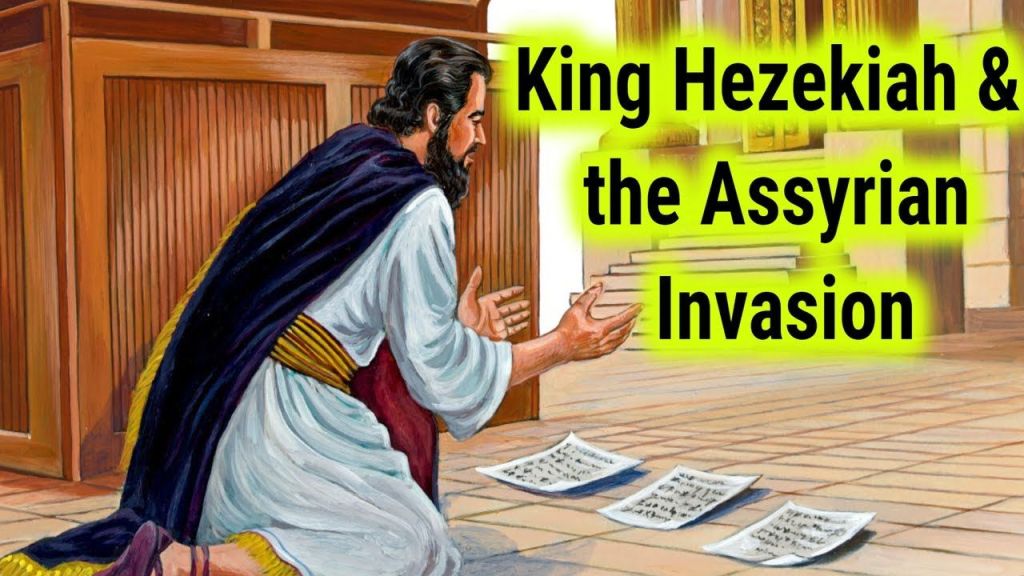
After receiving a threatening letter from King Sennacherib of Assyria, King Hezekiah tears his clothes, puts on sackcloth, and goes to the Temple of the Lord.
He sends messengers to Prophet Isaiah, expressing his despair and asking for divine intervention.
The prophet Isaiah sends back a reassuring message to Hezekiah, saying that God will make Sennacherib hear a rumor that will draw him back to his land, where he will die by the sword.
Despite God’s promise, King Sennacherib sends a new message, recounting his military victories and the impotence of gods of other nations to save their people.
Receiving the message, Hezekiah goes to the Temple and spreads the letter before God.
He prays fervently, acknowledging God’s power and pleading for deliverance from Assyrian oppression to show all nations that God is the one true God.
In verses 21 to 35 we read about The Power of Prayer…
Hezekiah’s Plea and God’s Deliverance
Hezekiah, a son of the wicked King Ahaz, reigned over the southern kingdom of Judah for twenty-nine years, from c. 715 to 686 BC.
He began his reign at age 25 (2 Kings 18:2).
He was more zealous for the Lord than any of his predecessors (2 Kings 18:5).
Because King Hezekiah put God first in everything he did, God prospered him.
Hezekiah “held fast to the Lord and did not stop following him; he kept the commands the Lord had given Moses. And the Lord was with him; he was successful in whatever he undertook” (2 Kings 18:6–7).
During his reign, the prophets Isaiah and Micah ministered in Judah.
Through Isaiah, God sends a message to Hezekiah, stating that He has heard his prayer.
God gives a prophecy about the downfall of Sennacherib, affirming that Jerusalem will be spared.
Isaiah 37:21-35 (ESV)
Sennacherib’s Fall 21 Then Isaiah the son of Amoz sent to Hezekiah, saying, “Thus says the LORD, the God of Israel: Because you have prayed to me concerning Sennacherib king of Assyria, 22 this is the word that the LORD has spoken concerning him:
“‘She despises you, she scorns you— the virgin daughter of Zion; she wags her head behind you— the daughter of Jerusalem.
23 “‘Whom have you mocked and reviled? Against whom have you raised your voice and lifted your eyes to the heights?
Against the Holy One of Israel!
24 By your servants you have mocked the Lord, and you have said, With my many chariots I have gone up the heights of the mountains, to the far recesses of Lebanon, to cut down its tallest cedars, its choicest cypresses, to come to its remotest height, its most fruitful forest.
25 I dug wells and drank waters, to dry up with the sole of my foot all the streams of Egypt.
26 “‘Have you not heard that I determined it long ago? I planned from days of old what now I bring to pass, that you should make fortified cities crash into heaps of ruins,
27 while their inhabitants, shorn of strength, are dismayed and confounded, and have become like plants of the field and like tender grass, like grass on the housetops, blighted before it is grown.
28 “‘I know your sitting down and your going out and coming in, and you’re raging against me.
29 Because you have raged against me and your complacency has come to my ears, I will put my hook in your nose and my bit in your mouth, and I will turn you back on the way by which you came.’
30 “And this shall be the sign for you: this year you shall eat what grows of itself, and in the second year what springs from that.
Then in the third year sow and reap, and plant vineyards, and eat their fruit.
31 And the surviving remnant of the house of Judah shall again take root downward and bear fruit upward.
32 For out of Jerusalem shall go a remnant, and out of Mount Zion a band of survivors. The zeal of the LORD of hosts will do this.
33 “Therefore thus says the LORD concerning the king of Assyria:
He shall not come into this city or shoot an arrow there or come before it with a shield or cast up a siege mound against it.
34 By the way that he came, by the same he shall return, and he shall not come into this city, declares the LORD.
35 For I will defend this city to save it, for my own sake and for the sake of my servant David.” ____
Through Isaiah, God sends a message to Hezekiah, stating that He has heard his prayer. God gives a prophecy about the downfall of Sennacherib, affirming that Jerusalem will be spared.
As God had promised, the Angel of the Lord slays 185,000 Assyrian soldiers in the night.
Sennacherib retreats to Nineveh, where he is eventually assassinated by his sons.
Isaiah 37 is a remarkable chapter in the Bible where we witness the raw desperation of King Hezekiah in the face of an impending Assyrian invasion, his passionate plea to God, and the Almighty’s profound response to his servant’s prayer.
In this chapter, we see a wonderful portrayal of the power of prayer, the assurance of God’s protection, and the downfall of the proud.
Similar to what we see happening in America today, King Hezekiah reigned in Israel during a time when the people had forgotten about God.
Unlike his predecessors, Hezekiah tried to restore the worship of God.
During these reforms, the expanding Assyrian Empire threatened his kingdom.
Even though Hezekiah was miraculously healed by God and his life was extended (see 2 Kings 21-22, nevertheless Isaiah chapter 39 records his pride and Isaiah’s announcement of judgment.
Even though God gave Hezekiah victory over snapper, and then Hezekiah’s selfish pride was his downfall. ____
Wednesday, Aug 21 cFaith
Spirit Filled Believer by Dick Mills
TURNING THE DEVIL’S ARROWS AGAINST HIM
“He shall not come into this city, nor shoot an arrow there. By the way that he came, by the same way shall he return…” — Isaiah 37:33-34
This verse can be used to keep your thought life undisturbed and in complete tranquility, serenity, and composure.
Satan uses thoughts like flaming arrows to lodge in our minds and arouse us to anxiety, fear, insecurity, anger, or lust.
The Greek word for devil (diabolos) is composed of two words: dia (dee-ah’), “through,” and ballo (bal’-lo), “to throw.”
Thus, it is Satan’s strategy to attempt to “throw” (shoot) arrows “through” (at) the believer to ignite trouble within him (Eph. 6:16).
In this passage, the Lord is speaking through the prophet Isaiah, telling the people of Israel that their enemy is coming against them but that he will not be able so much as to shoot an arrow into their city.
As Christians, we can have the same protection.
Our minds can be so fortified with the Word of God, our hearts so filled with His Spirit, our walk of faith so undergirded with His divine presence and support, that the enemy will have to flee the same way he came against us.
Lately, I have been verbalizing a confession of faith to contradict negative mental suggestions. I say:
“That is not my thought; I don’t think that way. Lord, it’s not Your thought either, because it does not agree with Your written Word.”
Then I quote a positive scripture in opposition to that negative thought.
Peace descends, and I can get on with serving the Lord.
You can do the same. Resist the devil with the Word!
[Source: The Spirit-Filled Believer’s Daily Devotional by Dick Mills] ____
The Promised Messenger I, the Lord All-Powerful, will send my messenger to prepare the way for me. Then suddenly the Lord you are looking for will appear in his temple. The messenger you desire is coming with my promise, and he is on his way.
A Day of Change 2 On the day the Lord comes, he will be like a furnace that purifies silver or like strong soap in a washbasin.
No one will be able to stand up to him.
3 The Lord will purify the descendants of Levi, as though they were gold or silver.
Then they will bring the proper offerings to the Lord, 4 and the offerings of the people of Judah and Jerusalem will please him, just as they did in the past. ____
Malachi 3:1-4 Messiah’s Coming in Judgment
God will send His messenger, a promise that had an early and partial fulfillment in John the Baptist, but awaits a later and complete fulfillment when Elijah (4:5) will prepare the way of the Lord, … the Messenger of the covenant whom they desired (irony).
The irony here is that when He later arrived (His First Advent), the nation of Israel did not delight in Him but crucified Him instead. 3:2–4
The day of His coming will be the Second Advent. The Lord will come in judgment on sin, and who will be able to stand?
This purifying ministry, pictured by Christ’s cleansing of the temple, awaits final fulfillment at His Second Coming.
The sons of Levi (priests) will be purified so that they can make offerings of holiness and righteousness that are pleasant to the LORD, as in the days of old.
God’s coming is both a delight and a difficulty.
It’s a delight because He comes to us.
It’s a difficulty because He comes to us in order to cleanse.
Using the strongest of soap, He’ll scrub us like dirty laundry.
Washing us. Rinsing us. Wringing us out.
Then repeating the cycle over and over again until we’re clean.
Which raises a question: “Who can survive his coming?”
And there’s ONLY one answer to that question:
The one who submits to the soap and the suds and the scrubbing.
Put God First in every area of your life – this is a key principle of life:
Put God first. If you want Him to bless your marriage; put Him first, if you want Him to bless your relationships; put Him first, if you want Him to bless your finances; put Him first.
Put Him first in whatever you want Him to bless or protect.
“And all, whatever you might do in word or in deed, do all in the name of the Lord Jesus, giving thanks to God the Father through Him.” (Colossians 3:17)
SELAH (let us pause and calmly think about these things) ____
Thursday, August 15 cFaith
The Anointed Word by Keith Butler THE LORD SHALL COME SUDDENLY
“Behold, I will send my messenger, and he shall prepare the way before me: and the Lord, whom ye seek, shall suddenly come to his temple, even the messenger of the covenant, whom ye delight in: behold, he shall come, saith the Lord of hosts.” — Malachi 3:1
Even the return of the Lord will be sudden.
In Mark 13:35-37, Jesus tells us the signs of His coming: “Watch ye therefore: for ye know not when the master of the house cometh, at even, or at midnight, or at the cockcrowing, or in the morning: Lest coming suddenly He find you sleeping. And what I say unto you, I say unto all. Watch.”
Suddenly He shall find you sleeping. You may say, “But you preachers have been talking about Jesus coming back all my lifetime.”
That’s right. We are that much closer to His return, and when He comes it’s going to be unexpectedly.
He will come and snatch up the believers with the rapture of the church.
One day people will be driving down the expressway and believers will be caught up out of their cars.
Some of them will be pilots of airplanes flying 35,000 feet above ground and they will be caught up out of the cockpit.
They’ll be at work and they’ll be caught up immediately, instantly, in a moment, in the twinkling of an eye, Jesus shall return – glory to God – and catch up the believers.
The point here is that it will happen so fast that people won’t have a chance to repent.
Then if you are left, you have to deal with what the Bible says is the worst seven years ever in the history of the planet.
It’s called the tribulation period.
God said if He did not cut these days short, no flesh would be saved.
Everything on earth would be destroyed. Don’t you know at the rapture of the church that people who never went to church are going to be there?
Don’t you know every church will be full, they’ll have ten Sunday morning services a day, but then they’re going to have to pay a price while on earth because they didn’t listen when the spirit of God ministered to them?
Now is the time to listen. Now is the time to follow the Spirit of God.
Now is the time to receive from God. Now is the time to accept the Word of God unto you this day.
Under the New Covenant God Himself lives inside of us…
Read Jeremiah 31:31-34
The New Covenant (31:31–34)
One section in the book of Jeremiah (chs 30–33) stands above other passages in the OT in its optimistic view of Israel’s future.
The high point (31:31-34) is the announcement that the Lord God will form a new covenant with his people.
It points toward Jesus of Nazareth, whose death would seal this new covenant.
One sentence in particular gives a new context to the key affirmation of the Sinai covenant:
“I will be their God, and they will be my people” (31:33; see also Exod 6:7).
The relationship between God and His people envisioned in the Sinai Covenant was surrounded by laws chiseled in stone and a priestly class in charge of all religious institutions and activities.
The new covenant would differ from the old in one primary way:
It would no longer be external to the worshipers, but would now be written on their hearts (31:33).
The great defect of the old covenant was that it lacked the power to enable people to do what it commanded (Rom 8:3).
The new covenant would be internalized through the power of the Holy Spirit, whose indwelling would be made possible through the sacrifice of Christ (Ezek 36:24-27).
Thus, it would become possible for people everywhere (not just a select few) to fulfill God’s covenant plan for life as summed up in the two “Great Commandments” (Matt 22:35-40):
“You must love the LORD your God” (Deut 6:5) and “Love your neighbor as yourself” (Lev 19:18).
In the new covenant, God’s role as Creator goes beyond making all material things.
The new covenant would achieve the goal that the old one pointed to, but could not reach: creating new persons and a new community.
The goal is a deep transformation of sinners, beginning with forgiveness of sins and culminating in a holiness exemplified by good works (Eph 1:4; 2:8-10).
According to the NT, all believers in Jesus Christ will know Him directly by the activity of the Holy Spirit.
They will know Him personally and experience Him powerfully, as only a few did in OT times.
Jesus applied the new covenant to Himself when He instituted the communion ritual (Matt 26:28; Mark 14:24; Luke 22:20; see also 1 Cor 11:25; 2 Cor 3:6).
Jesus’ death inaugurated the new covenant, and Christians commemorate that reality each time they take communion.
Hebrews 8:8-12 quotes Jer 31:31-34, and Heb 9 contrasts the old and new covenants.
The writer clearly states that Jesus’ death brought the new covenant into existence and made Him the mediator of the covenant for whoever believes in Him.
The day of the new covenant was realized when Jesus Christ accomplished His redemptive mission on earth.
The key difference between the new covenant and the one God made with their ancestors is that the Lord would write His instructions deep within His people’s hearts (see Heb 11:16).
The old covenant was external and legal, whereas the new covenant would be a vital, person-to-person relationship.
The new covenant would emphasize the redeeming, transforming change of an individual’s spiritual nature.
God says: *I will instruct you and teach you in the way you should go; I will counsel you with my eye upon you.” (Psalms 32:8)
SELAH (let us pause and calmly think about these things) ____
Faith Food Devotions by Kenneth Hagin
PROPHETS
“But this shall be the covenant that I will make with the house of Israel; After those days, saith the Lord, I will put my law in their inward parts, and write it in their hearts; and will be their God, and they shall be my people.” — Jeremiah 31:33
When Jesus appeared to me and told me to teach His people how to be led by the Spirit, He stated, “I didn’t set prophets in the Church to guide people.
The New Testament does not say, ‘As many as are led by prophets, they are the sons of God.’
“New Testament believers,” Jesus told me, “SHOULD NOT seek guidance through prophets.
The prophets of the Old and the New Testaments are similar in some ways.
Both see and know things supernaturally.
But in the Old Testament, the people did not have the Spirit of God in them, or on them.
They had a promise of the New Birth, but they didn’t have it.
“So, if they were to be led by the Spirit, they had to go to someone who was anointed with the Spirit.
But under the New Covenant, every believer has the Spirit of God.
They don’t have to go to anyone to seek guidance. The only thing the prophet’s ministry may do in this area under the New Covenant, is to confirm something someone already has.
And if it doesn’t confirm something you already have in your spirit, forget it!”
Confession: For as many as are led by the Spirit of God, they are the sons of God. God leads me!
[Source: Faith Food Devotions by Kenneth E. Hagin] ____
We are to put on the full spiritual armor of God each day, so that we will be able to win the spiritual war against the devil…
In the Christian life we battle against “principalities” and “powers” (the powerful evil forces of fallen angels headed by the devil, who is a vicious fighter, see 1 Peter 5:8).
To withstand their attacks, we must depend on God’s strength and use every piece of his armor.
Paul is not only giving this counsel to the church, the body of Christ, but to all individuals within the church.
The whole body needs to be armed.
As you do battle against “the rulers of the darkness of this age,” fight in the strength of the church, whose power comes from the Holy Spirit.
These who are not “flesh and blood” are demons over whom the devil has control.
They are not mere fantasies—they are very real.
We face a powerful army whose goal is to defeat Christ’s church.
When we believe in Christ, these beings become our enemies, and they try every device to turn us away from Him and back to sin.
Although we are assured of victory, we must engage in the struggle until Christ returns, because Satan is constantly battling against all who are on the Lord’s side.
We need supernatural power to defeat Satan, and God has provided this by giving us his Holy Spirit within us and his armor surrounding us.
If you feel discouraged, remember Jesus’ words to Peter:
“On this rock I will build My church, and the gates of Hades shall not prevail against it” (Matthew 16:18).
Are you trying to fight a spiritual battle with physical weapons?
Spend some time praying and reading the Bible to Spiritually strengthen yourself for the battle.
Satan will tempt you with lies.
Memorize Scripture to remind yourself of the truth.
SELAH (let us pause and calmly think about these things)
____
Friday, August 9 cFaith A Verse A Day by Tim Davidson
THE SHIELD OF FAITH
“Above all, taking the shield of faith, wherewith ye shall be able to quench all the fiery darts of the wicked.” — 1 John 1:6
In addition to the belt of truth, the breastplate of righteousness, and the shoes of readiness, we are to make sure we take the shield of faith above all.
With the shield of faith, we are able to snuff out all the fiery arrows that our enemy, Satan, has set on fire and thrown at us through the trying experiences of our life.
The Message Bible says: “Take all the help you can get, every weapon God has issued…faith….”
The Roman soldier carried a huge shield into battle against his enemies.
He would raise it up to protect himself as the adversary filled the air with a barrage of fiery arrows.
Everything the enemy threw at him failed, because the shield did its job by protecting the soldier.
So, let your faith be like a shield. Carry it with you at all times and you will be able to quench ALL the troubling circumstances shot at you by the wicked one.
Today’s Thought to Take With You:
I take my shield of faith and raise it against the fiery darts the enemy throws at me. I prevail over all the attacks of the enemy.
To begin with, the Bible tells us that God is a God of LOVE and not hate (1 John 4:7-21)…
John 3:17-18 (TPT) The Passion Translation
17 “God did not send His Son into the world to judge and condemn the world, but to be its Savior and rescue it!
[in verse 17, the Aramaic is “so that they shall live by His hand” – of power]
18 So now there is no longer any condemnation FOR THOSE WHO BELIEVE IN HIM, but the unbeliever already lives under condemnation because they do not believe in the name of God’s beloved Son.” ____
God is not a harsh, cruel ruler anxious to pour out His anger on mankind.
His heart is filled with tenderness toward man, and He has gone to the utmost cost in order to save men.
He could have sent His Son into the world to condemn the world, but He did not do so.
On the contrary, He sent Him here to suffer, bleed, and die in order that the world through Him might be saved.
The work of the Lord Jesus on the cross was of such tremendous value that all sinners everywhere could be saved if they would receive Him.
Now all mankind is divided into two classes: either believers or unbelievers.
Our eternal destiny is determined by the attitude we take toward the Son of God.
The one who trusts the Savior is not condemned, but the one who does not trust Him is condemned already.
The Lord Jesus has finished the work of salvation, and now it is up to each individual to decide whether he will accept Him or reject Him.
It is a terrible thing to reject such a gift of love.
If a man will not believe on the Lord Jesus, God can do nothing else but condemn him.
Believing in His name is the same as believing in Him.
In the Bible, the name stands for the person.
If you trust His name, you trust Him.
Jesus is not here to condemn you, but to rescue you!
Rescue you from sin, from sickness, from guilt and shame.
He sent the Holy Spirit to dwell in you and to convince you of your true identity, righteous (Through Christ)!
The Bible is our “Operations Manual for Life” and also it’s our Roadmap” in order that we may find Salvation.
Scripture first tells us to rightly divide the Word of Truth (see 2 Timothy 2:15).
Also in 2nd Peter, Peter also speaks about the inerrancy of God’s Word.
2 Peter 1:20-21 Expanded Bible
20 ·Most [First] of all, you must understand this: No prophecy in the Scriptures ·ever comes from the prophet’s own interpretation [or is a matter of one’s own interpretation].
21 No prophecy ever came from ·what a person wanted to say [L human will/intention], but people ·led [carried; moved] by the Holy Spirit spoke words from God.
[C True prophecy originates with God, and not with the prophet.] ____
The way I view this is that God speaks over a wide bandwidth, covering 66 books, from Genesis to Revelation.
And I believe what He is emphasizing here is that we don’t take just one scripture and establish a doctor around that one scripture unless we can verify it throughout the rest of the Bible.
The Bible is its own best commentary, and before we establish doctrine we have to first check and see what other parts of the Bible say on whatever the subject is that we’re looking at.
The fact of the matter is the bandwidth of God’s truth is spread over the entire 66 books of the Bible,
So the Bible tells us to study the whole Counsel of God’s Word so that we can correctly discern the truth.
“The sin, both of men and of angels, was rendered possible by the fact that God gave us free will.” — C. S. Lewis
God gives to each individual a free will, which He does not tamper with.
However the term “Free will” is not found anywhere in scripture. But we can see verses that describe the very heart of man, the core of his will.
We understand that man’s will is limited by his nature.
Man cannot flap his arms and fly, however much he wills it.
The problem isn’t with his will – it’s with man’s nature.
Man was not created to fly like a bird. Because it is not his nature, he is not free to do it.
The Bible is clear that man, in his natural state, is utterly and completely depraved.
At the Fall of Man, man’s nature became fully and totally corrupt.
Man is completely depraved. There is no good in him whatsoever.
So, by his nature, man can not choose to do anything completely good.
A depraved man can do something nice – like walk an elderly lady across the street.
But he does it for selfish reasons. It makes him feel good about himself.
It makes her think well of him.
He doesn’t do it for the only truly GOOD reason, which is to bring Glory to Christ!
The Bible also makes it clear that Man, in his Post-Fall state, is not free.
He is a slave to sin.
Man’s will in and of itself can not be free.
This unregenerate man’s will belongs to his master, Satan.
And when a Man has been Regenerated, he belongs to Christ.
He is under a new owner. So even now, man’s will is not entirely free in the same regard as the secular humanists use the term.
Jesus makes it very clear that we have to use our will to choose to pick up our cross daily and follow Christ.
We have to learn to live by faith and not by sight, and in the process of doing that everyday, we must reckon the following scripture as true for each of us, every single day.
Galatians 2:20
“I have been crucified with Christ; it is no longer I who live, but Christ lives in me; and the life which I now live in the flesh I live by faith in the Son of God, who loved me and gave Himself for me.”
The great evangelical preacher, Donald Barnhouse, related an insightful story about a young man who applied for a job with Western Union delivering telegrams.
Fortunately, a position was available—Could he start right away? the manager wanted to know.
“Well,” said the boy, “there’s one thing I must warn you about before I get started. I am psychologically so constituted that I cannot stand any scene of unhappiness.
I’m only willing to deliver good news. Birth announcements, that’s fine. Congratulations for success, fortunes that have been received, promotions, acceptance of marriages—all the joys and bliss news that I will deliver.
But sickness and death and failure and all of that, that’s alien to my nature.
I just won’t deliver them.”
It did not take the manager very long to say, “I guess I’m still looking for the one that’s gonna fill this job, because this responsibility requires that you also announce bad news” (Swindoll, p. 321).
Such is the case with the gospel of Jesus Christ.
There is good news, but there is also bad news.
We have said that the theme of the letter to the Roman believers is the gospel that is the power of God for salvation (Rom. 1:16).
Paul has already made it imminently clear in the early chapters of Romans that, as Adrian Rogers is wont to say, “It’s the bad news that makes the good news good.”
In the early chapters of Romans (esp. chapter 3), Paul made it clear that “all have sinned and fall short of the glory of God” (Rom. 3:23).
Following that bad news, he moves to the good news in chapters 4 and 5— though all have sinned, all can be justified (declared free of sin’s power and penalty) through faith in Jesus Christ.
The best way to learn theology is to watch the apostle Paul in action.
Did he believe only a remnant of Israel had been saved?
Yes (Rom. 9:27).
Did he believe that prayer for Israel’s salvation was still his responsibility?
Yes (Rom. 10:1). Paul’s constant ministry for the saved, as well as the unsaved, was a ministry of prayer (Rom. 1:10; 2 Cor. 13:7; Eph. 1:15-23; 3:16-17; Phil. 1:4; Col. 1:3,9-10; 1 Thess. 1:2-3; 2 Thess. 1:3,11-12; 2 Tim. 1:3; Phlm. 1:4,6).
Likewise, he tried to inculcate his readers with the importance and urgency of prayer for all types of needs (Rom. 15:30-31; 2 Cor. 1:11; Eph. 6:18-20; Col. 4:3-4; 1 Thess. 5:17,25; 2 Thess. 3:1-2; 1 Tim. 2:1; 5:5).
There was nothing in Paul’s doctrine of sovereignty, election, or predestination that could not, and should not, be touched by prayer.
Without a doubt, Paul’s prayer for Israel was that what had been taken away from them—spiritual discernment and knowledge (see Isa. 6:9-10)— would be restored to them.
He knew they were not carefully rejecting the claims of Christ, as if they knew something that he did not.
They were stumbling over Christ because of spiritual blindness.
It was as if they were walking down a path on a moonless night and stepped on the tail of the Lion of Judah who was lying in their way.
They never even knew what hit them.
Thus is the nature of spiritual blindness.
They did not lack zeal; they lacked knowledge (not “head” knowledge, gnosis, but “real” knowledge, perception, or recognition, epignosis).
As a result of their lack of knowledge, their zeal became misguided.
Interestingly, zeal (zelos) is most often translated “jealousy” in Paul’s epistles, context making the difference.
But in its essence, zeal is jealousy, and it can be in a healthy sense.
Paul is saying that because the Jews lacked spiritual perception, their jealousy was for their religious traditions rather than the things of God.
And Paul should know, as that is what he was zealous/jealous for (Acts 22:3; 21:20; Gal. 1:13-14; Phil. 3:6).
One of the most intriguing statements ever made by Christ is His Words to the “experts in the law” in Luke 11:52, where He castigates them for having “taken away the key to knowledge (gnosis).”
What was the key that was taken away that kept knowledge locked up in Israel?
The Scriptures themselves provide few certain clues.
Was it the repentance preached by the prophets (Luke 11:47-51)?
Was it the fear of the Lord (see the NIV translation of Isa. 33:6)?
If Jesus’ immediate audience, the experts in the law (scribes; Luke 11:46,52) are His specific audience, then perhaps a right understanding of the law (the Old Testament) is what the scribes had taken away from the people of Israel.
Not only did they themselves lack true knowledge, but they were preventing everyone else from gaining it as well (Luke 11:52b).
Not only did they fail to recognize Jesus as the Messiah, but they failed to point Him out to the nation.
Of all people, the scribes should have seen the fulfillment of the Old Testament messianic prophecies in Jesus.
Is it any wonder that Paul quotes more passages from the Old Testament in Romans 10 than in any other passage of similar length in his writings?
He wants the church at Rome to know that the Scriptures have been clear for generation after generation about God’s plan and how to live in step with it.
The fact that Israel was out of step was due to their failure to believe, not God’s failure to make it clear.
The specific knowledge they lacked was that righteousness. . . comes from God, not from themselves.
At the end of the law, Christ made it possible for everyone who believes to attain a righteous standing before God.
As the end (telos) of the law, Christ was its fulfillment (Matt. 5:17; Rom. 10:4), not its chronological termination (Rom. 6:15).
However, it was his fulfillment of the law’s requirements, and His resulting confirmation in righteousness, that cast the law aside as a tormentor of all who bore the guilt of not keeping it.
Israel’s present spiritual condition—both in Paul’s day and in ours—can be described in one word: unbelief.
And in her unbelief, Israel serves as an illustration of the gospel message, a gospel that must be believed to be received.
In chapter 9, Paul presented divine election as one side of the coin of Israel’s unbelief.
In this chapter, Paul presents Israel’s responsibility as the other side of her own unbelief.
As we examine Romans 10:1, the question arises what will happen to the Jewish people who believe in God but not in Christ?
Since they believe in the same God, won’t they be saved?
If that were true, Paul would not have worked so hard and sacrificed so much to teach them about Christ.
Because Jesus is the most complete revelation of God, we cannot fully know God apart from Christ; and because God appointed Jesus to bring God and people together, we cannot come to God by another way.
The Jews, like everyone else, must find salvation through Jesus Christ (John 14:6; Acts 4:12).
Like Paul, we should pray that all Jews might be saved and lovingly share the Good News with them.
Rather than living by faith in God, the Jews established customs and traditions (in addition to God’s law) to try to make themselves acceptable in God’s sight. But human effort, no matter how sincere, can never substitute for the righteousness God offers us by faith.
The ONLY way to earn salvation is to be perfect—and that is impossible.
We can only hold out our empty hands and receive salvation as a gift.
Christ accomplished the purpose for which the law was given in two ways:
1. He fulfills the purpose and goal of the law (Matthew 5:17) in that He perfectly exemplified God’s desires on earth.
2. But He is also the termination of the law because in comparison to Christ, the law is powerless to save.
In order to be saved by the law, a person would have to live a perfect life, not sinning once.
Then why did God give the law since He knew people couldn’t keep it?
According to Paul, one reason the law was given was to show people how guilty they are (Galatians 3:19).
The law was a shadow of Christ—that is, the sacrificial system educated the people so that when the true sacrifice came, they would be able to understand His work (Hebrews 10:1-4).
The system of ceremonial laws was to last until the coming of Christ. The law points to our need for a Savior.
In verses 6-8, Paul adapts Moses’ farewell challenge from Deuteronomy 30:11-14 to apply to Christ.
Christ has provided our salvation through His incarnation (God in human form) and resurrection.
God’s salvation is right in front of us.
He will come to us wherever we are. All we need to do is to respond and accept His gift of salvation.
Have you ever been asked, “How do I become a Christian?”
These verses give you the beautiful answer:
Salvation is as close as your own lips and heart.
People think it must be a complicated process, but it is not.
If we believe in our heart and say with our mouth that Christ is the risen Lord, we will be saved.
This is the way Faith Works, we must first believe in our heart and then we confess with our mouth what the word of God says.
This works for the Salvation of our soul, but it also works for whatever we are petitioning God for.
We must first look to God’s Word and find a promise related to whatever it is we are asking God for (see 1 John 5:14-15), and then we hang our faith and our obedience on that promise and stand there until we receive our breakthrough.
SELAH (let us pause and calmly think about these things) ____
Thursday, Aug 1 Faith to Faith
RECEIVED YOUR MIRACLE by Gloria Copeland
“For with the heart man believeth unto righteousness; and with the mouth confession is made unto salvation.” — Romans 10:10
Do you need a miracle? Then believe it, confess it, and receive it!
“Oh Gloria, I just don’t know if I can do that.”
Yes, you can! You’ve already done it once.
When you made Jesus the Lord of your life, you believed, confessed, and received the greatest miracle in the universe – the miracle of a reborn spirit!
Every other miracle you receive will come in exactly the same way.
You start by simply believing what God’s Word says concerning your area of need, by letting that Word change your heart and mind.
A lot of people try to skip that step. They try to believe for a miracle without spending enough time in the Word to change their heart and mind.
They just want to confess it with their mouth and have it instantly appear.
But that won’t happen. It’s what we believe in our heart and say with our mouth that we receive.
If you don’t have enough faith yet to believe for the miracle you need, then get it.
“Faith cometh by hearing, and hearing by the word of God” (Rom. 10:17).
So start filling the ears of your heart with the Word until faith for your miracle is born.
That’s what the woman did who had the issue of blood.
She believed in her heart that Jesus would heal her. Then she spoke her faith out loud.
Then she acted on that faith – and she received her miracle.
It wasn’t Jesus’ decision. He didn’t suddenly say, “You know, I think I’ll work a miracle for that little lady today.” No. She made it happen.
She took her faith and drew on the power of God.
That’s why Jesus said,
“Daughter, your faith has made you whole” (Matt. 9:22).
You have that same opportunity.
God’s power is always present everywhere.
Your faith will bring it into your life, body or circumstances.
Do it. Reach out to Jesus. Believe, confess and receive your miracle today. ____
Only God can save His people, not only from their sins, but from their sufferings as well.
When surrounded by troubles, believers should call upon God for deliverance, trusting that He will rescue them out of their distress.
Psalm 56 is such a song of trust, one in which David prayed to God to save him when he was under attack by enemies.
The historical background is an incident in David’s life when he fled from Saul to Gath, the hometown of Goliath.
In Gath he took up temporary residence among the Philistines (1 Sam. 21:10-15), only to escape to the cave of Adullam when hunted by his foes (1 Sam. 22).
The enemies in this psalm were not the Philistines but Saul and his men who dogged his steps in an attempt to take David’s life.
Understanding this, David’s first reaction was to be fearful (vv. 3-4,11).
But through it all, David put his trust in the Lord, who prevailed on his behalf.
According to the psalm’s title, it was to be sung according to a tune commonly known as “A Dove on Distant Oaks.”
God is trustworthy. He is a rock, a hiding place, a fortress. We have safety and comfort in Him.
From Max Lucado: (Encouraging Word Bible Notes)
David wrote Psalm 56 when the Philistines captured him in Gath (see 1Sa 21:10–15). He wrote Psalm 57 while hiding in a cave. Can you relate to David’s story?
Has your Saul cut you off from the position you had and the people you love?
In an effort to land on your feet, have you stretched the truth?
Distorted the facts?
Are you seeking refuge in Gath?
Under normal circumstances you would never go there. But these aren’t normal circumstances, so you loiter in the breeding ground of giants.
The hometown of trouble. Her arms or that bar. You walk shady streets and frequent questionable places.
And, while there, you go crazy. So the crowd will accept you, so the stress won’t kill you, you go wild.
You wake up in a Dead Sea cave, in the grottoes of Adullam, at the lowest point of your life, feeling as dumb as a roomful of anvils.
You stare out at an arid, harsh, unpeopled future and ask, “What do I do now?”
I suggest you let David be your teacher.
Sure, he goes wacko for a few verses. But in the cave of Adullam, he gathers himself.
The faithful shepherd boy surfaces again. The giant killer rediscovers courage.
Yes, he has a price on his head. Yes, he has no place to lay his head, but somehow, he keeps his head.
He returns his focus to God and finds refuge.
Refuge surfaces as a favorite word of David’s.
Circle its appearances in the book of Psalms, and you’ll count as many as 40-plus appearances in some versions.
But never did David use the word more poignantly than in Psalm 57.
The introduction to the passage explains its background: “Of David. A miktam.
When he had fled from Saul into the cave.”
Envision Jesse’s son in the dimness: on his knees, perhaps on his face, lost in shadows and thought.
He has nowhere to turn.
Go home, he endangers his family; to the tabernacle, he imperils the priests.
Saul will kill him; Gath won’t take him. He lied in the sanctuary and went crazy with the Philistines, and here he sits. All alone.
But then he remembers: he’s not.
He’s not alone. And from the recesses of the cave a sweet voice floats:
“Have mercy on me, my God, have mercy on me, for in you I take refuge. I will take refuge in the shadow of your wings until the disaster has passed” (Ps 57:1).
SELAH (let us pause and calmly think about these things) ____
Wednesday, July 31 cFaith
The Cutting Edge
THE LIGHT IN THE DARKNESS
We are living in difficult times. Unemployment is near an all time high, foreclosures are driving families out of their homes, and because of financial pressures, many marriages are at the breaking point.
Today I talked with two pastors who were ready to leave the ministry because of pressure. This should not be.
In times of trouble, faith people should be standing stronger than ever. Let me explain.
During the day, it might be impossible to tell if a lamp is turned on or not. But in the darkness a lamp, regardless of its brightness, is easily seen.
In these times of great darkness our light should actually seem brighter to the world than ever before, even if our light is of no greater intensity than it’s ever been.
In times of darkness, many are crying, “Lord, increase my faith.”
Faith, standing in a world of doubt, should be easily seen. Our light should look brighter than ever. As darkness tries to come over the world, we should remember that our faith has already overcome it (1 John 5:4).
However, the darkness should make our faith look brighter, even if we have no more faith than before.
I encourage you to stand in faith and I admonish you to not focus on the doubt and darkness around you.
Remember this. Light always overpowers darkness.
Darkness is governed by the light.
Darkness only prevails when the light is extinguished and your light cannot be extinguished unless you allow it.
You are the one who determines the intensity of your faith. You are the one who has access to the fuel (the Word of God) that feeds the faith in your life.
There may be reasons why some doubt, but we have no excuses for allowing that doubt to overtake us.
So, mighty men and women of God, I want to encourage you with these words.
Greater is He (the Light) that is in you, than he (the darkness) that is in the world.
No weapon (of darkness) formed against you can prosper. You can do all things through Christ (the Light) who strengthens you. With God (the Light), nothing is impossible.
And because you are the light of the world (Matthew 5:14), you are victorious and darkness cannot rule over you.
If nothing can separate the called of God from God’s love (Rom. 8:39), why is God’s chosen nation, Israel, cut off from His love?
Could the same thing happen to a believer in Christ?
And why are not more Jews believers in Christ if they are the chosen nation?
Paul begins a three-chapter aside on the nation of Israel to explain their spiritual condition: past (Rom. 9), present (Rom. 10), and future (Rom. 11).
In this chapter, Paul explains that salvation is not a function of lineage or merit, but of God’s merciful election.
Chapter 9 starts out with Paul expressing concern for his fellow Jews by saying that he would willingly take their punishment if that would save them.
While the only one who can save us is Christ, Paul showed a rare depth of love.
Like Jesus, he was willing to sacrifice so others would be saved.
How concerned are you for those who don’t know Christ?
Are you willing to sacrifice your time, money, energy, comfort, and safety to see them come to faith in Jesus?
Romans 9 challenges us to grapple with the complex issue of God’s sovereignty and human responsibility.
Despite the seeming paradox, it reminds us that God’s ways are just and that salvation is accessible to all—Jew and Gentile—through faith.
It is a chapter that encourages trust in God’s sovereignty and a reliance on faith, not works or heritage.
Paul reminded the Romans that no good work could bring salvation. Rather, God saves his people through his love.
The sovereign God told Moses that He would show mercy where He wants to show mercy, although no one deserves or can earn His mercy.
The following is from Max Lucado:
God could not love you more than He does right now. (From A Gentle Thunder by Max Lucado)
Do you sometimes feel that God can’t really love you?
If so, look at this chapter and commit it to memory.
God is there whether you walk away from Him or not.
Thank God for His acceptance of you because it’s based on the finished work of Christ and not on your own merit.
Exploration No Separation—John 10:27–29; 17:1–3; Romans 5:8–9; 1 Thessalonians 4:16–17.
New Life in Christ The Spirit we received . . . makes us children of God.
With that Spirit we cry out, “Father.”—Romans 8:15 God Has Adopted Us When we come to Christ,
God not only forgives us, He also adopts us.
Through a dramatic series of events, we go from condemned orphans with no hope to adopted children with no fear.
Here is how it happens. You come before the judgment seat of God full of rebellion and mistakes.
Because of His justice He cannot dismiss your sin, but because of His love He cannot dismiss you.
So, in an act which stunned the heavens, He punished Himself on the cross for your sins.
God’s justice and love are equally honored. And you, God’s creation, are forgiven.
But the story doesn’t end with God’s forgiveness. . . . . It would be enough if God just cleansed your name, but He does more.
He gives you His name.
It would be enough if God just set you free, but He does more.
He takes you home. He takes you home to the Great House of God.
Adoptive parents understand this more than anyone.
I certainly don’t mean to offend any biological parents—I’m one myself.
We biological parents know well the earnest longing to have a child.
But in many cases our cribs were filled easily.
We decided to have a child and a child came.
In fact, sometimes the child came with no decision.
I’ve heard of unplanned pregnancies, but I’ve never heard of an unplanned adoption.
That’s why adoptive parents understand God’s passion to adopt us.
They know what it means to feel an empty space inside.
They know what it means to hunt, to set out on a mission, and take responsibility for a child with a spotted past and a dubious future.
If anybody understands God’s ardor for His children, it’s someone who has rescued an orphan from despair, for that is what God has done for us.
God has adopted you. God sought you, found you, signed the papers and took you home.
(From The Great House of God by Max Lucado)
Since the Father has shown you mercy, you should show mercy to others.
Make a list of those to whom it is hard for you to show mercy.
What could you do to soften your heart toward them?
Act on what you know to be true.
SELAH (let us pause and calmly think about these things) ____
Wednesday, July 24 cFAITH Freedom in the Word
NUMBER TWO: THE INWARD VOICE by Kenneth E. Hagin
“I say the truth in Christ, I lie not, my conscience also bearing me witness in the Holy Ghost” — Romans 9:1
The number one way the Holy Spirit guides us is through the inward witness.
The number two way is through the inward voice.
The inward man has a voice just as the outward man has a voice.
We call the voice of the inward man “conscience.”
Sometimes it is also called intuition, inner guidance, or “the still, small voice.”
It is not the voice of the Spirit of God speaking to us, because when the Holy Spirit speaks, His voice is more authoritative.
The still, small voice is the voice of our own spirit. Yet our spirit picks it up from the Holy Spirit who lives inside us.
For example, I relate in the devotion of July 19 how a “buzzer” seemed to go off inside me as I stepped inside that building that was for sale in Tulsa.
I knew on the inside – This is it! But I didn’t want to listen.
When my wife asked about it later, I said, “No, we’ll just stay where we are.”
But when we went to bed that night, I couldn’t get to sleep. My conscience was hurting. My spirit knew I hadn’t listened to it.
So I said, “Lord, in the natural, I don’t want to move to Tulsa. But if that’s what You want, I won’t stand in Your way.”
Suddenly, on the inside of me, that still, small voice said, “I’m going to give you that building. You watch Me.” And God did just that!
Confession: I listen to the voice of my spirit. And I obey it!
Source: Faith Food Devotions by Kenneth E. Hagin. ____






 SB SALT AND LIGHT MINISTRIES