Why did Jesus curse the fig tree?
This incident is the Savior’s interpretation of the tumultuous welcome He had just received in Jerusalem.
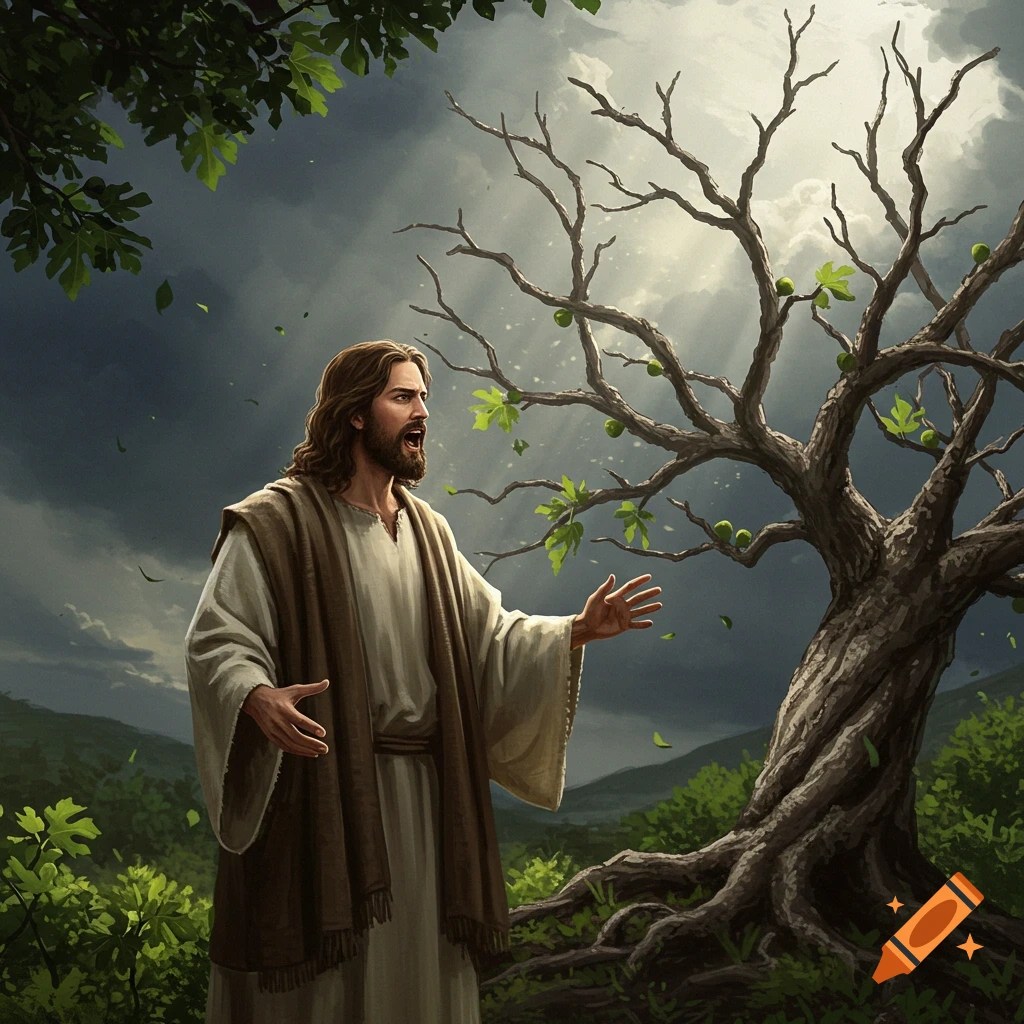
He saw the nation of Israel as a barren fig tree—it had leaves of profession but no fruit.
The cry of Hosanna would soon turn into the blood-curdling cry, “Crucify Him!”
There is an apparent difficulty in that He condemned the fig tree because it had no fruit, although the record distinctly says that it was not the season for figs.
This seems to picture the Savior as unreasonable and petulant.
We know this is not true; yet how can we explain this curious circumstance?
Fig trees in Bible lands produced an early edible fruit before the leaves appeared. It was a harbinger of the regular crop, here described as the season for figs.
If no early figs appeared, it was a sign that there would be no regular crop later on.
When Jesus came to the nation of Israel, there were leaves, which speak of profession, but there was no fruit for God.
There was promise without fulfillment, profession without reality.
Jesus was hungry for fruit from the nation.
Because there was no early fruit, He knew that there would be no later fruit from that unbelieving people, and so He cursed the fig tree.
This prepictured the judgment which was to fall on Israel in A.D. 70.
However, the incident does not teach that Israel was cursed to perpetual barrenness.
The Jewish people have been set aside temporarily, but when Christ returns to reign, the nation will be reborn and restored to a position of favor with God.
This is the only miracle in which Christ cursed rather than blessed, destroyed life rather than restoring it.
This has been raised as a difficulty. However, the objection is not valid.
The Creator has the sovereign right to destroy an inanimate object in order to teach an important spiritual lesson and thus save men from eternal doom.
Although the primary interpretation of this passage relates to the nation of Israel, it has application to people of all ages who combine high talk and low walk.
2 Timothy 4:2 states, “Preach the Word; be ready in season and out of season; reprove, rebuke, and exhort, with complete patience and teaching.”
This verse emphasizes the importance of being prepared to share the message of God at all times.
Romans 10:17 tells us that faith comes by hearing and hearing by the Word of God…
But this only works as we produce obedient action in response to our faith!
Another scripture I always refer to is found in one John five 14-15…14
“And this is the confidence that we have toward Him, that if we ask anything according to His will He hears us.
15 And if we know that He hears us in whatever we ask, we know that we have the requests that we have asked of Him.”
God never tells us to ask for things He doesn’t want us to have!
As Believers, we often have to learn how to exercise the authority which God has given us and contend for those things that He has made available to us through our faith, as the enemy will always be working to try to hinder this from happening, so this requires persistent action on our part.
SELAH (let us pause and calmly think about these things)
____
365 Days of Healing…
Faith is of the Heart
“For verily I say unto you, That WHOSOEVER shall say unto this mountain, Be thou removed, and be thou cast into the sea; and shall not doubt in his heart, but shall believe that those things which he saith shall come to pass; he shall have whatsoever he saith”
(Mark 11:23).
Let’s look at two major principles of faith in this verse: believing in the heart and saying with the mouth.
People often make mistakes in the believing side of faith. You see, real faith is of the heart, not the head.
Romans 10:10 confirms this, saying, “For with the heart man believeth unto righteousness….”
People need to realize they don’t have enough strength in their heads to believe in something they can’t yet see.
Now, it’s important to understand that you can have faith in your heart while doubts are coming into your head.
For instance, at times I find Scriptures in the Word that cover my needs. I pray the prayer of faith, believe I receive and take my stand on the Word.
On the inside, I have peace and rest; I know I’m in faith. But at the same time, doubts hit my mind one after another:
What if it doesn’t work?
It’s not going to work.
When these types of doubts start coming into your mind, it’s easy to think, “Well, I thought I believed, but I guess I didn’t.”
But just realize that those doubts aren’t yours.
When thoughts of doubt come, cast them down and get rid of them in the name of Jesus.
Don’t try to believe with your head, or your faith level will be up and down like a yo-yo.
Remember, it’s with the heart—the spirit, the inner man—that man believes.
So if your mind is giving you fits when you’re trying to stand in faith, just shut your head off and follow what’s in your spirit!
Prayer Confession:
With my heart I believe. I don’t lean to my own understanding or allow doubts to hinder me.
I pray for healing, and despite what I feel, think or see, I know I’m healed according to God’s Word. Amen
[Source: 365 Days of Healing by Mark Brazee]
Come join the Adventure!
Skip 🕊️
l

 SB SALT AND LIGHT MINISTRIES